


Sylhet fails to overcome chronic waterlogging despite billion-taka infrastructure spending

Photo Collected
Sylhet city’s battle with chronic waterlogging remains unresolved despite a massive influx of public funds over the past 16 years. Between 2009 and 2025, the City Corporation has spent approximately 1,127 crore BDT on drainage infrastructure and the excavation of canals and streams, yet residents continue to face severe flooding even after moderate rainfall.
The degradation of the city’s natural drainage network—comprising 39 streams and canals—is central to the crisis. The Gaviar Canal, which once spanned 12 to 15 meters, has been reduced to a width of just 5.5 meters due to systematic encroachment and a lack of enforcement. In the 1980s, a portion of the canal was filled to accommodate a local government engineering office, setting a precedent that encouraged further illegal construction along its banks. Subsequent efforts to restore the canal in 2013 failed to address these encroachments or restore the original water flow, leaving the project largely ineffective.
বিজ্ঞাপন
Environmentalists and urban planners point to “unplanned development” as the primary culprit. Critics argue that projects have been executed without a cohesive master plan, with officials frequently opting for box culverts that obstruct natural flow and hinder waste removal. Furthermore, recent construction in areas like Zindabazar and Chouhatta involved sealing drainage channels with concrete for pedestrian tiles, effectively preventing essential maintenance and cleaning.
“We are dealing with the consequences of building over natural water bodies and creating permanent structures that cannot be maintained,” noted Professor Mushtaq Ahmad of Shahjalal University of Science and Technology. He emphasized that the past reliance on box culverts and covering open drains was a fundamentally flawed approach that exacerbated the city’s vulnerability.
বিজ্ঞাপন
The city’s drainage infrastructure currently spans roughly 105 kilometers of canals and streams, supported by 3,000 kilometers of drains, of which only a third are paved. While officials maintain that these interventions have reduced the severity of flooding, the reality on the ground—such as persistent waterlogging in areas like Upashahar, Machimpur, and Ghasitula—tells a different story.
In response to these systemic failures, the City Corporation has recently inaugurated a new 4,635-crore BDT project. According to city administrator Abdul Qaiyum Chowdhury, the plan focuses on sustainable, science-based intervention. The initiative includes the construction of high embankments along 13 kilometers of the Surma River, the installation of regulator gates and pump stations to manage water discharge, and the implementation of flap gates to prevent river overflow.
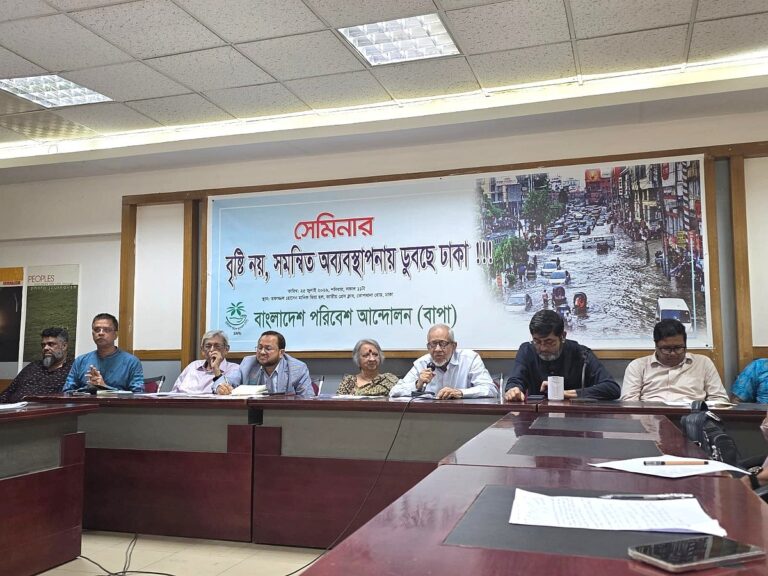
While officials express optimism that this latest project will provide a permanent solution, the local chapter of the Bangladesh Environmental Movement (BAPA) remains cautious. General Secretary Kasmir Reza warned that as long as ponds and wetlands continue to be filled for construction, and as long as the city’s drainage lines remain clogged with plastic and silt, infrastructure spending alone will not solve the crisis. Experts are now urging the administration to conduct rigorous, transparent scientific studies before beginning the new construction to avoid repeating the planning errors of the past.
0%
0%
0%
0%