Rajshahi University removes controversial billboard images of convicted war criminals following student protests
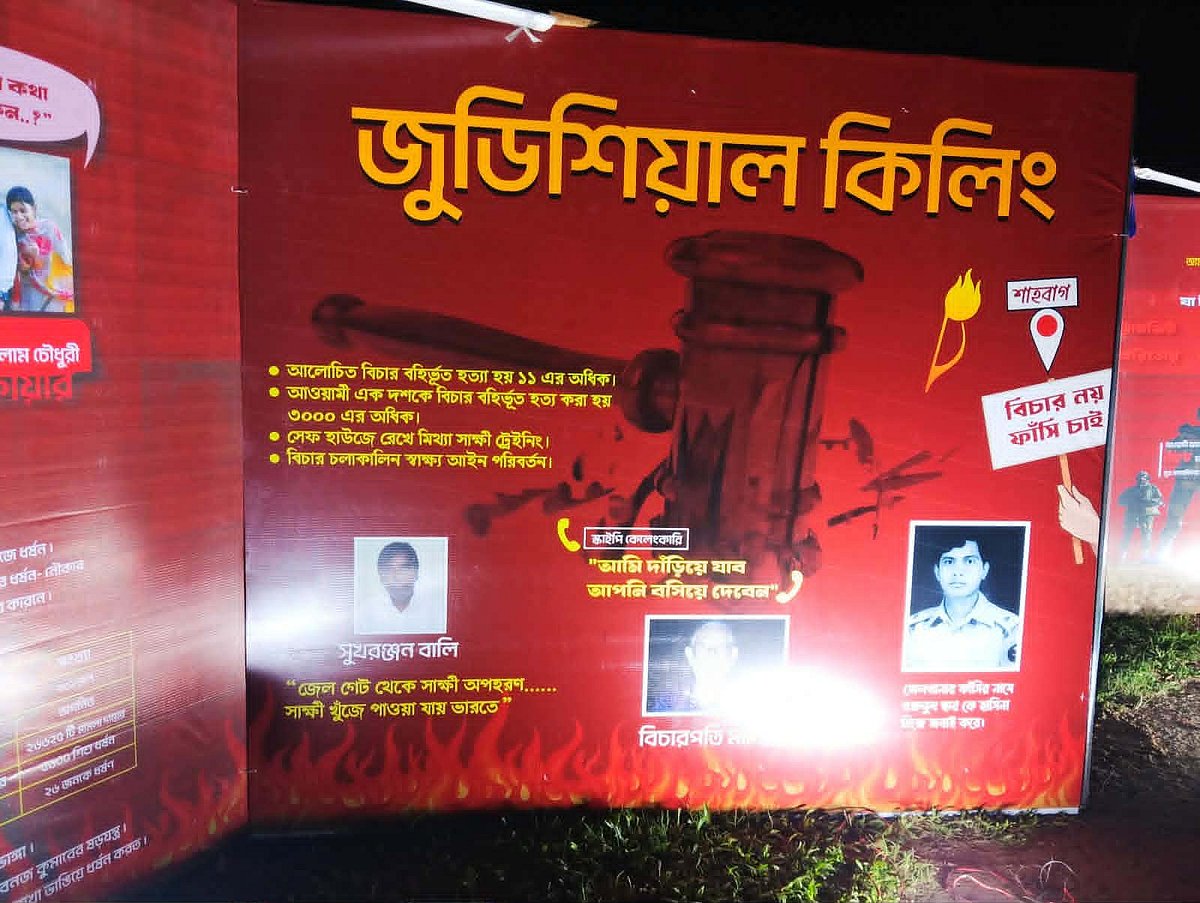
Photo Collected
Rajshahi University authorities removed images of convicted 1971 war criminals from a controversial billboard late Sunday following intense protests by students who condemned the display as an attempt to normalize figures responsible for crimes against humanity.
The billboard, titled “Judicial Killing,” had been installed on the university’s iconic Paris Road last Friday by a cultural platform known as “Novoculture,” led by Salauddin Ammar, the general secretary of the Rajshahi University Central Students’ Union (RAKSU). The display featured photos of several high-ranking leaders convicted of war crimes, including former Jamaat-e-Islami leaders Motiur Rahman Nizami, Delawar Hossain Sayeedi, Abdul Quader Molla, Ali Ahsan Mohammad Mojaheed, and Mir Quasem Ali, along with former BNP standing committee member Salauddin Quader Chowdhury.
Tensions escalated on Sunday afternoon when a group of students staged a sit-in protest in front of the university’s administrative building, demanding the immediate removal of the images. The protest concluded around 10:45 p.m. after Proctor Professor Mahbubur Rahman announced that the university administration had decided to scrub the objectionable images from the display.
Student activist Sadek Rahman stated that the protesters would not tolerate any attempts to rehabilitate identified war criminals on campus. He added that while the students withdrew their current protest based on the administration’s intervention, they remain prepared to resume demonstrations if further action is not taken to address the incident.
According to Professor Mahbubur Rahman, the administration initially requested that Salauddin Ammar remove the billboard voluntarily. When Ammar refused to comply, university officials intervened directly to erase the images.
The display, which was part of a series of installations by Novoculture commemorating the July mass uprising, drew sharp criticism from various student organizations. Fuad Ratul, convener of the university branch of the Socialist Student Front, emphasized that the campus would not serve as a venue for the rehabilitation of war criminal ideologies, arguing that the 2024 student-led movement against the former government should not be exploited to sanitize or reintroduce extremist narratives.
0%
0%
0%
0%