


July 19 Violence Marks Turning Point in Bangladesh Student-Led Uprising
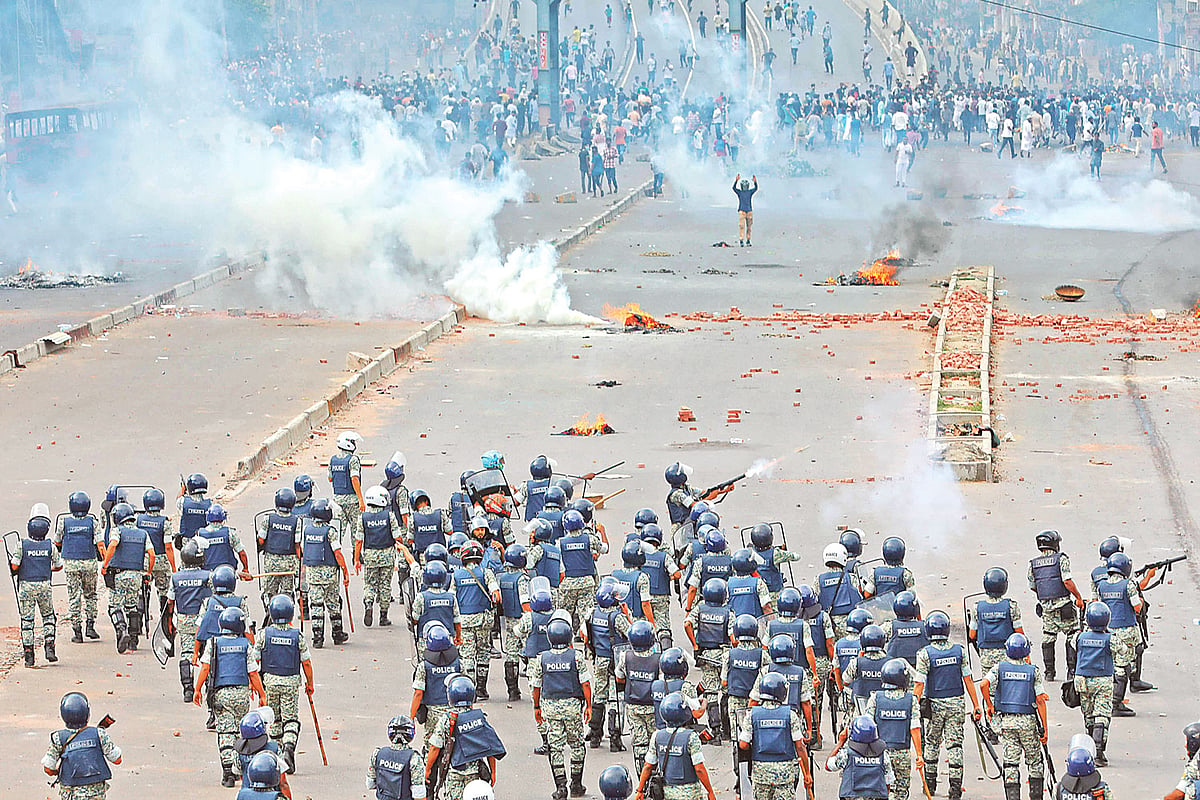
Photo Collected
The nationwide blackout of mobile and broadband internet, enforced by the former Awami League government on July 17 and 18, 2024, plunged the country into a communication vacuum that masked an unprecedented escalation in violence. By the morning of July 19, as the anti-discrimination student movement entered its second day of a “complete shutdown,” the lack of connectivity left citizens largely unaware of the rapidly unfolding chaos. Reports later confirmed that at least 56 protesters were killed on that Friday alone—44 of them in Dhaka—bringing the death toll over the preceding three days to more than 100.
What began as a student-led protest against the quota system had transformed by July 19 into a mass uprising. As demonstrators took to the streets across the capital and multiple districts, security forces responded with heavy-handed tactics, including the deployment of helicopters to fire tear gas canisters and sound grenades into crowds. Major clashes were reported in Dhaka’s Rampura-Badda, Jatrabari, and Uttara neighborhoods. The unrest also expanded to involve various political factions, including the BNP and Islamist groups, who faced repeated police intervention during rallies near the National Press Club and the Paltan area.
Protest participation extended beyond students to include concerned parents, cultural activists, and various professionals. Demonstrations occurred at the Shahbag National Museum and Manik Mia Avenue, while the Editors’ Council issued a formal statement demanding the immediate restoration of internet services. Simultaneously, violence spiraled in areas outside the capital, including Narayanganj, Bhairab, Mymensingh, Madaripur, and Comilla, where government facilities, political party offices, and the private properties of political figures were targeted by arson and vandalism.
The government’s response intensified as night fell on July 19. Following a meeting at the Gono Bhaban with leaders of the 14-party alliance, then-Prime Minister Sheikh Hasina ordered a nationwide curfew and the deployment of the military, effective from midnight. Security agencies also launched a crackdown on the movement’s leadership, abducting key coordinators—including Nahid Islam, Asif Mahmud Sajib Bhuiyan, and Abu Baker Majumder—from various locations across the capital throughout the evening and night.
Despite the mounting arrests and military intervention, the student movement remained defiant. Around 9:30 p.m. on July 19, coordinator Abdul Kader announced a new list of nine demands, which included a public apology from Sheikh Hasina and the resignation of three cabinet ministers. He declared that the “complete shutdown” would continue indefinitely until these demands were met.
0%
0%
0%
0%