

History of Jamdani Bangladesh cannot be changed
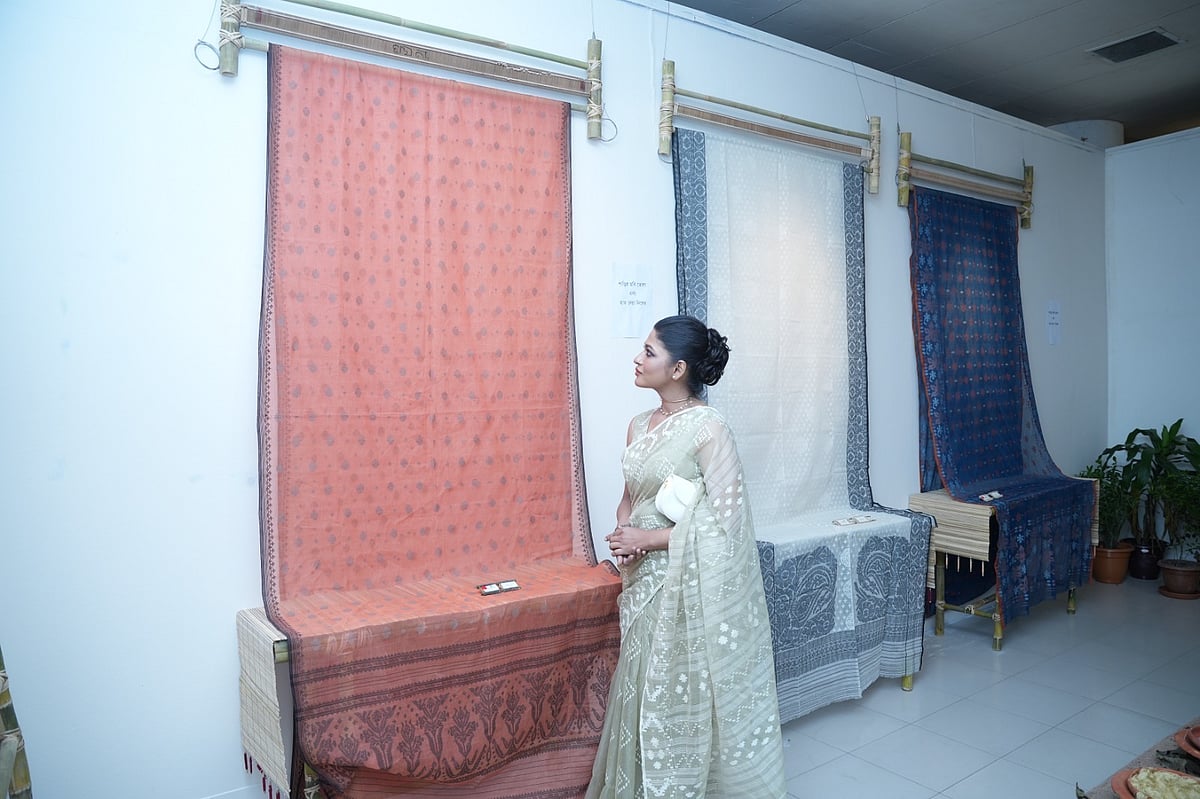
Photo Collected
Jamdani is ‘back’ – it is being claimed in the media of neighboring countries. The fact is, Jamdani was never lost; Rather, this living weaving tradition survives in the face of adversity. It is exclusive to Bangladesh. But today new claims, confusions and battle of narratives have been created around this heritage.
Shared legacy, or tricky claims?
বিজ্ঞাপন
The shared legacy is the result of geopolitical realities—the subcontinent is no exception. Having once been part of an integral India, Bangladesh, India and Pakistan have many similarities in art, culture, literature, music and crafts, which are still discussed in various ways today. And this is increasingly visible because of the tension over multiple textile-heritage as a Geographical Indication (GI) product. It started in 2009 with Uppada Jamdani. India has since registered another Jamdani as a Geographical Indication product. Another one applied. Each time we responded. Couldn’t act earlier. still can’t
This series of attacks by India on Jamdani is being fueled by regular propaganda by the country’s media and influencers. Not only do they use the word ‘Jamdani’, now they are also claiming hairdressing as theirs, even to UNESCO recognition. All this is possible because of the weakness of our diplomatic policy.
বিজ্ঞাপন
Bollywood star Kangana Ranaut’s saree was in discussion after the West Bengal elections on April 23. She wore a white saree woven in Nandigram in East Midnapore during the election campaign. Indian newspapers refer to it as Jamdani. They even did not shy away from calling it a ‘UNESCO Heritage’.
Soon after this, several articles were published about Jamdani. One of these happened on the website called ‘Aza’ (www.azafashions.com). Title: ‘The Jamdani Comeback: How the 2000-Year-Old Bengali Lum Claimed Its Spot on the Global Map’.
The main problem with Azar’s article lies in its opening. Jamdani did not return. 170 years ago, although muslin disappeared, Jamdani did not disappear; Rather, it survives through adversity. In this case, the role of Bangladeshi weavers and their families is undeniable. At various times, the government of Bangladesh or the head of state or sometimes their wives, elites of the society, various entrepreneurial organizations or institutions like the Bangladesh National Crafts Council have been catalysts in sustaining this industry. And this whole struggle belongs to the people of Bangladesh. So there is no question of its comeback. In fact, the concept of ‘comeback’ is unrealistic.
In this article, Dhaka has been placed in the ranks of Fulia and Shantipur. But Jamdani was never woven in Shantipur. Not even in Fulia. Even the history of fullia weaving is not remarkably ancient.
In addition, as mentioned here very vaguely, this Jamdani ‘Technique’ has been included in UNESCO’s list of ‘Intangible Cultural Heritage of Humanity’. That is not the case. This will come later.
Another article appeared on the Vogue India website on the same day. The article on the Vogue staff was titled: ‘Nita Ambani’s Jamdani Saree Was Won Twenty-Four Months by a Padma Shri Award’.
Neeta wore this saree at the Time Hundred Summit held in New York. Neeta was also seen talking about this saree in that conference. This saree is named Swadesh Jamdani. It was woven by Biren Kumar Basak; He was awarded the Padma Shri by the Government of India. Biren Basak migrated from Tangail to Phulia in West Bengal. Working all over the texture of this saree. He has done such work before. Indian designers have also exhibited at MIT in the US, courtesy of Nobel laureate economist Abhijit Banerjee. Although these clothes are not jamdani; Because, these fabrics are woven on jacquard or vital loom. Jamdani on the other hand is woven in pitlooms.
That will come later. Before this let us mention one more article from Vogue India. On October 8, 2025, Vogue India Nupur Sarvaiya wrote an article titled ‘Alia Bhatt’s Custom Olive Dhakai Jamdani Saree Was Handwoven Over Three Months’. It is clearly written there that Jamdani originated in West Bengal and Bangladesh.
Abu Jani and Sandeep Khosla, two famous designers in India, worked zardozi on this saree. As a result it becomes a designer’s saree. Alia Bhatt wore that saree during last Durga Puja. But the intellectual property of Jamdani belongs to weavers. As a result, value cannot be added to their woven sarees by undermining their creativity.
Jamdani is actually floral muslin. That is, while weaving, the design is drawn by hand with a separate yarn. For this reason Jamdani is also called figured muslin. But these figures are mainly flowers, creepers, bird feet etc. All designs are geometric. History says that Jamdani developed during the Mughal Emperor Jahangir (1569-1627). He brought some weavers from Persia. They basically teach our weavers the technique of picking flowers by hand while weaving cloth. The word Jamdani also comes from Persian. It has multiple meanings. Panpatra or boots or patterned clothes.
Till 1900 Jamdani was white or black in color. It gets stained later. Similarly silk thread is also added at the same time. It is due to Nawab Sir Salimullah of Dhaka. But the original jamdani is woven with cotton yarn. As a result, the topic of the return of Bengal looms after 2000 years is irrelevant. Because, muslin was woven 5 thousand years ago. And Jamdani is being woven for 500 years.
The wonderful feature of Jamdani is its memory and auditory dependence. Because all designs are in the weaver’s memory. Jamdani weaving has to start learning from the age of 10 to 12 years; The same way everyone learns vocal music.
Jamdani is woven on pitloom or hole loom. Side by side, two people sit on the loom and weave cloth from both sides. One of them is a master and the other is Harkit or disciple. Ustad Buli laughed. The apprentice follows suit and weaves the same pattern.
Jamadani has its own motifs, fringes and welt designs, developed through long practice by the weavers themselves. This is how this tradition of weaving has been created.
Jamdani’s present position and development is behind the very effective and timely role of Bangladesh National Crafts Council. During the year 2016-18, the American Ambassadors Fund for Cultural Preservation conducted a survey and published the original motifs of Jamdani in the form of a book and the Jamdani festival organized in 2019 under the title of ‘Reconstruction of Heritage’ is notable in this regard. For this festival, more than 500 pictures of Jamdani were collected from museums of different countries and more than 40 sarees and garments were made and exhibited for a month. At that time, our weavers developed the technique of weaving cloth with 200 count hand-spun yarn in tana and bharan. Now they are effortlessly weaving cloth with 300 or more count yarns. It was at that time that the World Crafts Council recognized the World Crafts City at Sonargaon. Jamdani’s excellence and popularity continued to grow in this way.
In the article mentioned at the beginning, Jamdani Kaushal has been included in UNESCO’s list of ‘Intangible Cultural Heritage of Humanity’. This is not correct at all. In fact, Bangladesh’s Jamdani weaving technique was included in the list of ‘Intangible Cultural Heritage of Humanity’ in 2013, at the UNESCO session held in Baku, Azerbaijan. It is a recognized tradition of Bangladesh. But in recent years, the recognition has been presented differently in various Indian media, creating confusion. It was first noticed on a site called uppadad.com. And now Deda is being written.
This is where Geographical Indications (GI) come into play. The issue came to our attention in 2009. Sebar Bharat applied for and received their Uppada Jamdani Geographical Indication product the following year. Bangladesh National Crafts Council tried in various ways to stop it, but it was not possible because of the government-related people at that time.
However, Jamdani of Bangladesh got the status of Geographical Indication Product in 2016. Interestingly, the website of the Crafts Council of Andhra Pradesh (CCAP) makes it clear that once upon a time there was no such thing as Uppada Jamdani. The weavers there used to weave plain sarees. Then from there three weavers came to Bangladesh and learned the technique of weaving jamdani and started weaving jamdani there. But their looms are not similar to our looms. They weave in jacquard; We are in Pitlum. There is no match in the motif. Not even precisely in hairdressing. Uppada Jamdani is like a tapestry. Somehow that saree cannot be Jamdani. Again, they admitted to learning from Bangladesh, but it was not mentioned in the GI product application.
It is to be noted that India has registered the Tangail saree as a geographical indication of its origin in West Bengal, and the design or motif of that saree is again called ‘Jamdani’. But Jamdani is not a design, Jamdani is a weaving technique or method of weaving. As a result, they have played a contradictory role.
It does not stop here; They have also applied for another Jamdani Geographical Indication product. In this application the name of the product has been given as ‘Jamdani Saree of West Bengal’. Applications have been made in the names of two associations, Shantipur and East Burdwan. This application was made on 13 April 2024. In this application, the production cost of this saree is mentioned as not less than 2 thousand 500 rupees, which is unrealistic.
The photo of the loom given in this application is vital loom. There are many inconsistencies in the various documents provided with the application. Even a line from Rabindranath’s poem ‘Banshi’ is used here, where there is this line: ‘Parne Dhakai saree, kapale sindoor.’ This Dhakai means a saree handmade in Dhaka. Jamdani was called ‘Dhakai’ by the people of West Bengal. Now they also call it ‘Dhakai Jamdani’. So that their so-called Jamdani can be made halal.
Now the question comes, how many types of Jamdani can be in a country? On the one hand they say that the motif of Tangail is Jamdani. On the other hand, many sarees are claiming to be Jamdani and are trying to get registration of Geographical Indication products. They are surrounded by confusion. Their media is making the situation more confusing. If that’s the case, why don’t they apply for GI products from multiple places? Why only go after Jamdani and Muslin?
It is not just a question of preserving heritage, it is a question of strategy, policy and presentation.
In this case, we have no choice but to strengthen our diplomatic policy. It is also necessary to inform future diplomats about our heritage and traditions. In parallel, experts feel that it is necessary to formulate timely policies to protect our heritage textiles (not only Jamdani) and increase the promotion of our heritage textiles at home and abroad, determine the limits of shared legacy through proper research and its promotion, and protest if any of our resources are claimed as their own in the name of shared legacy.
A three-sixty degree plan requires timely and effective initiatives by concerned individuals and the involvement of qualified individuals.
Jamdani is not just fabric—it is a fabric of memory, skill and identity.
Misrepresentation cannot erase the truth, but silence weakens it. Now is the time to speak consciously, clearly and collectively.
In fact, history cannot be rewritten, so the truth must be brought forward. This truth is nothing else, but Jamdani Bangladesh; Muslin and Tangail too.
0%
0%
0%
0%