
Haor Farmers Face Critical Labor Shortage Amid Quadrupled Harvester Costs
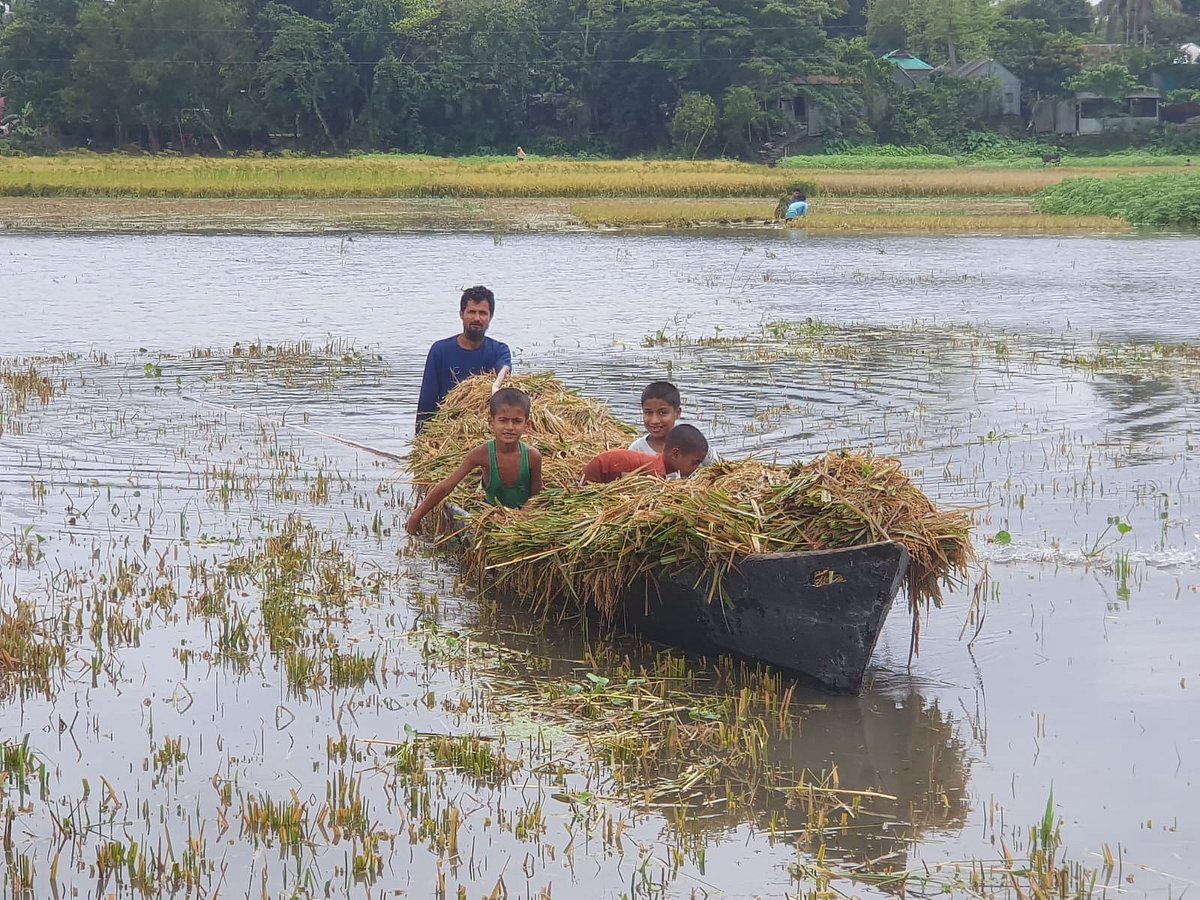
Photo Collected
KISHOREGANJ, Bangladesh – Farmers in Bangladesh’s northeastern haor region are grappling with a severe labor shortage and exorbitant harvesting costs after a week of incessant rain submerged vast paddy fields, leaving many facing financial ruin. The crisis, which has seen daily wages for farmhands skyrocket to 2,000 taka ($17) and harvester machine rentals quadruple, is pushing farmers to desperate measures, often involving entire families in the harvesting effort.
The dramatic shift in conditions followed intense rainfall that began last Monday, submerging over 9,045 hectares of paddy fields in Kishoreganj alone by Saturday, according to the District Agriculture Directorate. This sudden inundation has impacted approximately 32,000 farmers, with estimated damages topping 100 crore taka ($8.5 million), though farmers themselves contend the actual losses are four to five times higher.
বিজ্ঞাপন
On Saturday afternoon, farmer Saidur Rahman was seen cutting paddy in knee-deep water in Karimganj’s Borohaor, assisted by his ninth-grade and twelfth-grade sons, while his 10-year-old daughter ferried bundles of cut rice to a nearby dinghy. This scene of families working together to save their crops has become increasingly common across the haor areas. Rahman explained that while many whose fields were completely submerged have given up hope, those with paddy in slightly elevated areas are battling waist-deep water to salvage their ripened crops.
“How can I bear to see the paddy vanish before my eyes?” Rahman lamented, noting the impossibility of finding laborers. Just a week ago, a farmhand could be hired for 800 to 1,000 taka; now, even 1,500 to 2,000 taka fails to secure workers. “If I pay 2,000 taka a day for paddy that sells for 700 taka per maund, what will be left for the farmer?” he questioned, underscoring his decision to harvest with his family.
বিজ্ঞাপন
Abdul Qadir, another farmer from Boratia Haor, expressed similar frustration, criticizing what he perceived as opportunism during a crisis. He highlighted the double burden of anxiety over submerged crops and the unresponsiveness of both labor and harvester operators. Qadir noted that many fields are now inaccessible to harvester machines due to waterlogging, and for those that are reachable, rental costs have surged from an expected 6,000-7,000 taka per acre to an exorbitant 20,000-25,000 taka. He questioned how farmers could survive selling paddy at 600-700 taka per maund under such conditions.
The District Water Development Board reported that water levels in the Dhonu-Boulai River in Itna and the Mogra River at Chamra Ghat rose by 5-10 centimeters in the 24 hours leading up to Sunday. The continuous rain and storms have left countless fields underwater, forcing many farmers who borrowed heavily to cultivate their land to return home empty-handed. Remaining ripe paddy in higher or semi-haor areas is also at risk due to the acute labor and machinery shortages.
Investigations reveal that in previous years, thousands of seasonal workers from districts like Kurigram, Gaibandha, Sirajganj, Jamalpur, and Netrokona would flock to Kishoreganj for harvesting. However, an early season of adverse weather has significantly reduced their arrival this year. This has made it nearly impossible for local laborers alone to handle the immense task of harvesting, threshing, storing, and stacking straw. Adding to the woes, allegations have surfaced of a powerful syndicate manipulating harvester machine rental prices.
Mohammad Sadikur Rahman, Deputy Director of the Kishoreganj Agricultural Extension Department, acknowledged the challenges. He stated that 367 combined harvesters, 70% subsidized by the Ministry of Agriculture, have been deployed in the haor areas, but this number is insufficient. While the set rental rate is 6,000 taka per acre, there is flexibility for negotiation in low-lying and waterlogged areas. Rahman emphasized that exploiting the disaster for abnormal charges is unacceptable, pledging discussions with harvester owners and farmers to address the issue.
0%
0%
0%
0%