

Government working to resolve energy crisis as ministers address infrastructure gaps and supply challenges
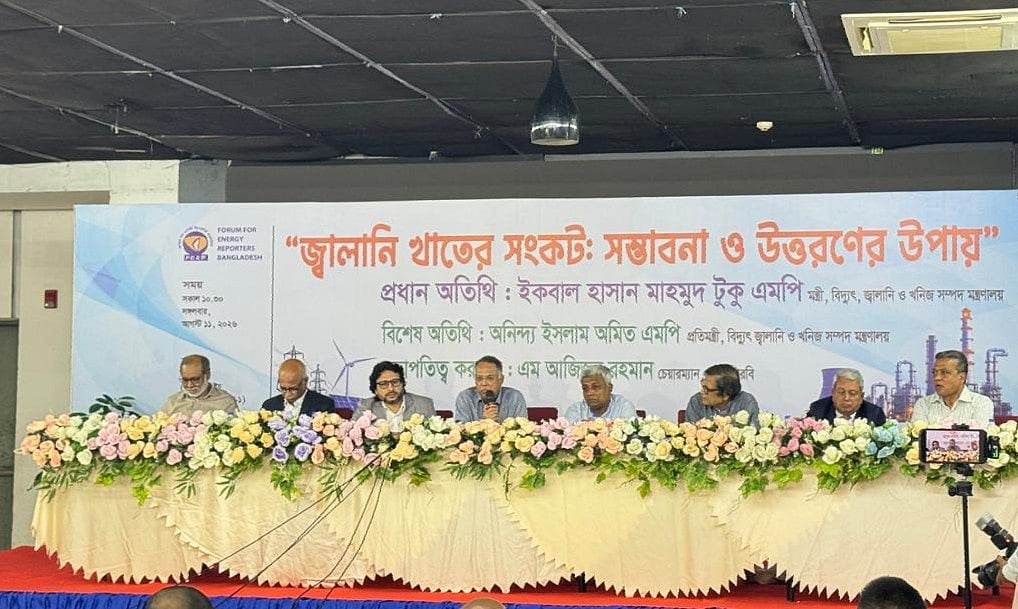
Photo Collected
DHAKA — The government is actively implementing strategies to resolve the nation’s long-standing energy crisis, which officials describe as a legacy challenge inherited from previous administrations. Minister of Power, Energy and Mineral Resources Iqbal Hasan Mahmud stated that the current government, now six months into its tenure, has had to navigate both domestic supply shortfalls and global energy market volatility triggered by ongoing conflicts in the Middle East.
Minister Mahmud addressed these issues during a seminar titled “Energy Sector Crisis: Prospects and Remedies,” hosted by the Forum for Energy Reporters Bangladesh at the Dhaka Club on Tuesday. The Minister criticized the infrastructure planning of the previous Awami League regime, asserting that investments were focused on profit-driven projects rather than sustainable national needs. He noted that the recent shutdown of a single liquefied natural gas (LNG) terminal exposed systemic vulnerabilities, leading to widespread gas shortages. To address this, the government has initiated plans for a new floating terminal and is currently in discussions to establish a land-based terminal.
Addressing concerns over fuel security, Minister Mahmud highlighted the government’s efforts to prevent supply gaps during the recent regional geopolitical instability. He announced plans to involve the private sector in fuel distribution, moving beyond the current dominance of state-owned entities like Padma, Meghna, and Jamuna. A new policy framework is being developed to facilitate this transition and foster a more competitive market.
State Minister for Power, Energy and Mineral Resources Anindya Islam Amit acknowledged the significant gap between electricity demand and supply, noting that the government faces a structural deficit of 1.2 billion cubic feet of gas per day. While noting that the administration is operating under severe financial constraints comparable to a middle-class household, he emphasized that the government is committed to transparency. He stated that while launching a new LNG terminal typically requires 30 to 36 months, the government is making an urgent, law-abiding effort to accelerate that timeline to within two years.
Energy expert M. Tamim cautioned that there is no immediate fix for the energy crisis, predicting that stability remains at least six months away. He urged a shift toward maximizing coal utilization and increasing renewable energy production to reduce reliance on gas. Additionally, Tamim suggested that the government should engage in negotiations to reduce the cost of electricity imported from Adani Power in India.
Professor Ezaj Hossain of the Bangladesh University of Engineering and Technology (BUET), who presented the keynote paper, warned that past policy warnings have manifested into current reality. He noted that while LNG imports remain a stop-gap measure, they are not a long-term solution due to the compounding pressure of the ongoing foreign currency crisis. The paper projected that national gas demand could reach 4.6 billion cubic feet per day by 2030, stressing the need to boost domestic exploration to keep production levels stable.
M. Shamsul Alam, energy advisor to the Consumers Association of Bangladesh (CAB), argued that the sector is plagued by irrational pricing policies. He criticized the preference for purchasing expensive energy from foreign firms over upgrading the capacity of domestic institutions, urging the government to move away from previous patterns and prioritize consumer protection over corporate profit motives.
The seminar, chaired by Forum for Energy Reporters Bangladesh Chairman M. Azizur Rahman, also featured remarks from Executive Director Serajul Islam Siraj and East Coast Group Chairman Azam J. Chowdhury.
0%
0%
0%
0%