



Dilwar Khan The Forgotten Robin Hood of Sandwip
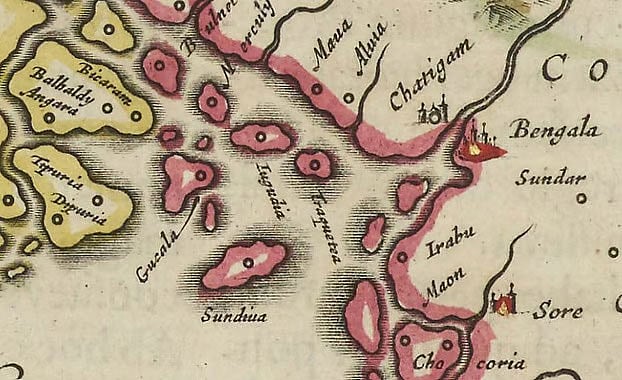
Photo Collected
Situated at the confluence of the Meghna River in the Bay of Bengal, the island of Sandwip holds a storied place in maritime history. During the 16th and 17th centuries, its strategic location made it a focal point of intense geopolitical rivalry among the Mughal Empire, the Kingdom of Arakan, and roving Portuguese pirates. Amid this volatility, Sandwip maintained a period of remarkable autonomy under the leadership of Dilawar Khan, a renegade Mughal commander who governed the island for nearly half a century.
Often referred to as “Dilal Raja,” Dilawar Khan is remembered in local folklore as the last independent king of Sandwip. According to popular accounts, he served as a benevolent ruler who brought stability and prosperity to the island. Legends often compare him to the English folk hero Robin Hood, suggesting that he seized wealth from marauding pirates and redistributed it among his impoverished subjects. While these tales lack definitive written documentation, they remain deeply embedded in the oral traditions of Sandwip’s residents.
Historical records corroborate the island’s economic significance during this era. Venetian traveler Cesare Federici, whose accounts were featured in Samuel Purchas’s 1625 collection “Purchas his Pilgrimes,” described Sandwip as one of the most fertile lands in the world, noting that commodities such as rice and beef were available at exceptionally low prices. Later, Scottish merchant Captain Alexander Hamilton, who spent over three decades in South Asia between 1688 and 1723, wrote in “A New Account of the East Indies” that the island’s economy was remarkably affordable, with staples and textiles sold for mere fractions of their value elsewhere.
Dilawar Khan’s rise to power is a subject of historical debate. In his work “Fathiya-i-ibriya,” chronicler Shihabuddin Talish identifies him as a deserter from the Mughal navy who seized control of the island during the tenure of Subahdar Ibrahim Khan, likely around 1618. Other historians, including Sir Jadunath Sarkar in “The History of Bengal,” support the view that Dilawar transitioned from a Mughal officer to a sovereign ruler after the failure of earlier campaigns to expel Arakanese forces from the region.
Independent narratives, such as one documented by Maulvi Mohammad Abdul Halim in the 1907 “Journal of the Moslem Institute,” offer a more mythic origin story, describing Dilawar as the son of a merchant who survived a shipwreck and rose from the status of a herd boy to a king—a destiny allegedly foretold by a cobra seen shielding him while he slept. Regardless of his origins, he is credited with establishing a sophisticated judicial system that disregarded caste and religious distinctions. He famously promoted inter-communal marriage to foster social cohesion, a policy noted in the “Eastern Bengal and Assam District Gazetteers: Noakhali.”
Dilawar’s military prowess was central to Sandwip’s survival. He constructed a formidable network of fortifications, utilizing the island’s narrow waterways to repel superior forces. Historical accounts recount his significant victories against the Arakanese in 1624 and 1644, which resulted in the capture of vast quantities of war elephants, artillery, and equipment. For years, he maintained a delicate balance of power, even exchanging diplomatic gifts with Shah Shuja, the son of the Mughal Emperor.
The island’s independence ultimately waned under the expansionist ambitions of Shaista Khan, who sought to secure the Chittagong coast by neutralizing Sandwip. In November 1665, a Mughal naval force led by Abul Hasan launched a decisive offensive. Despite his advanced age and tactical brilliance, Dilawar Khan was eventually captured after a protracted struggle. He was taken to Dhaka in chains along with his family and supporters, where he died in prison shortly thereafter.
Today, Dilawar Khan’s legacy endures in the geography of Sandwip. A road stretching across the island is still known as the “Delwar Khan Road,” and landmarks like the Mogh-Dhara—where he reportedly defeated the Arakanese forces—and the tank named after his daughter, Mosa Bibi, serve as enduring reminders of the man who turned an isolated island into a sovereign bastion of trade and justice.
0%
0%
0%
0%