Dhaka Unveils Ambitious 2045 Transport Master Plan to Expand Metro Network and Curb Traffic Congestion
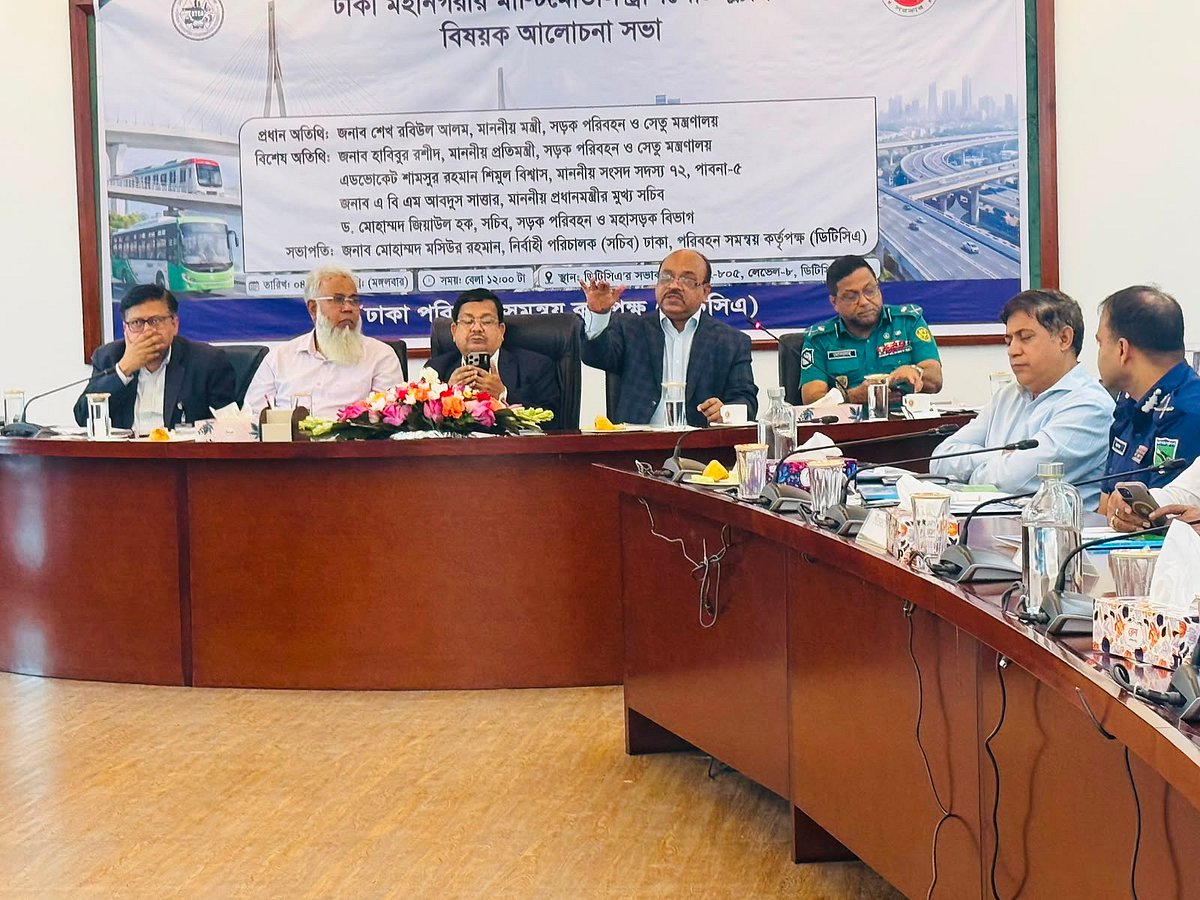
Photo Collected
The Dhaka Transport Coordination Authority (DTCA) has unveiled an ambitious long-term strategic transport plan aimed at transforming the capital’s fragmented transit network into a seamless, multimodal system by 2045. The initiative, dubbed the Strategic Transport Plan 2026–2045, outlines a massive expansion of the city’s infrastructure, including the extension of the metro rail network to 268.5 kilometers, the construction of eight metro lines, two bus rapid transit (BRT) routes, six expressways, and 21 transit hubs.
Details of the proposal were presented during a high-level meeting held at the DTCA headquarters in Tejgaon, chaired by Executive Director Mohammad Mashiur Rahman. Officials from various government bodies, including the Prime Minister’s Office, the Ministry of Road Transport and Highways, and the Dhaka Metropolitan Police, attended the session to address the city’s mounting traffic congestion and declining public transit usage.
Data presented at the meeting highlighted a sharp decline in the reliance on public transport, which plummeted from 22.8 percent of daily commutes in 2014 to just 8.9 percent in 2023. As residents increasingly shift toward private vehicles, motorcycles, and three-wheelers, the DTCA emphasized the urgent need to restore public confidence in a unified and reliable transport system. To support this, the agency is restructuring the city’s bus network, proposing a consolidated system of 32 main routes and 25 feeder routes to replace the current inefficient layout, where only 98 of the 418 authorized bus routes remain active.
The roadmap for metro expansion is phased to achieve steady growth, scaling from the existing 19.8 kilometers to 72.2 kilometers by 2030, and reaching 137.8 kilometers by 2035 before hitting the final target of 268.5 kilometers in 2045. Furthermore, to enhance connectivity, the DTCA is proposing five monorail corridors spanning 79.4 kilometers as feeder services for the metro, with the Bangladesh University of Engineering and Technology (BUET) expected to conduct pre-feasibility studies.
Beyond rail, the plan incorporates a circular waterway from Sadarghat to Ashulia and the construction of three ring roads encircling the capital. The DTCA is also prioritizing the relocation of inter-district bus terminals to the city’s periphery to ease urban gridlock. Significant progress was reported on the “Rapid Pass” smart card system, which is now utilized by over 1.9 million passengers and processes roughly 7 million trips monthly on the metro rail alone.
Sustainability is a key pillar of the new strategy, with the DTCA confirming plans to introduce 400 electric buses under the Bangladesh Clean Air Project. This fleet rollout is scheduled between September 2026 and August 2031. Additionally, large-scale multimodal hubs are planned for Gabtoli, Kamalapur, and the Dhaka airport area to integrate rail, bus, air, and water transport into a single, efficient travel experience for commuters across the greater Dhaka region, which encompasses six districts including Narayanganj, Gazipur, and Munshiganj.
0%
0%
0%
0%