

Bangladesh Prioritizes Native Species in Nationwide 250 Million Tree Planting Drive
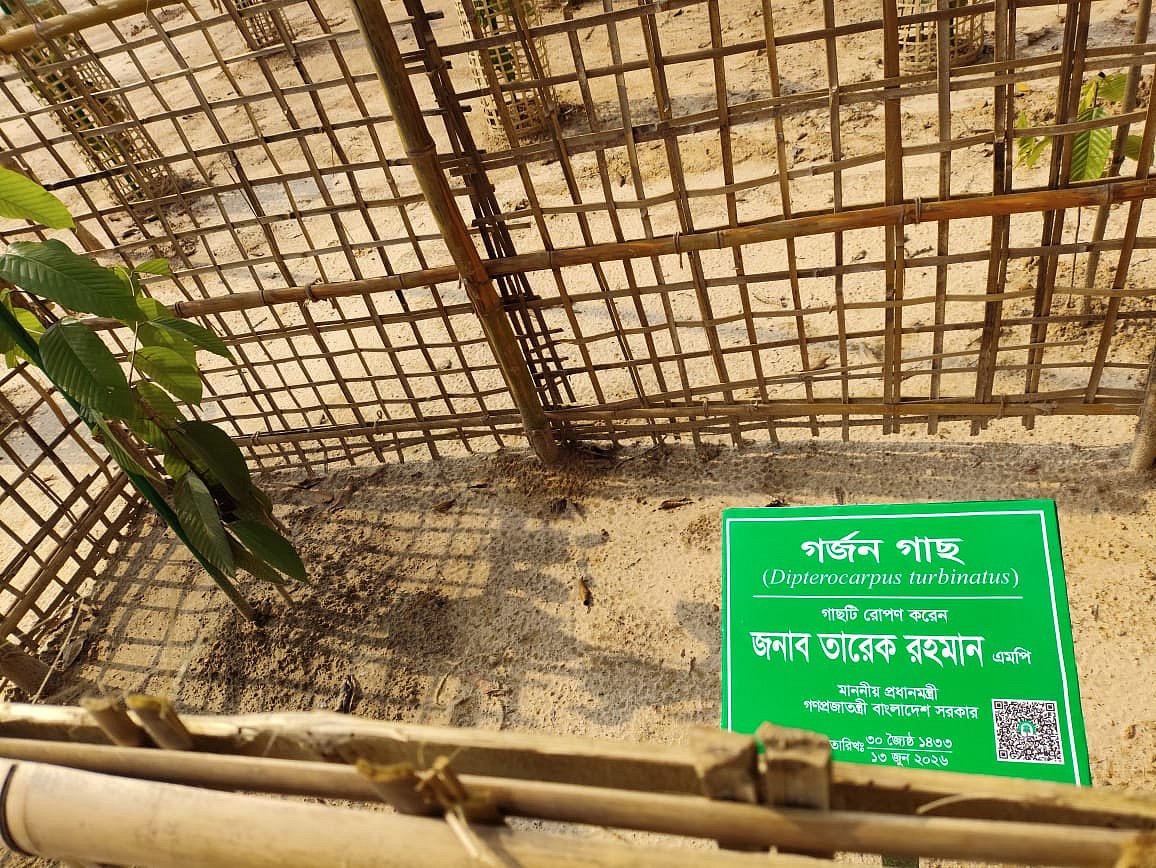
Photo Collected
Prime Minister Tareq Rahman inaugurated a nationwide campaign to plant 250 million trees in the Malumghat area of Cox’s Bazar on June 13, emphasizing a strategic pivot toward indigenous species. The centerpiece of the initiative at this site is a Teli Garjan sapling planted by the Prime Minister himself, a species currently classified as vulnerable by the International Union for Conservation of Nature (IUCN).
The Malumghat site, situated between the Chattogram-Cox’s Bazar highway and the Dohazari-Cox’s Bazar railway line, has since become the focus of a comprehensive preservation effort. Beyond the Teli Garjan, authorities have planted 2,000 saplings across ten indigenous species, including Jam, Chapalish, Nim, and Civit. To ensure the survival of these plants, officials have implemented strict security measures, including bamboo fencing, informative signage, and round-the-clock surveillance by a dedicated team of five workers who maintain the site in shifts.
বিজ্ঞাপন
Botanists underscore the ecological importance of the selection. Professor Animesh Biswas of the Department of Botany at the University of Chittagong noted that the Teli Garjan is vital for soil erosion prevention in hilly regions and serves as a critical biodiversity hub in the country’s fragile southeastern forests. Despite its ecological value, the tree has long been a target for illegal logging due to its high-quality, durable timber. Forest Department surveys indicate that the Cox’s Bazar region currently hosts approximately 4,068 Garjan trees out of 5,520 identified mature trees.
During the same visit, the Prime Minister also planted a rare Nagalingam sapling at the Dulahazara Safari Park. According to global botanical data, the Nagalingam is a decorative, large-canopy tree native to South America that is highly prized for its striking flowers and fruit, which serve as a primary food source for elephants.
বিজ্ঞাপন
This shift toward indigenous vegetation marks a departure from the historical reliance on fast-growing foreign species like Eucalyptus and Acacia. While these non-native trees were introduced in the 1980s to meet timber demand, experts have long warned that they drain excessive groundwater, degrade soil quality, and fail to support local wildlife. In response to declining biodiversity, the government has moved to prioritize native varieties such as Mahogany, Gamar, Jarul, and Neem in its national reforestation projects.
The current administration is scaling up these efforts with ambitious short-term targets, including the planting of 100,000 Neem trees within the next 180 days. Coastal regions are also being targeted for reforestation with species like Jhau, Sundari, and Gewa, reflecting a broader policy commitment to restoring the nation’s natural ecological balance through science-based forest management.
0%
0%
0%
0%