

Advocates Urge Increased Budgetary Funding to Eradicate Hazardous Child Labor in Bangladesh
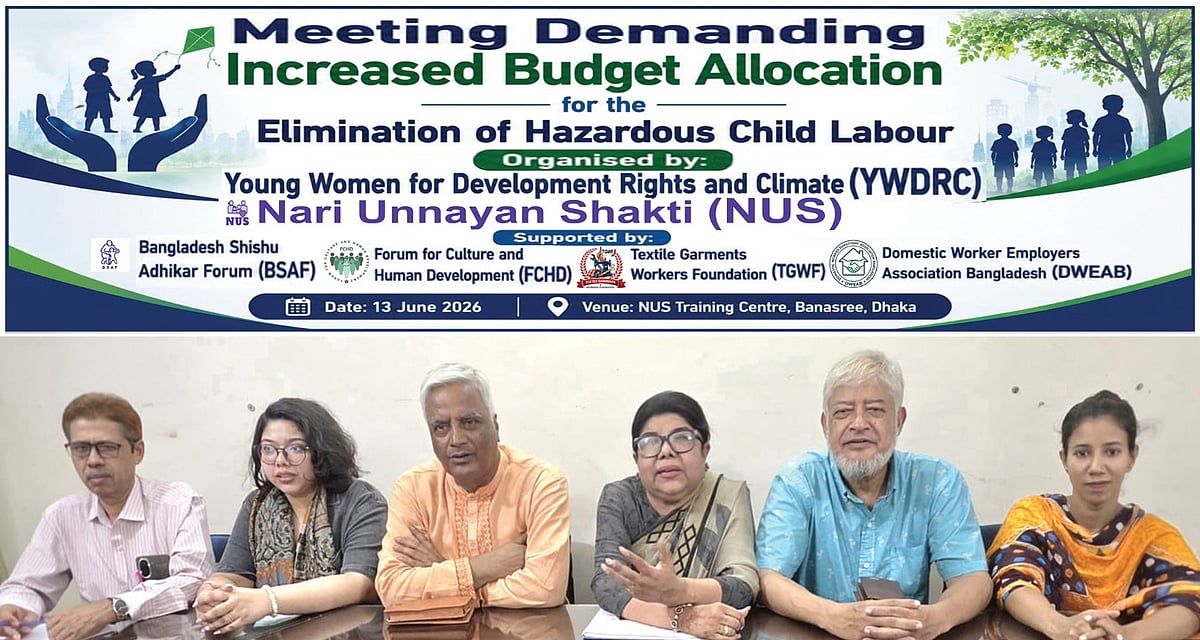
Photo Collected
Advocates and labor rights activists are calling for a significant increase in national budget allocations to effectively combat hazardous child labor in Bangladesh. During a policy discussion held in Dhaka’s Banasree area, experts argued that current efforts to protect vulnerable minors must be bolstered by targeted financial support for families, expanded educational opportunities, and robust social safety net programs.
The meeting, titled “Increasing Budget Allocation for the Eradication of Hazardous Child Labor,” was organized by Young Women for Development, Rights and Climate (YWDRC) and Nari Unnayan Shakti (NUS). The event saw participation from key advocacy groups, including the Bangladesh Shishu Adhikar Forum, the Textile Garments Workers Federation, the Domestic Workers Employers Association, and the Forum for Culture and Human Development.
বিজ্ঞাপন
Presenting the keynote paper, YWDRC Executive Chairperson Nusrat Sultana Afroz identified the systemic drivers of child labor, noting that poverty, unemployment, limited access to schooling, the escalating impacts of climate change, and entrenched social inequalities remain the primary catalysts. She emphasized that meaningful change requires moving beyond simple prohibitions toward a model of family-based economic assistance and long-term investment in skills development.
Nari Unnayan Shakti Executive Director Afroza Parvin, who chaired the discussion, described child labor as a complex multi-dimensional issue tied to fundamental rights, public health, and social justice. She urged the government to prioritize the rescue and rehabilitation of children currently trapped in hazardous working conditions by ensuring that fiscal policies reflect the urgency of the crisis.
বিজ্ঞাপন
The sentiment was echoed by veteran trade unionist and guest of honor Abdul Hossain, who advocated for broader social security coverage and strategies to increase the household income of working-class families. Representing the interests of marginalized communities, participant Hasi Akter highlighted the harsh reality faced by many households, noting that extreme poverty often leaves parents with no alternative but to send their children into the labor force. She asserted that if families were provided with sustainable income-generating opportunities, the prevalence of child labor could be reduced significantly.
0%
0%
0%
0%