
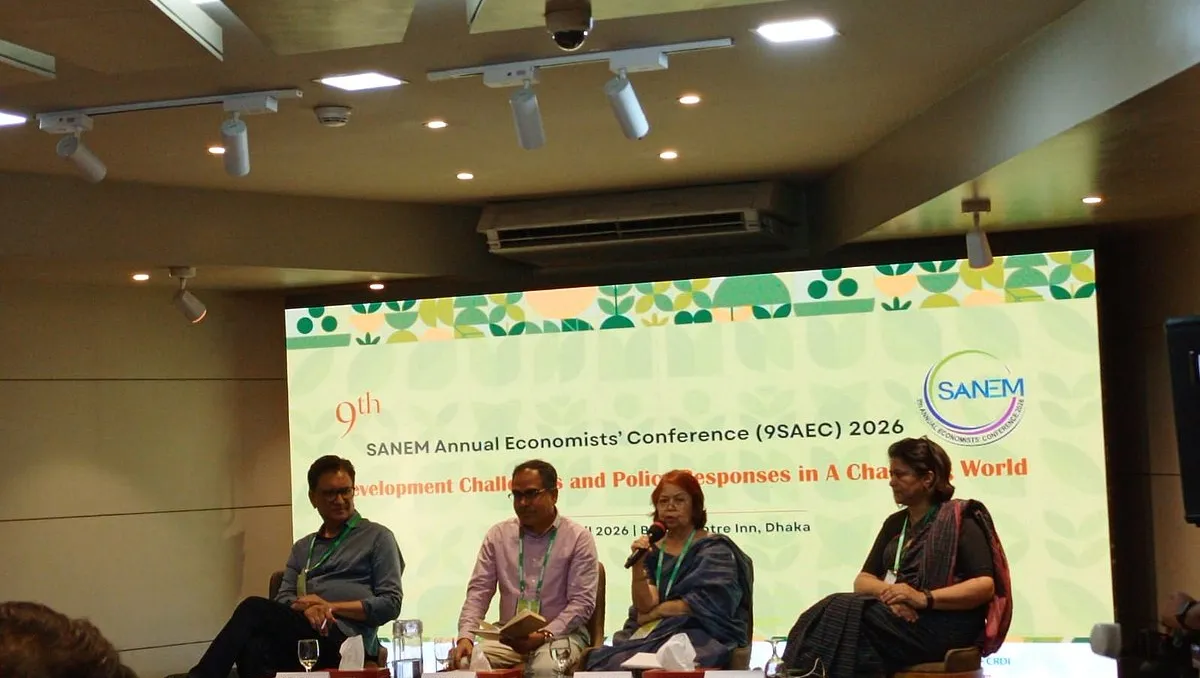
Ronak Jahan, Honorary Fellow of Center for Policy Dialogue (CPD), a private research organization, said, "I have told the two main political parties of the country many years ago, you can alternately come to power, but please do not try to eliminate each other. But even in all these years they have not listened to this advice.
Raonak Jahan said this in the president's speech at a session of the annual economist conference organized by the private research institute South Asian Network on Economic Modeling (SANEM) at the BRAC Center in Mohakhali of the capital on Saturday. Yesterday was the second day of the three-day conference.
Professor Kazi Maruful Islam of the Department of Development Studies of Dhaka University presented an essay on stability, order and growth in the political settlement of Bangladesh at the event. BRAC Institute of Governance and Development (BIGD) Senior Research Fellow Mirza M Hasan and Supreme Court Senior Advocate Sara Hossain were present as discussants.
On the occasion, political scientist Professor Raonak Jahan said, 'The general idea of the citizens is that the country's politicians will act according to a rational or logic. But we have seen in the history of last 54 years, what we think of as rational civil society, politicians do not think and act like that. They (politicians) have a rationality, they have an argument, they work with that.'
"We have been telling the two main political parties of the country for many years, especially since 1990—you can come to power alternately, but please don't try to eliminate each other," said Ronak Jahan. But even in all these years they have not heard this. Now how can they accept it in the future?'
"Question of Sustainable Stability"
Professor Kazi Maruful Islam while presenting the paper in the session said that political stability will be the first priority for the new government. Along with this, the government will try to create institutional controls. Then he will go towards economic growth. The amount of investment needed to increase growth and employment on a large scale, the government will not do at the moment. Rather, they will provide social security services as per election promises. But the range may not increase much.
Kazi Maruful Islam thinks that the opposition party also agrees to bring political stability with the government. He said, they (opposition parties) have benefit in it. Among the opposition parties, Jamaat-e-Islami was out of politics for a long time. They have a crisis of acceptance; There is a matter of grouping. If there is a natural environment they can do the work. The weakness of NCP (National Citizen Party) is that they do not have grass root organization as such. As a result, they will also want stability.

In this context, Ronak Jahan raised the question of how long the political stability will last without giving Awami League a chance in politics. He said that Sheikh Hasina tried to bring some kind of political stability in the last 15 years. This stability was brought by the exclusion of all political opponents, but it did not last. Even now if the definition of opposition party is only Jamaat-e-Islami or NCP and there is no political space for Awami League; So how long that stability can be sustained is a question.
Political scientist Professor Raonak Jahan said, "We have been talking about transitional justice (judgment of past injustice) in the country for many years. But we could not start it. I remember we talked about it in December 1996 as well. At that time, the trial of the war criminals of 1971 was going on. At that time Barrister Sara Hussain proposed why we are not starting a Transitional Justice and Truth and Reconciliation Commission. But it was not accepted in the end. Still if Awami League admits the crime and apologizes, then transitional justice can be done. But if no one from Awami League does that, this method will not work. Another big question here is, is this concept of transitional justice applicable only to Awami League, or will it be applicable to other parties as well.'
Senior lawyer Sara Hossain said that some of the arrests made in the last 18 months after the July massacre may be justified; But many are not logical. A new victim narrative has now emerged around the arrest and detention. This narrative revolves around another type of fundamental rights violation, arbitrary or arbitrary detention. In many cases detainees are being tortured; Several died while in prison.
Sara Hossain talks about the arrest and bail of former Speaker Shirin Sharmin Chowdhury. He said that recently former Speaker Shirin Sharmin Chowdhury was arrested mysteriously and got bail again. How it happened, in what communication, for what political benefit, some questions are arising in everyone's mind. The question is that he is exempted, why others are not exempted.
Sara Hossain also said, "No matter what is the terrible human rights violation or crime against humanity in our country, there is no accountability system at the end."
Mirza M Hasan, senior research fellow at BRAC Institute of Governance and Development (BIGD), said, after July, the expectation was that the new government would run the country logically, strategically. But that didn't happen. Rather, BNP is walking on the same path as Awami League. Sheikh Hasina's lions have now become BNP's lions in running the state.
Mirza M Hasan said that the country has not seen rule of law in the last 54 years. One of the key points of the July Charter was that the traditional liberal balance of power was not working effectively. Hence a multiple and multi-dimensional power balancing system is required. But at present, it seems that BNP's position is not establishing the balance of multidimensional power.




