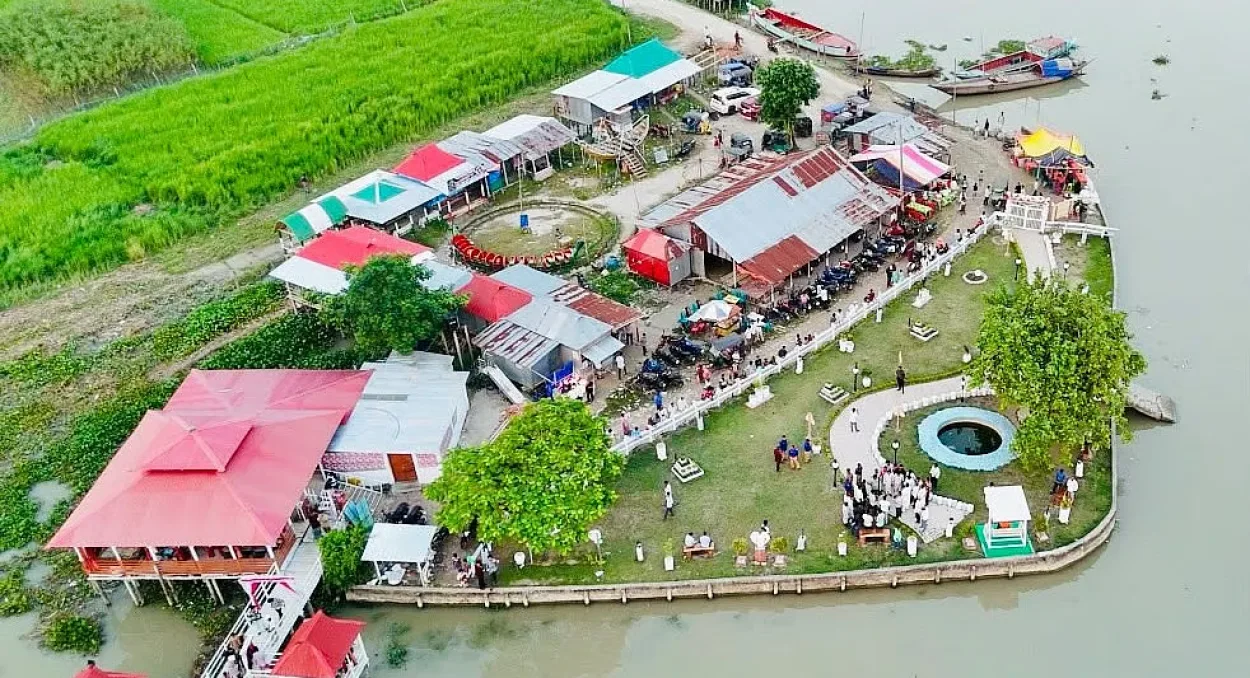

The historic Hobarhat-Shamsherganj Bazaar, a bustling rural trading hub situated on the border of Moulvibazar Sadar and Sreemangal upazilas in Bangladesh, continues to thrive as a vibrant center of commerce over a century after its establishment. Operating bi-weekly on Mondays and Thursdays, the centenarian marketplace spans across Sreemangal's Mirzapur Union and Sadar's Upper Kagabala Union, drawing crowds from surrounding countryside who converge along dirt tracks and roadways carrying baskets of fish, fresh vegetables, poultry, and livestock.
During a visit on Thursday afternoon, vendors were observed systematically arranging their merchandise across specialized alleys dedicated to distinct commodities, ranging from seasonal greens and betel leaves to dried fish, eggs, and bamboo-crafted household items. Stalls overflow with locally harvested produce such as red and green amaranth, gourds, eggplants, taro, beans, ridge gourds, and tomatoes, supplied predominantly by nearby farming communities in areas including Binngram, Sheker Hijra, Adarshagram, and Raybani.
Beyond conventional produce, the marketplace preserves unique regional traditions, featuring roadside vendors offering freshly harvested black water lilies from the adjacent Hail Haor at thirty Taka per kilogram, alongside traders selling wild persimmons utilized by local fishermen to treat fishing nets. Local resident Kala Mia noted that while the trade in persimmons has diminished compared to two decades ago, the market remains renowned for its agricultural abundance, with gourds, amaranth, and taro serving as the primary commercial drivers for local livelihoods through both retail and wholesale transactions.

The regional landmark is equally celebrated for its rich stock of freshwater fish originating from Hail Haor and the Gopla River, drawing eager buyers from distant villages as afternoon approaches and traders auction off native fish species like Puti, Cheng, Shol, and Bain at the local commission houses. Additionally, the centuries-old tradition of cultivating local betel leaves—locally known as Bangla pan—on nearby hill tracts remains a cornerstone of the market economy, where veteran growers like sixty-year-old Kanti Lal Dhar and fellow vendor Arjun Dutta have traded their harvests for decades, attracting wholesale buyers from far and wide.
Although the exact origins and founding date of the market remain shrouded in local lore—with some elders placing its historic roots east across the Gopla River and others on a western hillock—the sprawling bazaar now encompasses over three hundred permanent and temporary storefronts. Lubon Mia, a local nursery owner selling vegetable saplings by the roadside, emphasized the enduring economic vitality of the institution, estimating that trade turnover easily reaches between three million and 3.5 million Taka during every single market day.