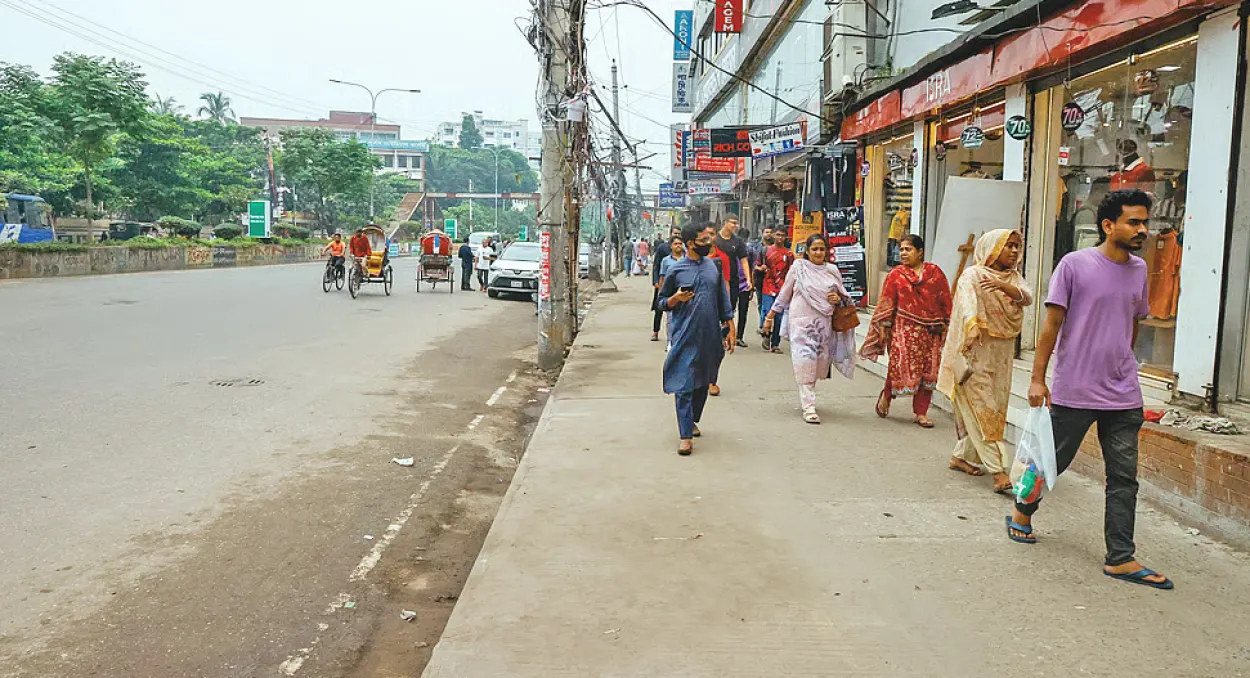

Persistent traffic congestion has emerged as the foremost crisis in Mymensingh, severely disrupting daily commuters, compounding public suffering, and wasting countless work hours. The crippling gridlocks are primarily fueled by narrow roadways, the uncontrolled proliferation of battery-powered three-wheelers, and the presence of 10 railway crossings intersecting the municipal area. Despite various administrative initiatives designed to ease the gridlock, these measures have largely failed to produce tangible results on the ground, leaving residents increasingly frustrated.
According to official data from the Mymensingh City Corporation, the municipality currently counts approximately 17,000 registered three-wheelers, comprising 5,968 easy-bikes, 5,608 mishuks, and 5,400 auto-rickshaws. Although the city authority has halted the issuance of new registrations, widespread irregularities persist, with multiple unauthorized vehicles operating on the streets using duplicated registration numbers. Mohammad Golam Mawla, inspector of administration for the district traffic police, disclosed last night that an estimated 22,000 to 25,000 unregistered three-wheelers flood the city daily, swelling the total operational fleet to roughly 40,000 vehicles.
Elaborating on the systemic infrastructure deficit, Mawla observed that while high-rise buildings have multiplied across Mymensingh over the past two decades, road networks have remained stagnant. While an ideal urban layout requires 25 percent of its land dedicated to roads, Mymensingh possesses a meager five percent. Urban planners note that the city's main thoroughfare from Town Hall crossing via Ganginarpar to the station area is a two-lane road where each lane measures a mere 17 feet in width, causing vehicles to crawl in a stop-and-start manner. Other critical arteries, such as routes from Ganginarpar to Charpara and Town Hall to Patgudam Bridge, suffer from severe spatial constraints.

Population pressure in Mymensingh has escalated sharply following its elevation to a divisional headquarters in September 2015 and the subsequent formation of the city corporation on October 14, 2018. Residents report that moving across the city has become an ordeal. Jibon Hossain, a resident of the Brahmapalli area, recounted that walking often proves faster than using vehicular transport, forcing commuters to allocate an extra 30 to 40 minutes for any journey. Similarly, Rehena Hasan, a college student commuting daily through the Dhopakhla area, noted that getting trapped at railway crossings routinely costs passengers 15 to 20 minutes. Fares have also spiked, with trips from Badar Mor to Ganginarpar rising from five BDT to 10 BDT over the past six months, even as vehicles routinely get stalled before reaching destinations like the Minto College railway crossing.
To address the compounding crisis, the district administration formulated a comprehensive action plan in September of last year, identifying 13 major congestion hotspots—including Patgudam Bridge Mor, Charpara Mor, Notun Bazar Mor, and several key railway crossings—alongside 10 core catalysts of gridlock. Alongside narrow roads and three-wheeler saturation, authorities highlighted commercial parking, encroached sidewalks, inter-district buses transiting through the city, and daytime entry of freight trucks as primary contributing factors. Meanwhile, Sumona Al Majeed, acting chief executive officer of the Mymensingh City Corporation, stated that newly appointed administrator Md. Rukunozzaman has undertaken fresh strategies to curb traffic congestion, with implementation expected to conclude within the next month by effectively barring outside auto-rickshaws from entering the city center.