
Satkhira laborers turn surplus pond moss into sustainable income source for fish farmers
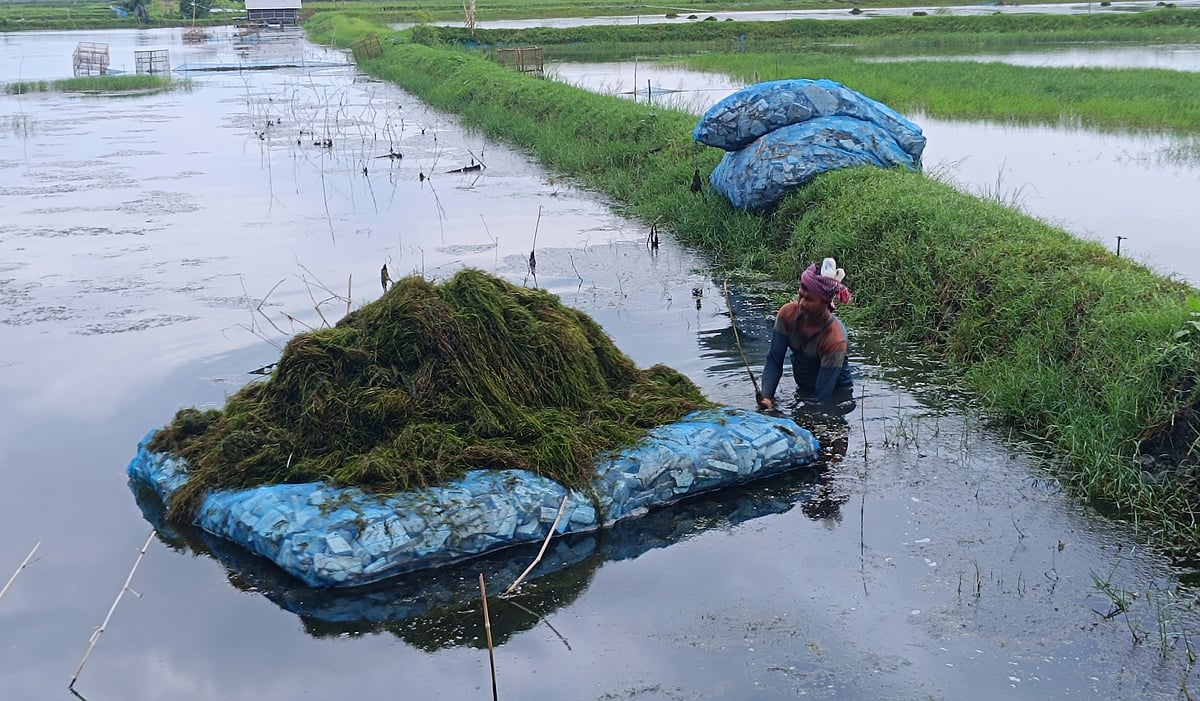
Photo Collected
Workers in the Shoshadanga village of Satkhira’s Debhata Upazila have developed a localized circular economy by harvesting and trading aquatic moss, a byproduct of commercial fisheries that has become a valuable commodity for fish farmers.
The process involves laborers wading waist-deep into fisheries using flat rafts constructed from polystyrene foam and netting to collect dense, mud-covered green moss. While the activity may appear to be routine pond maintenance to onlookers, it represents a structured trade where unwanted moss is cleared from one enclosure and sold as supplemental feed for carp species in others.
Rajkumar Gain, a laborer involved in the collection, explained that excessive moss growth hinders the movement of fish. By clearing these enclosures, laborers provide a dual service: maintaining the health of the primary pond and supplying organic feed for freshwater species such as grass carp, roe, and mrigel. A single van load of the moss, locally known as “kata shela,” fetches between 700 and 800 taka.
The trade has created a niche market for low-income workers. Abu Sayed, a collector working in the Parulia area, noted that he harvests moss from saline-water shrimp ponds—where excessive growth is a common nuisance—and sells it to operators of freshwater fish farms. For laborers like Sayed, this provides a reliable income for five to six months of the year, yielding daily earnings of 400 to 500 taka during the peak season.
For shrimp farmers, the moss is often a significant operational challenge. Business owner Oziar Rahman, who operates a 15-bigha shrimp farm, explained that dense moss growth restricts the mobility of shrimp larvae and hinders their growth by blocking sunlight from penetrating the water. Consequently, clearing the moss is essential for shrimp production.
Satkhira District Fisheries Officer GM Salim confirmed that uncontrolled moss growth can disrupt the natural food cycle of a pond by limiting sunlight and impeding the movement of shrimp. He noted that the practice of repurposing this excess vegetation as feed for carp fisheries is an efficient solution that simultaneously addresses pond maintenance needs and reduces overhead costs for fish farmers.
This ecosystem of harvesting and distribution is now prevalent across several regions, including the Maheshwarkati area of Ashashuni Upazila, where the trade continues to serve as both an environmental necessity for fisheries and a critical livelihood for local laborers.
0%
0%
0%
0%