
Former migrant worker finds success in horticulture through digital innovation and mixed fruit farming in Pekua
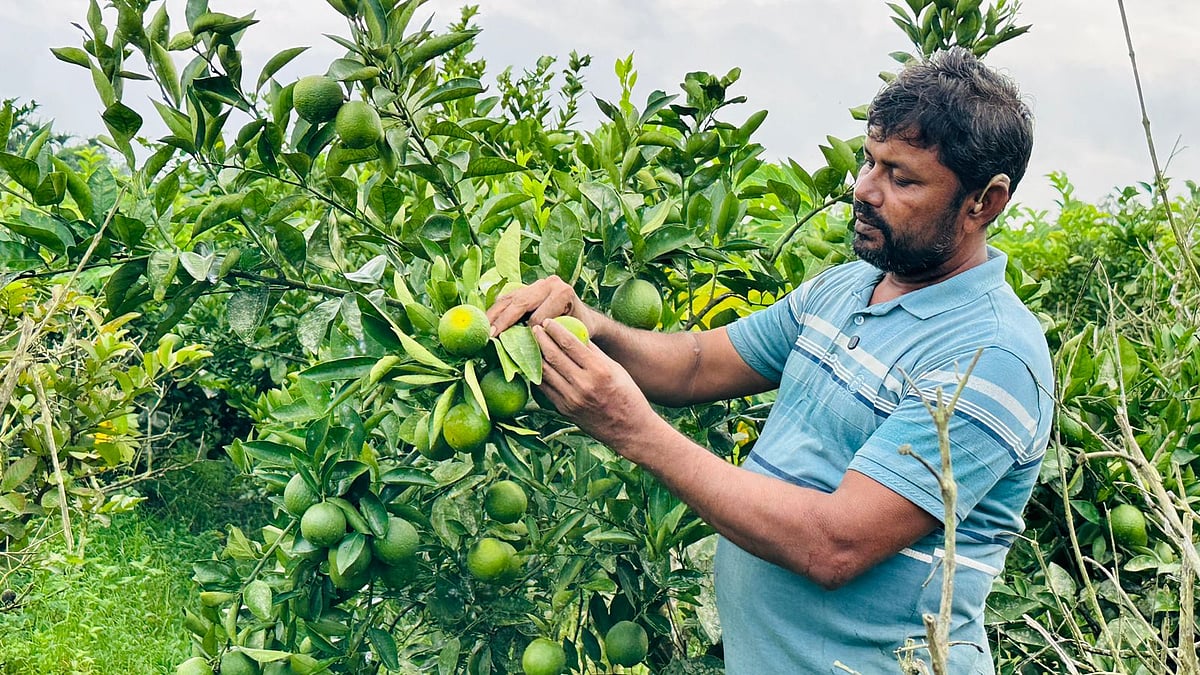
Photo Collected
After spending 13 years working in Saudi Arabia and Qatar, 45-year-old Jamir Uddin has successfully transitioned to commercial fruit farming in Cox’s Bazar. Despite initial setbacks in retail and transport businesses, Uddin has turned his four-acre orchard in the Sonaichhari area of Pekua Upazila into a thriving enterprise, generating millions in annual revenue through innovative, technology-driven cultivation.
Uddin’s orchard, located in the hilly region of Ramizpara, was established in 2023 on leased land. The facility features a diverse range of crops, including 1,400 guava trees, 800 Malta orange trees, 250 pomelo trees, and 250 Darjeeling orange trees. He sources his saplings from various regions, including Nilphamari, Thakurgaon, and the Chittagong Hill Tracts.
Lacking formal agricultural training, Uddin relies on digital resources, specifically YouTube and Google, to master cultivation techniques and disease management. When faced with complex horticultural issues, he consults local agricultural officials. His investment has been substantial, with over 3.2 million taka spent on land development, saplings, irrigation, and labor over the past two years. Last year, his maiden harvest yielded 2.2 million taka in sales.
The operation recently suffered a significant setback due to severe flooding in early July. Floodwaters from the surrounding hills submerged the orchard for six days, resulting in the loss of approximately 700 trees and tens of thousands of fruits. Uddin estimates the damage at 1 million taka, yet remains optimistic about the current season, projecting total sales of 1.7 million taka. Wholesale buyers from Cox’s Bazar and Chittagong currently purchase his produce directly from the orchard, with local market rates for Malta ranging from 120 to 150 taka per kilogram and guavas fetching 80 to 100 taka per kilogram.
Uddin’s path to farming was unconventional. After his initial return from the Middle East in 2009, he struggled to find stability in the cosmetics trade and later in the CNG-run auto-rickshaw rental business. His foray into agriculture began in 2018 with a papaya project, followed by banana cultivation, which netted an 800,000 taka profit before yields declined. These experiences prompted his shift toward the current mixed-fruit model, which offers financial resilience by diversifying product offerings.
Local agricultural officials have lauded Uddin’s initiative, noting that the hilly terrain of Pekua is highly suitable for citrus and exotic fruit cultivation. Faruk Hossain Chowdhury, the Pekua Upazila Agriculture Officer, described the orchard as a standout example of commercial fruit farming in the region. He emphasized that the mixed-crop strategy provides a vital buffer against market volatility, allowing farmers to offset losses in one fruit variety with gains from others. The agriculture department continues to provide regular advisory support to assist in the long-term viability of the project.
0%
0%
0%
0%