
Experts call for balanced drug policy to ensure medicine affordability and industry sustainability
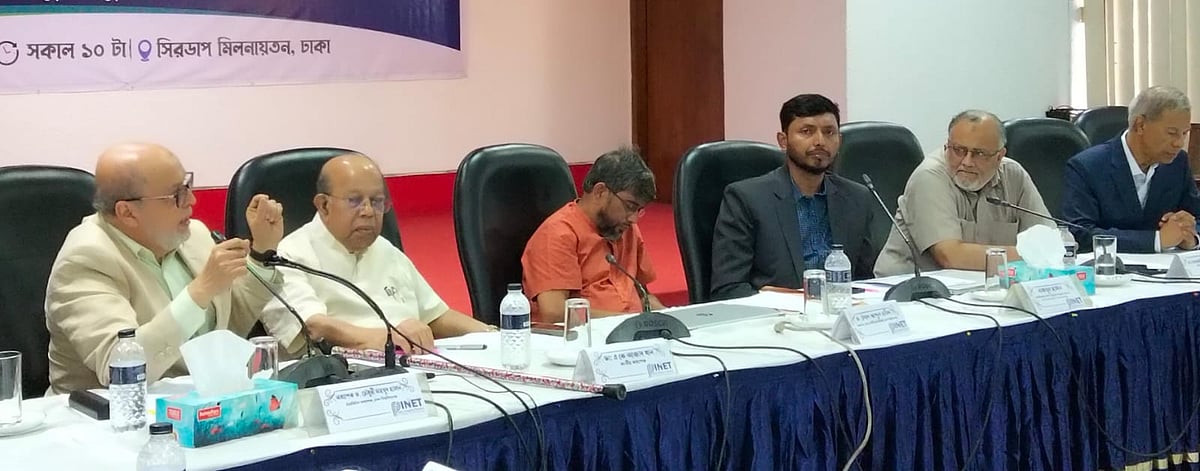
Photo Collected
Health experts, economists, and pharmaceutical industry representatives gathered in Dhaka on Tuesday to urge the government to formulate a balanced drug policy that ensures both the affordability of life-saving medicine for patients and the long-term sustainability of domestic manufacturers. The policy dialogue, titled “Medicine within Reach, Manufacturer Sustainability: In Search of a Balanced Drug Policy,” was organized by the Public Integrity Network for Evidence and Transparency (PINET) at the CIRDAP auditorium.
Professor Syed Abdul Hamid of the Institute of Health Economics at the University of Dhaka presented the keynote paper, noting that the current pricing formula for 117 essential drugs is based on outdated 1982 standards. He argued that the formula fails to account for modern increases in production, energy, logistics, and research costs. While the list of essential drugs expanded to 285 in 2016 and further to 295 by 2026, many newly included medications remain outside the current pricing framework. He stressed that periodic adjustments, aligned with annual inflation, are essential to prevent market instability.
The discourse highlighted that over 70 percent of health expenditure in Bangladesh is paid out-of-pocket, with approximately 60 percent of that amount spent on medicine. Experts argued that simply slashing prices is not a panacea, as it risks triggering medicine shortages and forcing manufacturers to halt production. Instead, participants called for stricter control over irrational medicine use, over-the-counter sales, and unethical marketing practices.
National Professor AK Azad Khan emphasized that the solution does not lie in a “blame game” between the government and pharmaceutical companies. He urged the Directorate General of Drug Administration (DGDA) to adopt a more professional and robust approach to oversight. Similar sentiments were echoed by Mohammad Mosleh Uddin Farid, a Member of Parliament, who warned that the transition to new intellectual property regulations post-2030 could lead to rising costs, necessitating urgent investment in local research and development.
Public health expert Mushtaq Hossain suggested that the government should prioritize strengthening state-run manufacturing to ensure the poor receive medicine free of charge, while the middle class could benefit from subsidized options. World Health Organization (WHO) representative Mamunur Rahman Malik further emphasized the need to regularly update the essential medicine list to reflect advancements in medical science, while also strengthening pharmacovigilance and demand forecasting.
Representatives from the pharmaceutical sector cautioned against aggressive price interventions. Syed S. Kayser Kabir, Vice President of the Bangladesh Association of Pharmaceutical Industries and Executive Director of Renata PLC, argued that forced price reductions could jeopardize production levels in an industry that currently meets 98 percent of local demand. Similarly, Mizanur Rahman, Executive Director of Square Pharmaceuticals, noted that while the monthly national consumption of medicine reaches approximately 3.5 billion BDT, the per capita cost remains low, suggesting that systemic support for the poor is more effective than artificial price caps.
Professor Emeritus Chowdhury Mahmud Hasan of the University of Dhaka concluded that the progress of the domestic industry since 1994 stems from a competitive, deregulated market environment. He advised that instead of arbitrary price controls, the government should focus on increasing the production of Active Pharmaceutical Ingredients (API) to reduce import dependency and curb unethical promotional practices that inflate healthcare costs. The participants collectively agreed that a comprehensive policy must integrate affordability, quality assurance, and rational medical usage to protect both public health and industrial viability.
0%
0%
0%
0%