
Professor Mushtaq Khan Urges Legal Strategy to Nullify Corrupt Energy Deals and Address Structural Sector Crisis
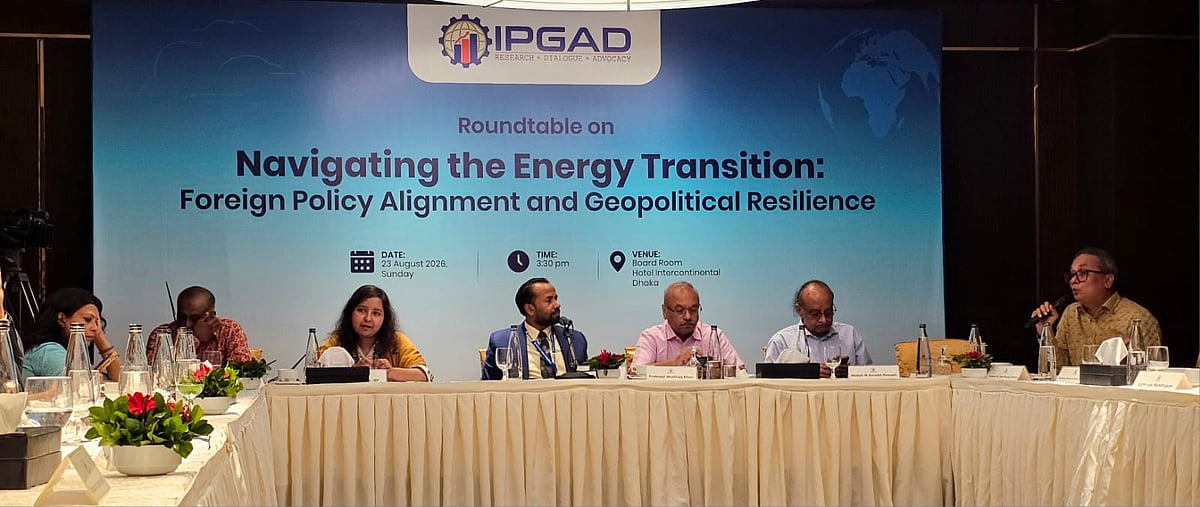
Photo Collected
Mustaq Khan, a professor at the School of Oriental and African Studies at the University of London, has called for a bifurcated approach to addressing Bangladesh’s deepening energy crisis, categorizing it into short-term supply shortages and long-term structural and production failures. Speaking at a roundtable titled “Navigating the Energy Transition: Foreign Policy Alignment and Geopolitical Resilience,” held Sunday at the Hotel InterContinental in Dhaka, Khan emphasized that the sector requires urgent systemic reform.
Professor Khan criticized the previous Awami League administration, noting that while official figures claimed a fourfold increase in power generation capacity, actual operational costs surged elevenfold, and capacity charges escalated twentyfold. He asserted that many power plants were approved solely to facilitate the collection of capacity charges, despite the lack of a sustainable fuel supply chain.
Addressing the legal complexities of 25-year sovereign contracts, particularly the agreement with India’s Adani Group, Khan warned that simple international arbitration over outstanding bills would likely result in a defeat for Bangladesh. Instead, he argued that the government must pursue a legal strategy to prove the contracts were fundamentally corrupt and irregular from their inception, a concept known as “void ab initio.” He noted that international legal experts, including King’s Counsel in London, suggest Bangladesh has a strong case if supported by professional international investigations. Khan urged the Prime Minister to personally oversee this crisis management, describing it as a critical effort to prevent national collapse.
Energy and Power magazine editor Mollah Amzad Hossain attributed the crisis to a lack of policy consistency and criticized past governments for neglecting domestic gas exploration. He pointed out that while Petrobangla holds 4 trillion cubic feet (TCF) of reserves in Bhola, daily production remains stagnant at 600 to 700 million cubic feet. In contrast, he noted that Chevron produces 900 million cubic feet daily from reserves of only 1.1 TCF, labeling the government’s underperformance a significant failure.
Other experts echoed concerns regarding systemic exploitation. Syed Mizanur Rahman, associate dean at Daffodil International University, argued that the national economy has been crippled by corrupt officials and unethical business syndicates. Dhaka University professor Moshahida Sultana added that inequitable contracts have created massive fiscal deficits within the national budget.
Security concerns were also highlighted, with Brigadier General Nasimul Gani warning that if national energy infrastructure falls under the strategic control of foreign powers, it would pose a direct threat to Bangladesh’s national security. Research fellow Lam-Ya Mostak of the Bangladesh Institute of International and Strategic Studies (BIISS) noted that 20 to 23 percent of the nation’s energy imports pass through the Strait of Hormuz, urging a shift toward renewable energy to reduce geopolitical dependency.
Political and civic representatives also weighed in on the crisis. BNP lawmaker Mansura Alam demanded the removal of taxes on solar equipment to incentivize private investment, while Faridul Haque of the National Citizens Party questioned the lack of transparency regarding the fire at the Moheshkhali floating LNG terminal. The event was moderated by Mustafa Hossain, Executive Director of the Institute of Policy, Governance and Advocacy for Development (IPGAD), the organization that hosted the discussion.
0%
0%
0%
0%
More News from Business