Rise of Illegal Loan Apps in Bangladesh Triggers Financial Extortion and Privacy Concerns
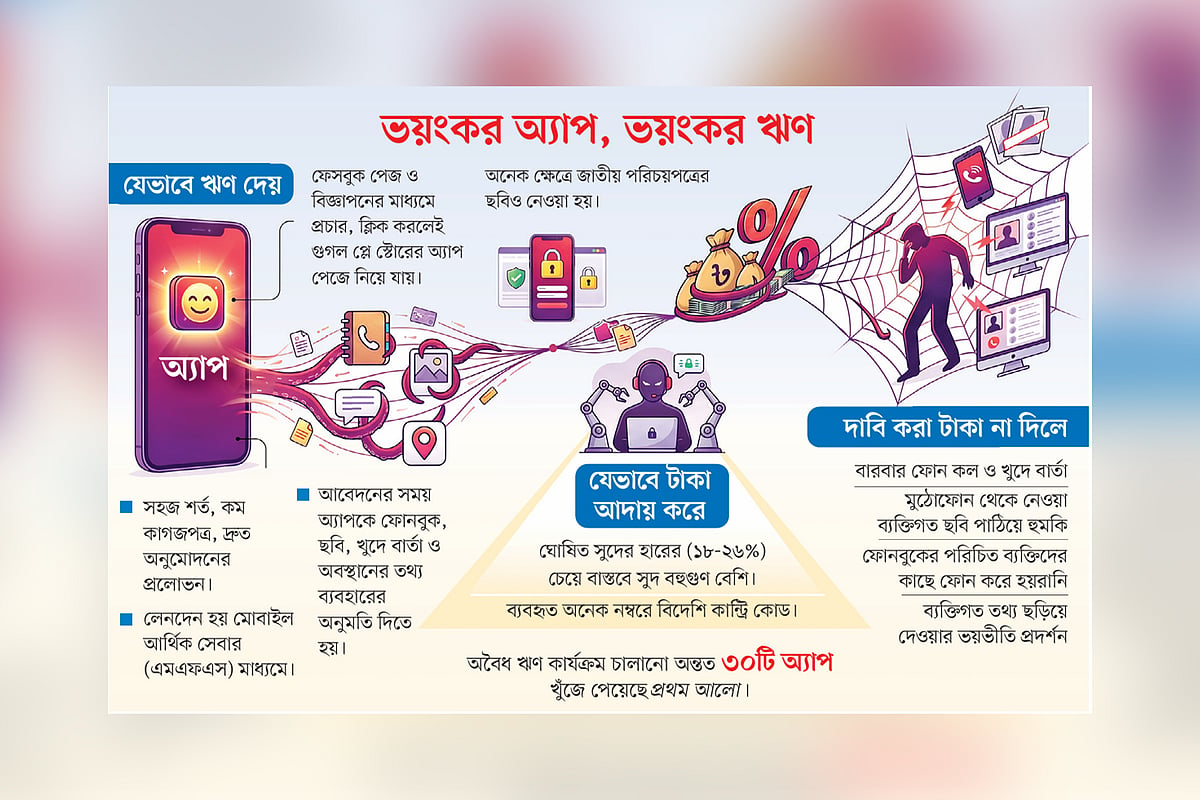
Photo Collected
A growing network of unregulated mobile applications is entrapping Bangladeshi citizens in predatory lending schemes, imposing interest rates as high as 800 percent and resorting to digital extortion to recover funds. Investigations have identified at least 30 illicit lending apps operating in the country, which mirror similar criminal operations across South Asia that have already been linked to cases of severe harassment and suicide.
One victim, Shaheen Hossain, reported borrowing 6,000 taka through an app called “Fincash” last June. Within a month, the lenders demanded 10,000 taka. When Hossain refused to pay the exorbitant interest, the operators threatened to leak his private data and contact his relatives. Fearing social disgrace, he eventually settled the debt but warned others against the predatory practice.
These platforms typically lure users through social media advertisements. Upon installation, the apps secretly access the user’s phone gallery, contact list, and personal messages. If a borrower fails to meet the repayment demands, the operators use this harvested information to blackmail the victims. In India, such harassment recently led to the suicide of a 25-year-old man in Andhra Pradesh after lenders circulated manipulated photos of his bride when he could not repay a small loan.
While legal lending channels in Bangladesh include banks, non-bank financial institutions, and government-regulated microcredit organizations—which hold a combined loan portfolio of over 2 trillion taka—these formal institutions often lack the instant, “no-questions-asked” accessibility that attracts desperate borrowers. Recognizing this gap, illicit apps like “Sathi Loan,” “Quick Loan,” and “BD Sahaj Loan” have proliferated. “Quick Loan,” launched on the Google Play Store last September, has already been downloaded over 500,000 times.
Despite the fact that unauthorized currency trading, online gambling, and unregulated financial transactions are illegal in Bangladesh, these apps continue to operate with impunity. They require applicants to submit National ID cards and mobile financial service account details, granting the apps full permission to access sensitive device data during the registration process.
Central Bank spokesperson Arif Hossain Khan stated that the Bangladesh Bank is currently unaware of the specific scope of this illegal digital lending but pledged to initiate efforts to raise public awareness. Meanwhile, law enforcement agencies, including the Criminal Investigation Department (CID) and the Detective Branch (DB) of the Dhaka Metropolitan Police, have reported that they have received few to no formal complaints regarding these platforms.
Cybersecurity experts warn that the lack of institutional oversight is fueling a crisis. Professor B.M. Mainul Hossain of the Institute of Information Technology at the University of Dhaka noted that the offenders constantly evolve their tactics. He argued that the rise of these platforms is a failure of both public digital literacy and the ability of regulatory bodies and law enforcement to take proactive, decisive action.
International observers note that these digital scams often originate from criminal hubs along the borders of Cambodia, Laos, and Myanmar. With the United Nations estimating that such syndicates steal nearly $64 billion annually worldwide, analysts suggest that Bangladesh must act swiftly to regulate the digital space before the crisis reaches the extreme levels of financial exploitation and social instability seen in neighboring nations like India, which has already banned over 3,700 such applications.
0%
0%
0%
0%