

Experts and Industry Leaders Urge Balanced Spectrum Pricing to Boost Digital Economy and Network Quality
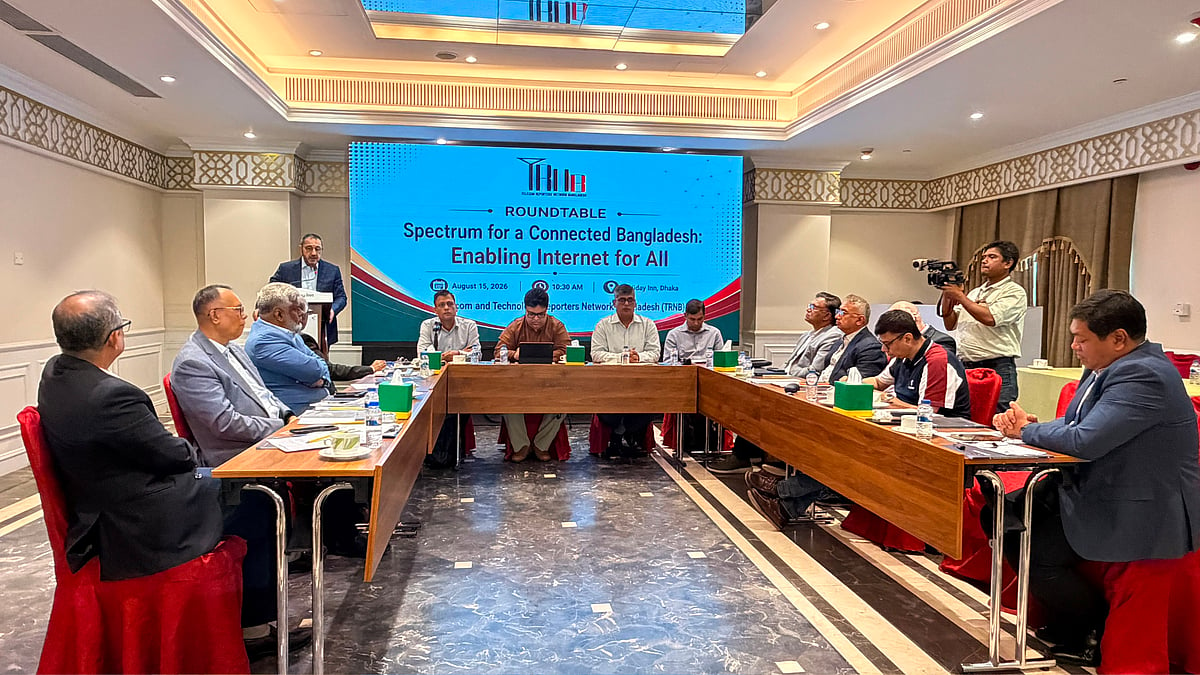
Photo Collected
Telecom industry experts and stakeholders are urging the government to pivot its approach toward telecommunications spectrum, shifting the focus from viewing it merely as a source of state revenue to recognizing it as a critical engine for long-term national economic growth and digital infrastructure. During a roundtable discussion titled “Spectrum for a Connected Bangladesh: Enabling Internet for All,” held Saturday in Dhaka, participants emphasized that affordable spectrum allocation and investor-friendly policies are essential to accelerating the country’s digital economy.
The event, organized by the Telecom and Technology Reporters Network Bangladesh (TRNB), took place as three private mobile operators face an upcoming deadline in November to renew a combined 79.2 megahertz of spectrum. According to data from the Bangladesh Telecommunication Regulatory Commission (BTRC), the nation’s operators currently utilize a total of 463 megahertz. The November renewals involve 32.4 megahertz for Grameenphone, 29.4 megahertz for Robi, and 21 megahertz for Banglalink.
Rehan Asif Asad, advisor to the Prime Minister on Posts, Telecommunications and Information Technology, served as the chief guest and assured stakeholders that decisions regarding spectrum renewal would be grounded in reason. He stressed that policies must account for network quality, future business models, operational capacity, and consumer needs, urging the industry to prioritize public service and practical realities.
BTRC Chairman Major General (Retd.) Emdad Ul Bari stated that the regulator’s primary objective is to identify a “sweet point” in pricing that balances immediate state revenue with operator viability and broader economic growth. He noted that future telecommunications policies and pricing structures will be based on rigorous scientific research rather than speculative assessments.
In his keynote presentation, telecommunications consultant Munir Hasan highlighted that Bangladesh ranked 93rd in mobile network performance in 2025. He argued that excessively high spectrum costs force operators to divert capital toward government fees rather than network infrastructure, ultimately increasing the outflow of foreign currency. Conversely, he suggested that affordable and timely spectrum allocation would improve service quality and foster a more robust digital ecosystem.
Ziad Shatara, president of the Association of Mobile Telecom Operators of Bangladesh (AMTOB), echoed these sentiments, asserting that the value of spectrum should be measured by the resulting connectivity, investment, and productivity rather than tax intake alone. Grameenphone CEO Yasir Azman and Banglalink CEO Erik Aas, represented by Taimur Rahman, both underscored the necessity of a collaborative approach between the government and the private sector to ensure affordable access and sustainable network expansion.
The roundtable, moderated by TRNB President S.M. Masuduzzaman Robin, also featured contributions from AMTOB Secretary General Mohammad Zulfikar, Robi Chief Corporate and Regulatory Officer Shahed Alam, and Banglalink Chief Corporate Affairs Officer Taimur Rahman. The event opened with welcome remarks from TRNB General Secretary Faruk Hossain.
0%
0%
0%
0%