Katimon Mango Cultivation Gains Commercial Momentum Across Bangladesh as Farmers Replace Traditional Varieties
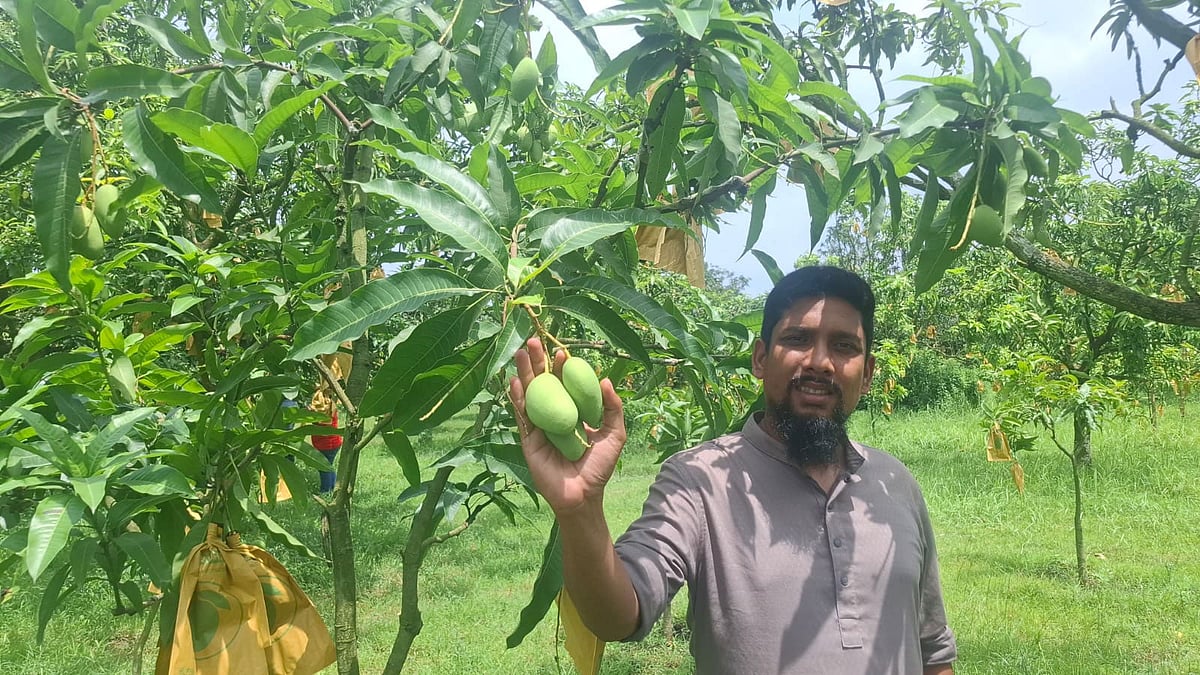
Photo Collected
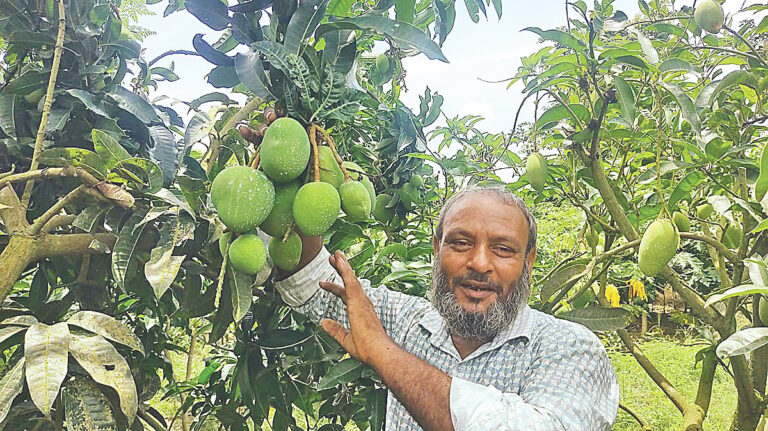
The cultivation of Katimon mangoes is transforming Bangladesh’s horticultural landscape, as farmers increasingly shift toward this perennial variety to ensure year-round production. Unlike traditional seasonal mangoes that ripen primarily during the Bengali month of Baishakh, Katimon matures multiple times annually, offering harvest opportunities even in the late season month of Kartik.
Across the country’s major mango-producing regions, growers are pivoting to this variety, often by grafting scions onto mature, existing trees rather than planting entirely new orchards. According to the Department of Agricultural Extension, Chapai Nawabganj leads the transition, with 4,462 hectares currently dedicated to Katimon. Similar shifts are evident in Rajshahi and Naogaon, where 242 hectares and 160 hectares have been converted, respectively.
In a seven-bigha orchard located in the Shikarpur mouza of Shibganj Upazila, Chapai Nawabganj, leaseholders—including Sahabuddin, Md. Remon Khan, Abdus Sabur, Mahmudul Hasan, and Akmal Mahmud—have demonstrated the efficacy of this grafting strategy. By converting old trees, such as the 15-year-old Lokna variety, into Katimon, farmers are seeing significant economic gains. Sahabuddin noted that while a traditional Lokna tree previously yielded a maximum of five maunds of fruit, the same tree grafted with Katimon now generates substantially higher revenue. With Katimon currently selling for 7,000 to 8,000 taka per maund—and potentially reaching 10,000 to 12,000 taka as seasonal supply wanes—the variety is proving highly lucrative.
Beyond economic returns, the Katimon mango is prized for its specific characteristics. The fruit averages 396 grams in weight with a thin seed, light yellow firm flesh, and a 78 percent edible portion. Capable of yielding 15 to 18 tons per hectare, the variety is valued for its ability to be consumed both raw and ripe.
The expansion of Katimon cultivation has also spurred a niche service sector, with skilled laborers specializing in grafting techniques to facilitate the variety shift. For a fee of four to five taka per graft, these technicians can replace existing tree branches with Katimon scions, a process that shows viability within roughly 20 days.
Despite its commercial success and popularity among farmers, the Katimon remains an unlisted variety in Bangladesh. Shafiqul Islam, chief scientific officer at the Rajshahi Fruit Research Center, noted that the variety originated in Thailand and was introduced to the country roughly a decade ago. While it is currently highly profitable, researchers suggest that its long-term market stability depends on maintaining production levels as adoption continues to grow. For growers, the primary appeal remains the ability to capture market share during the off-season, filling the void left when conventional domestic mango supplies dwindle.
0%
0%
0%
0%