

Landslides Kill Eight Rohingya Refugees in Coxs Bazar as Heavy Rains Hit Camps
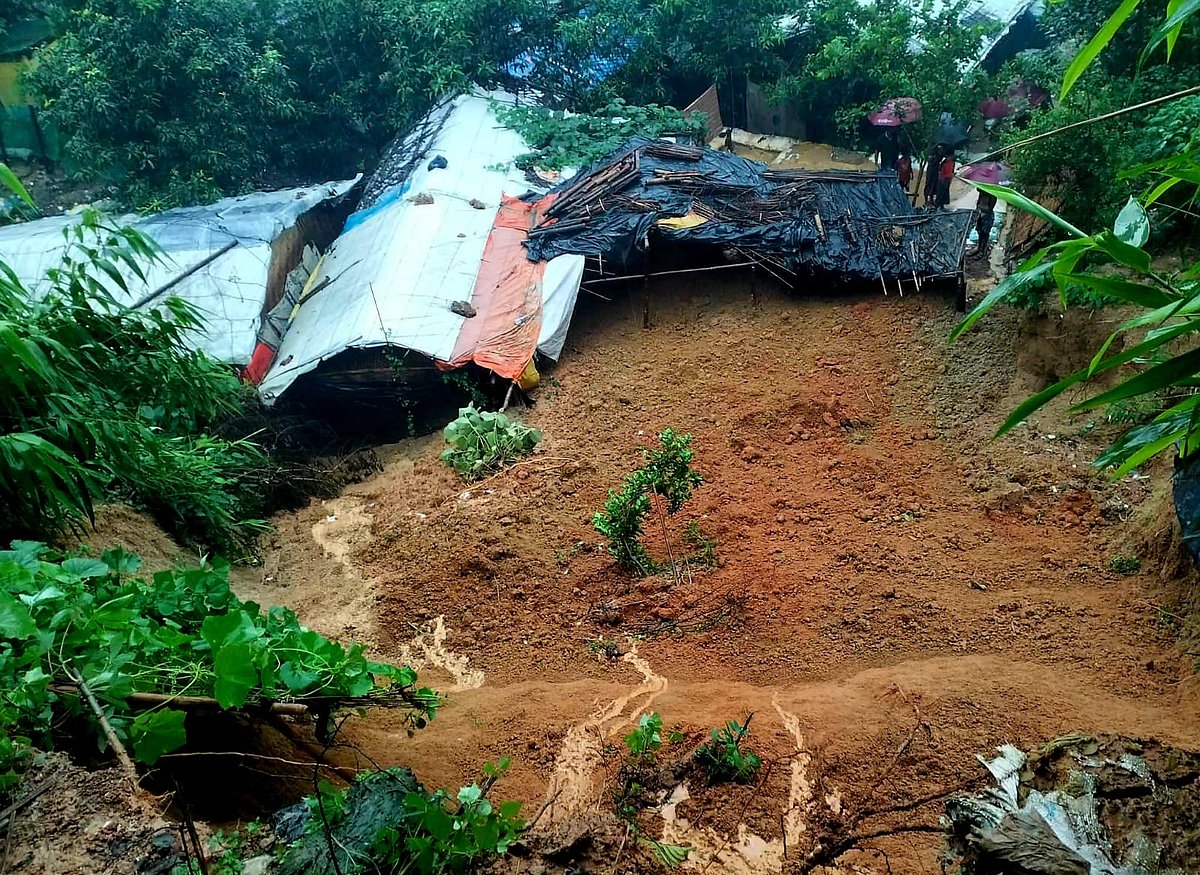
Photo Collected
Heavy monsoon rains triggered multiple landslides across Rohingya refugee camps in Cox’s Bazar, Bangladesh, late Sunday night, leaving eight people dead and several others injured. The fatalities, which included numerous women and children, occurred in the Balukhali, Kutupalong, and Jamtoli camps between 1:00 a.m. and 3:30 a.m. as relentless rainfall caused precarious hillside dwellings to collapse.
The most severe incident struck the Balukhali camp, where a single family was buried alive while sleeping. Four members—27-year-old Umme Habiba, her 13-year-old sister Tanjina Akter, and Habiba’s two young sons, five-year-old Md Rihan and three-year-old Harunur Rashid—died when their hillside shelter was crushed under a mass of mud. The family, originally from the Sikdarpara village in Myanmar’s Rakhine state, had fled to Bangladesh roughly 18 months ago to escape violence by the Arakan Army. Unable to secure formal housing, they had constructed a makeshift shelter made of plastic sheeting and bamboo on the slopes of the camp.
বিজ্ঞাপন
Separate landslides in the Jamtoli and Kutupalong camps claimed four more lives. In the Jamtoli camp’s D-6 block, 44-year-old Kamal Hossain, his 39-year-old wife Humayra Begum, and their four-year-old son, Mohammad Anas, were killed when a section of the hillside gave way during the night. In the Kutupalong camp, seven-year-old Md Ekram, the son of a local resident, also perished in a similar collapse. Outside the refugee settlements, a landslide in the Chattarghona area of Cox’s Bazar city killed a man named Ali Akbar and left two of his family members injured.
Local officials and camp leaders reported that the disaster was exacerbated by heavy downpours that saturated the hilly terrain, causing deep fissures and instability. According to Dollar Tripura, an official with the Ukhiya Fire Service and Civil Defense, rescue operations were hampered by the ongoing torrential rain, which hampered efforts to reach survivors buried under debris.
বিজ্ঞাপন
With 267 millimeters of rainfall recorded in Cox’s Bazar over a 24-hour period, meteorologists have warned that the danger is not yet over. The meteorological department forecasts heavy rain for at least two more days, increasing the risk of further landslides in both the refugee camps and the surrounding residential areas.
The crisis has highlighted the vulnerability of thousands of refugees living in densely packed, informal settlements built on unstable slopes. Refugee Relief and Repatriation Commissioner Mohammad Mizanur Rahman stated that authorities are working to evacuate those living in the most high-risk areas. Approximately 1,000 refugees have been moved to safer ground so far, with plans to relocate thousands more as conditions develop. Officials are conducting emergency outreach to persuade families to abandon hazardous hillside shanties, though the sheer scale of the displaced population makes comprehensive relocation a significant challenge.
0%
0%
0%
0%