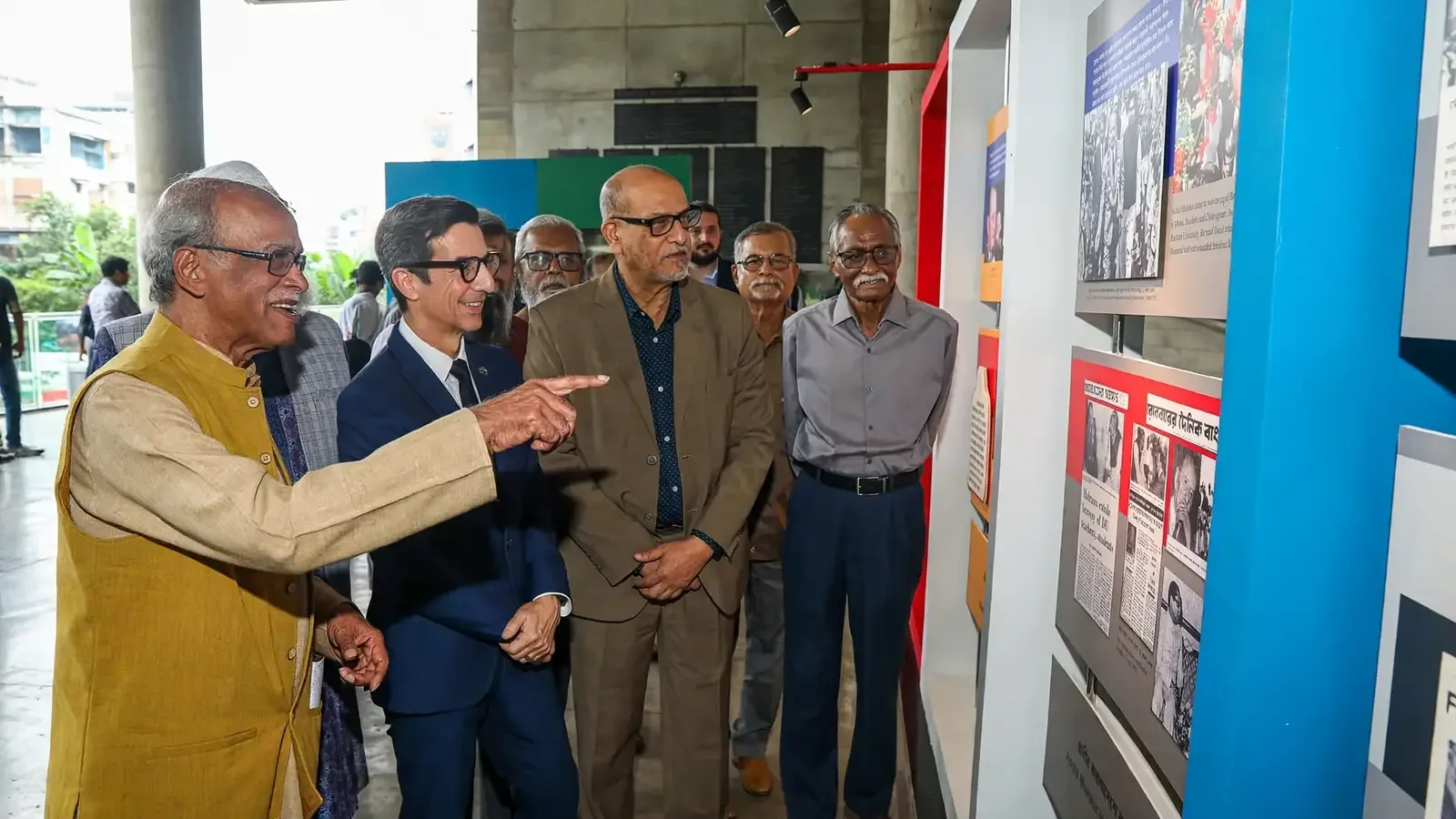
The exhibition was inaugurated at noon on Sunday in the museum lobby by Frédéric Inja, Deputy Head of Mission at the French Embassy. War-wounded freedom fighter Dr Amjad Hossain attended as special guest. Foreign diplomats, freedom fighters, cultural activists and young students from various educational institutions took part in the inaugural ceremony. The exhibition will remain open every day from 10 in the morning to 5 in the afternoon until 30 November.
A voice that spoke out for Bangladesh
When the Pakistani occupation forces were carrying out indiscriminate genocide, torture, mass rape and arson against the innocent people of Bangladesh in 1971, André Malraux was among the humanitarian voices in the outside world that protested most strongly. The French philosopher, writer, art theorist and France's first culture minister said in clear words: "This struggle of Bangladesh is not only for democracy, but a fight for existence. It needs armed resistance."
He was ready to fight himself
Malraux was 70 years old at the time. He did not stop at statements alone. Having fought on the front lines in the Spanish Civil War and in the Second World War for France, Malraux announced that he would form an international brigade and take part directly in Bangladesh's Liberation War. Because of his age, he was kept from joining the war. But he did not remain inactive. He wrote to President Nixon strongly criticising American policy on the Liberation War. He gave an interview to the famous Time magazine. In reply to a letter from the noted Bangladeshi writer and filmmaker Zahir Raihan, he reaffirmed his support for the Liberation War and expressed sympathy for the people. In this way, throughout the war, Malraux worked to build world opinion in favour of the Liberation War. After independence, at the invitation of the Bangladesh government, he visited the country on a four-day trip from 21 to 24 November 1973. He died on 23 November 1976.
A lasting bond of friendship
Frédéric Inja said, "The role Malraux played on behalf of the French people in Bangladesh's Liberation War created a lasting bond of friendship between Bangladesh and France. Today we remember him with respect. He did not think of Bangladesh's suffering as some distant political matter. Rather, he understood it as a fundamental question of human dignity and freedom. He expressed deep respect for the courage and endurance of the people of this country."
At the start of the inaugural ceremony, Liberation War Museum trustee Tropa Majumdar, who anchored the programme, gave a brief introduction to André Malraux and his role in the Liberation War. Liberation War Museum trustee Mofidul Haq also spoke at the ceremony.
It inspired us greatly
Amjad Hossain said, "We were young then. The invading soldiers were killing thousands of people. They were violating the honour of our mothers and sisters. Thousands of such incidents were happening every day. It was hard to accept. We went to the battlefield with our friends. Death was very close to us. A friend of mine was martyred in the war. I myself was seriously injured. The protest Malraux raised as a representative of the French people and the announcement he made about joining our Liberation War inspired us greatly."
Mofidul Haq said Malraux had played an extremely important role in building world opinion in favour of the Liberation War. After independence, during his visit to Bangladesh, he paid respects at the National Memorial, then under construction, and met war-wounded freedom fighters in hospital. He also visited Chattogram and Rajshahi. Through this exhibition, the young generation will be able to learn about the contribution of this true friend of Bangladesh in the Liberation War.
What the exhibition shows
Four display boards, in the blue-white-red of the French national flag and the red-green of the Bangladeshi national flag, have been arranged with photographs, newspaper cuttings and graphics. On entering, visitors will see on the eastern boards the role Malraux played during the Liberation War while living in France — his letter to US President Nixon, the cover and interview of Time magazine, and his reply to Zahir Raihan's letter, among many other items.
The western boards are arranged around Malraux's 1973 visit to Bangladesh — his reception at the airport, his paying respects at the memorial, his visits to war-wounded freedom fighters in hospital, and Rajshahi University conferring an honorary D-Litt on him, among many photographs and reports from local dailies of the time.
In the middle, on the southern side between the two rows of display boards, a documentary about him is being shown on an LED monitor. At the western end stands a large cut-out photograph. In hospital, a war-wounded freedom fighter was garlanding Malraux with flowers. Malraux put the garland back around the freedom fighter's neck and said, "Not me, you deserve this garland." When he had moved a little away, the injured freedom fighter rushed up with another garland and put it on Malraux. An emotional atmosphere was created then. Photographers captured the scene. Journalists reported Malraux's words.
Malraux said, "The significance of France is that it sent someone to shake hands with all these wounded people, and in return these hands brought flowers and flowers and flowers."