Study reveals systematic suppression of academic freedom in Bangladeshi universities between 2014 and 2025
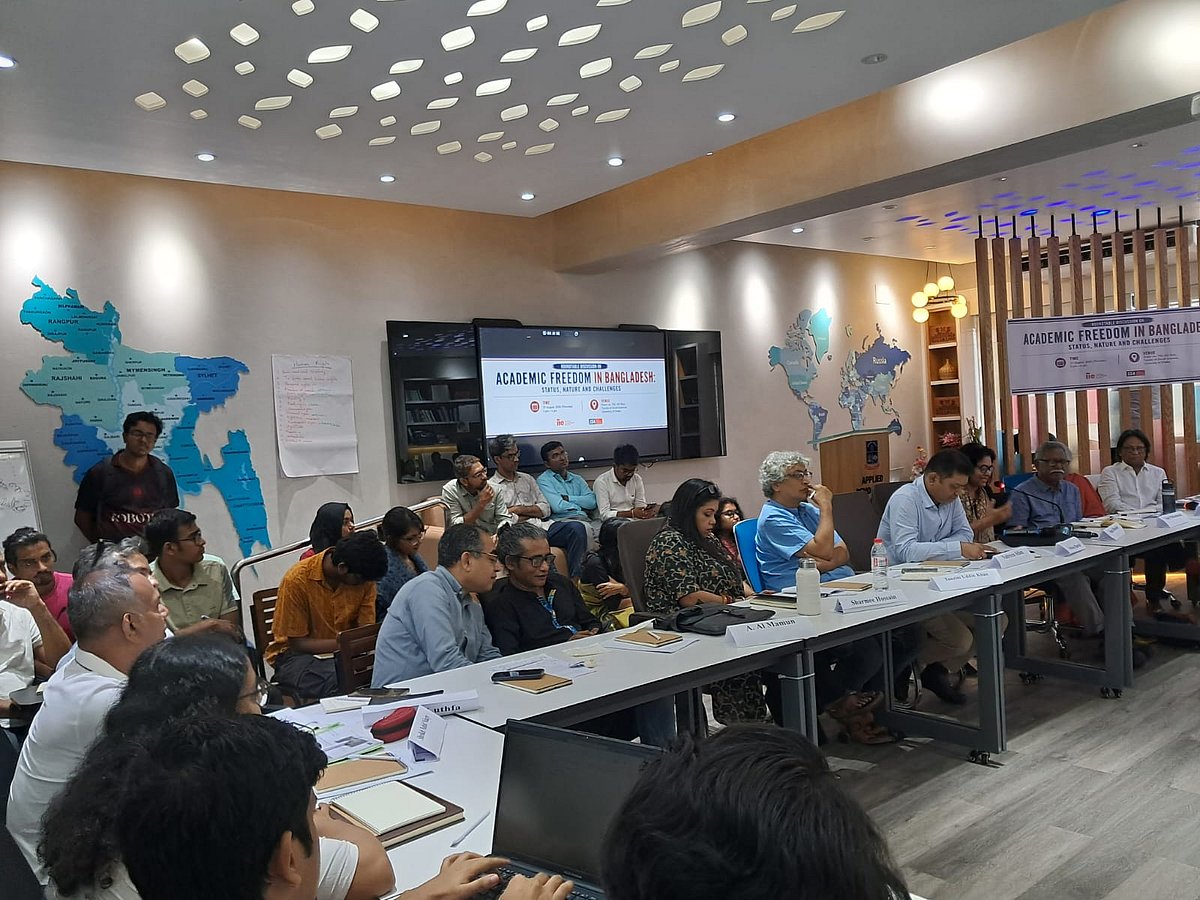
Photo Collected
A decade-long study has revealed that university educators in Bangladesh faced systematic persecution and a narrowing of academic freedom between 2014 and 2025. The findings, presented during a roundtable titled “Academic Freedom in Bangladesh: Status, Nature, and Challenges” at the University of Dhaka on Thursday, highlighted seven categories of oppression: extrajudicial killing, enforced disappearance, physical assault and harassment, arbitrary arrest, termination of employment, forced leave, and administrative intimidation.
The research, conducted by Professor Mohammad Tanzimuddin Khan of the Department of International Relations and Professor Samina Lutfar of the Department of Sociology at the University of Dhaka, examined how these repressive measures led to a dual response among faculty. While many chose self-censorship to avoid repercussions, a smaller group of critical scholars resisted by challenging power structures. The study noted that professional networking served as a vital survival mechanism, providing emotional, legal, and financial support to persecuted academics.
The roundtable, organized by IIE-The Power of International Education and the Social Scientists Association, featured five distinct research papers. Professor Anisur Rahman of Independent University and Professor A-Al Mamun of Rajshahi University argued that university regulations in Bangladesh have been transformed into tools for enforcing political loyalty rather than facilitating administration. They concluded that the lack of a formal definition for academic freedom has allowed political control over universities to intensify.
Further discourse focused on the systemic nature of these restrictions. Professor Mirza Taslima Sultana of Jahangirnagar University and Associate Professor Kazli Shehreen Islam of the University of Dhaka proposed the implementation of a restorative justice system to address the grievances of victimized faculty. They emphasized that public and private institutions are increasingly utilized by the state as ideological apparatuses to suppress dissent.
Critiquing the neoliberal shift in education, Professor Bakhtiar Ahmed of Independent University and Fahmidul Haque of Bard College argued that marketization and extreme administrative control have stifled research excellence. They noted that while faculty face immense pressure to produce research, the prevailing control mechanisms and lack of institutional funding force scholars to adhere to conventional, state-sanctioned research agendas, further eroding intellectual autonomy.
The scope of the challenges extends beyond Bangladesh, according to Professor Kazi Maruful Islam of the University of Dhaka, who presented a comparative study of student politics in South Asia. His research indicated that while student organizations in India, Nepal, Pakistan, Sri Lanka, and Bangladesh possess the capacity to influence national politics, they have frequently acted as agents that curtail academic freedom on campuses.
Reflecting on the state of the nation, former Jahangirnagar University professor Anu Muhammad characterized the current educational crisis as a convergence of authoritarianism and neoliberalism. He warned that academic freedom cannot exist in a vacuum when broader personal and political liberties are absent. Despite the climate of fear, participants emphasized that the intellectual struggle led by teachers and students remains essential for the future of society.
The session was chaired by Professor Gitiara Nasreen. The discussion included contributions from Supreme Court lawyers Sara Hossain and Jyotirmoy Barua, as well as various academic representatives and student leaders, who collectively underscored the urgent need to protect institutional integrity from ongoing political interference.
0%
0%
0%
0%
More News from Local