
Scholars warn of rising political polarization and right-wing dominance following Bangladesh July uprising

Photo Collected
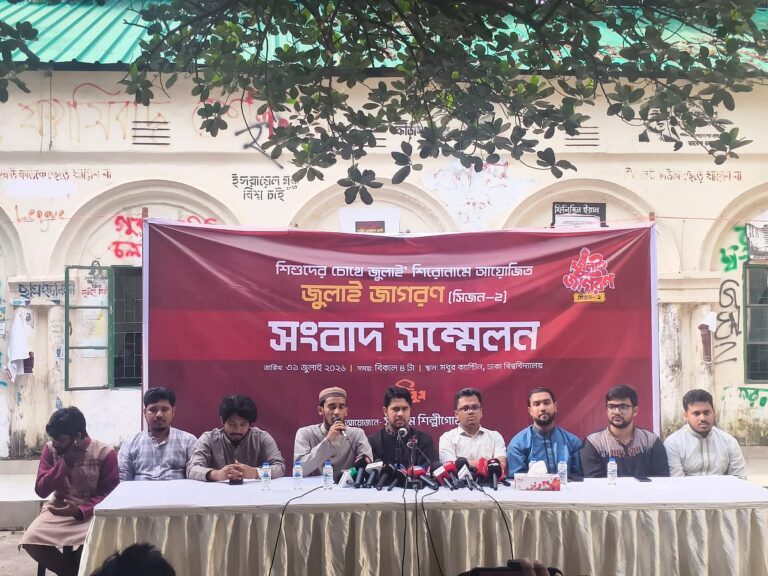
Academic experts and public intellectuals gathered at Dhaka University on Friday to assess the evolving political landscape following the July uprising, warning that the movement’s aspiration for an inclusive, non-discriminatory society is currently being undermined by rising sectarianism and a pronounced rightward shift in political discourse.
The seminar, titled “The Achievements of July, The Questions of July” and organized by the University Teachers’ Network, sought to reconcile the immediate success of toppling the autocratic regime of Sheikh Hasina with the subsequent challenges facing the nation. Speakers noted that while the uprising effectively ended state-sponsored enforced disappearances, extrajudicial killings, and media suppression, the political vacuum has fostered an environment of heightened intolerance and the near-total marginalization of liberal and left-wing voices.
New Age editor and president of the Editors’ Council, Nurul Kabir, argued that while the revolution achieved its primary objective of removing the autocracy, the post-uprising political momentum has been dominated by the Jamaat-e-Islami. He observed that due to a lack of organizational capacity among leftist factions, Jamaat successfully maneuvered to influence the movement’s trajectory and maintain sway within the interim government.
Presenting the keynote paper, Dhaka University professor Kazi Maruful Islam asserted that the current political culture has become increasingly narrow. He warned that political competition has devolved into a race to capture right-wing support, with mainstream parties like the BNP largely refraining from challenging this trend due to their own voter bases. The paper characterized this shift as a negative development for the country’s democratic project, noting that institutional accountability efforts have stalled.
Despite these criticisms, participants cautioned against labeling the July movement a failure. The keynote recommended five strategic priorities: moving reform discussions from elite negotiations into the public sphere, transforming fragmented resistance into sustainable organizations, reclaiming political discourse from sectarianism, rebuilding accountability institutions, and shifting toward a moral economy.
Several speakers highlighted a burgeoning “cultural war” in the aftermath of the revolution. Independent University, Bangladesh professor Ahmad Mostafa Kamal suggested that the true success of the movement would only be measurable in two decades, contingent upon whether the nation has permanently dismantled the foundations of fascism. He expressed concern over the active participation of extremist groups in the current societal friction.
Other contributors, including Dhaka University professor Samina Lutfah and Ganosamhati Andolan leader Firoz Ahmed, emphasized the need for a critical analysis of the post-uprising era. Ahmed reflected on how progressive forces were previously trapped by the binary political divisions of the Awami League era, which hindered the formation of a unified democratic front against fascism.
The event, moderated by Bard College lecturer Fahmidul Haq, also featured voices from student coordinators and various academic experts, who collectively expressed concern over instances of mob violence. They warned that unless the nation fosters a culture of justice and moves past the cycle of retaliatory politics, the revolutionary spirit risks being squandered, potentially allowing old patterns of oppression to resurface.
0%
0%
0%
0%