
Professor Salimullah Khan calls for deep historical analysis to navigate Bangladesh post-July uprising
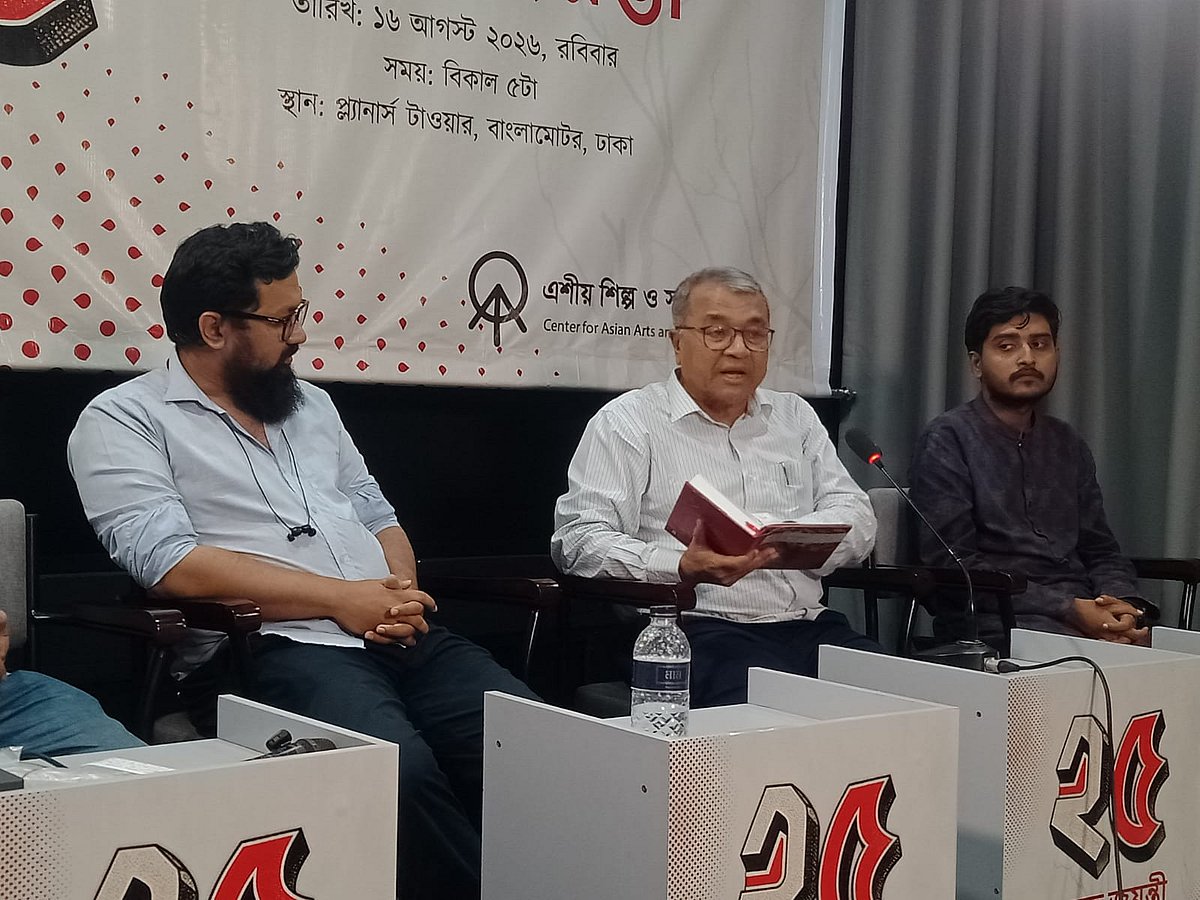
Photo Collected
Writer and professor Salimullah Khan has stated that Bangladesh currently lacks a predefined roadmap for its future following the mass uprising in July. Emphasizing the risk of repeating historical mistakes by failing to learn from the past, Khan argued that understanding the July movement requires a comprehensive examination of history beyond the events of 2024, including the political and intellectual evolution of Bengali Muslims, the 1947 Partition, the anti-British movement, and the long struggle for language and culture.
Khan made these remarks on Sunday during a seminar held at the Planners Tower in Dhaka’s Banglamotor area. The event, which included a reunion and open discussion, was organized by the Asian Art and Culture Society (AACS) to mark its silver jubilee.
Addressing the current political climate, Khan cautioned against relying solely on surface-level observations. Drawing a parallel to scientific inquiry, he suggested that reality often exists beyond what is immediately visible. Referring to the Spanish poet Antonio Machado, Khan noted that paths are not predetermined but are created through the act of walking. He asserted that Bangladesh is currently at a juncture where, regardless of the July events, the way forward must be navigated and evaluated retrospectively.
Khan further identified the need to revisit the 1920s “Movement for Freedom of Intellect” to understand Bangladesh’s intellectual trajectory. He argued that while intellectuals of that era viewed knowledge as the primary condition for liberation, their perspectives were limited by contemporary debates on religion, society, and the identity of Bengali Muslims—tensions he believes persist today. He criticized the current trend of intellectuals aligning with rigid political or ideological factions, which he says prevents critical engagement with broader perspectives.
On the subject of national identity, Khan advocated for a re-evaluation of poet Kazi Nazrul Islam, citing his unique ability to command respect across both Hindu and Muslim communities. Utilizing Antonio Gramsci’s concept of “hegemony,” Khan explained that such cultural leadership is built through public trust rather than coercion.
The professor also raised concerns regarding the state of higher education, arguing that universities have become overly focused on admissions, examinations, and rankings at the expense of genuine intellectual pursuit. He suggested that significant knowledge often develops outside institutional walls and urged academia to practice self-reflection.
Researcher and writer Sahul Ahmed echoed the need for a fresh review of Bangladesh’s history, noting that the nature of political movements has shifted over the last decade. He observed that the transition from party-led politics to coordinator-based, spontaneous, and internet-driven mobilization has created new political spaces.
Journalist and researcher Tahmidal Jami added that the role of an intellectual is not to impose a single narrative, but to interpret and articulate the diverse aspirations of the groups involved in the uprising. He pointed to a current lack of such interpretation and urged intellectuals to systematically organize and analyze the experiences of the July movement.
In his welcome address, AACS President Zahirul Islam reaffirmed the organization’s 25-year commitment to fostering a space where no ideology or individual is considered beyond critique. He stated that the responsibility of intellectuals in uncertain times is to provide a “map” that helps society understand the relationship between current events and broader historical realities. Journalist Minhajul Islam also participated in the discussion.
0%
0%
0%
0%
More News from Local