



PM Targets Tech-Driven, Citizen-Friendly Land Management
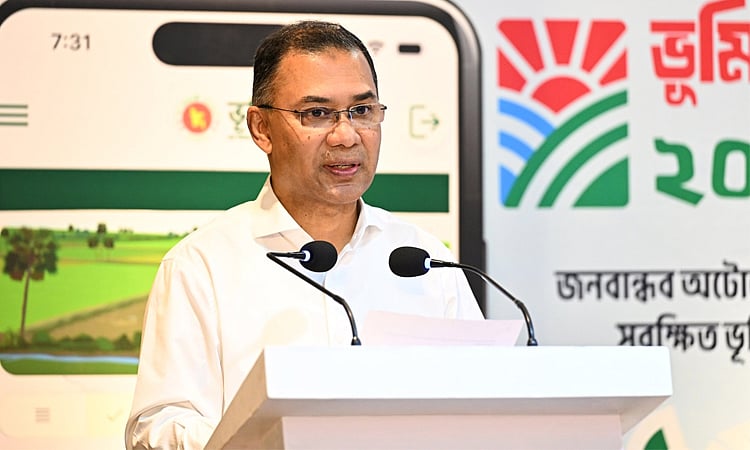
Photo Collected
Prime Minister Tarek Rahman on Tuesday underscored the critical need for transparent, accountable, and citizen-friendly land management to establish a just and modern state system in the country. He made the remarks while inaugurating the ‘Land Service Fair-2026’ at the Land Building in Tejgaon, Dhaka.
The Prime Minister asserted that providing services is not a favour but rather a fundamental duty of the government to ensure public welfare. He outlined the administration’s goal to create a corruption-free, harassment-free, technology-driven, and citizen-centric land management system, which he believes will significantly accelerate the nation’s sustainable development.
বিজ্ঞাপন
Rahman noted the evolving complexity of land ownership over time. He explained that a parcel of land once owned by a single individual a century ago might now be divided among a hundred or more co-owners, thereby escalating the responsibility of land officials to accurately record these fragmented ownerships.
He acknowledged the public’s familiarity with common land terms such as ownership, tax (khajna), deeds (dalil), ledgers (khatiyan), plot numbers (dag), extracts (porcha), mutation (namjari), amalgamation/separation (jama-khariz), administrative units (mouza), and various survey records (CS, RS, DS). Historically, citizens had to visit land offices to update their ownership records, but technological advancements have now modernized land management.
বিজ্ঞাপন
The Prime Minister stated that a more modern and technology-dependent land management system would simplify the resolution of land-related disputes. He highlighted that ensuring online facilities for land management would largely mitigate public suffering and reduce the influence of middlemen in land offices. He added that the ongoing Land Service Fair aims to further educate the public about their responsibilities regarding modern land management.
Rahman observed that as the country’s population grows, per capita land availability diminishes, leading to an increase in land’s economic value as well as a rise in land-related disputes, lawsuits, and complexities. He noted that these conflicts often disrupt individual and family peace, besides impeding national development initiatives. In this context, he emphasized that planned land use, accurate record keeping, and efficient management are indispensable demands of the current era.
The Prime Minister affirmed that the Land Ministry is diligently working to prepare accurate land records through advanced surveying technologies. He mentioned that nearly all land administration services are being brought under a digital platform to make service delivery easier, faster, and more effective for citizens.
“Our goal is to build a land management system where people will no longer have to wander from office to office unnecessarily to receive land services, nor will they be subjected to corruption or harassment,” Rahman stated.
He recalled that the government’s commitment to modernizing land management and assisting the public with land-related issues was outlined in its 31-point agenda, formulated several years before the national elections, and reiterated in its latest election manifesto. Rahman announced that the government has fulfilled another electoral promise by launching the three-day nationwide Land Service Fair.
The Prime Minister said that the government is progressively advancing a style of politics focused on fulfilling promises made to the people, systematically implementing each point of its election manifesto. He added that the government aims to remain accountable to the public not just in land matters but across all sectors through pro-people initiatives. Rahman asserted that after prolonged periods where public rights were reportedly stifled, the populace now seeks a reflection of their rights in state and politics, which is why the current government has focused on implementing its electoral manifesto and “July Charter” from its first week in office.
Rahman highlighted that over 4.7 million civil and criminal cases are pending in various courts across the country, with land-related cases constituting a significant portion. He stressed that a primary government priority is the expeditious resolution of these pending cases. However, he also emphasized the urgent need to strengthen alternative dispute resolution (ADR) mechanisms, such as village courts and other legal avenues for land dispute settlement, outside conventional courts. This approach, he suggested, would not only reduce resolution time but also prevent conflicts from escalating into animosity.
Recalling Albert Einstein’s profound quote, “Peace cannot be kept by force; it can only be achieved by understanding,” Rahman applied this to land disputes. He proposed that if land-related or civil cases are progressively resolved through mediation, negotiation, and arbitration as alternative dispute resolution methods, it would simultaneously reduce the backlog in courts and facilitate quicker settlement of land disputes.
The Prime Minister reiterated that land is not merely a piece of property but a source of security, reliability, economic stability, livelihood, and a foundation for the future. It is with this understanding, he said, that the current government is working to deliver state services to the public’s doorstep with a pledge to make land management harassment and corruption-free.
Rahman concluded by expressing confidence that the land fairs, commencing today in all districts and sub-districts nationwide, will undoubtedly benefit the public. He noted that the fairs offer facilities for e-mutation, online land development tax payments, record correction, ledger access, and resolution of any land-related complaints.
0%
0%
0%
0%