
Netrokona Medical College faces infrastructure and clinical training crisis eight years after inception
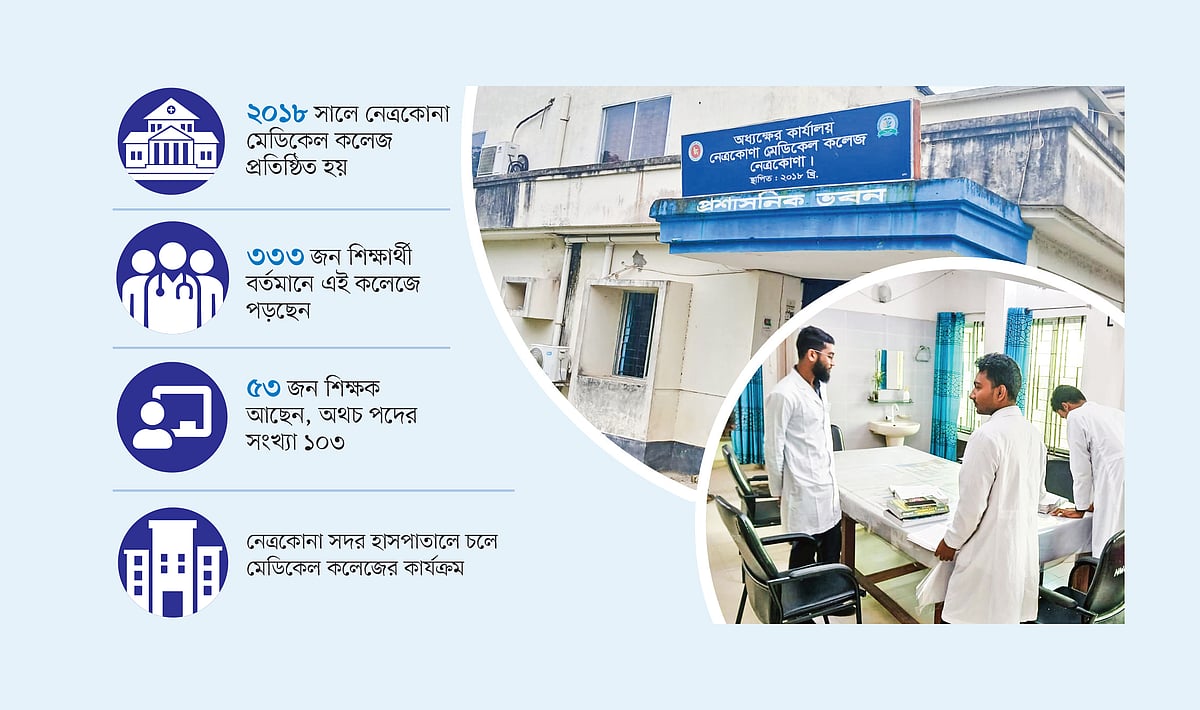
Photo Collected
Eight years after its inception, Netrokona Medical College remains in a state of institutional limbo, struggling with a lack of a permanent campus, severe faculty shortages, and inadequate clinical training facilities. Despite successfully graduating its first cohort of physicians, the institution continues to operate out of cramped, temporary infrastructure adjacent to the 250-bed Netrokona Sadar Hospital, leaving the future of its 333 current students in uncertainty.
The college’s inability to secure a permanent home stems from a series of stalled administrative initiatives. A 2019 proposal to establish a comprehensive campus, including a 500-bed hospital and nursing college in the Mouze-Bali area, failed to gain project approval from the health directorate. Subsequent plans to carve out space from a nearby university project also collapsed following the political transition in August 2024, when the university administration officially objected to the land transfer.
The lack of permanent facilities has created a cascading effect on academic quality. Students currently occupy four temporary buildings covering roughly 19,000 square feet, which include limited lecture space and a library restricted to a 20-seat capacity. Housing remains a significant burden, with students forced to rely on hospital quarters or private rentals due to the absence of dedicated, permanent dormitories.
Experts and local stakeholders have raised alarms regarding the quality of clinical training, which is fundamentally tethered to the constraints of the local Sadar Hospital. With the hospital suffering from a 50% vacancy rate among its medical staff and lacking essential units such as Intensive Care (ICU) and Cardiac Care (CCU), students are exposed to a limited range of medical cases. Educators emphasize that medical proficiency requires hands-on experience in diagnosis, complex surgery, and patient history—opportunities that are currently severely restricted by the hospital’s operational shortcomings.
Faculty members are equally strained, as they are tasked with managing multiple student cohorts, theory classes, and practical examinations with a severely depleted workforce. Of the 103 sanctioned teaching positions, only 53 are filled. Professors note that the disproportionate workload, compared to the staffing standards of established institutions, places immense pressure on the remaining faculty and risks compromising the depth of instruction.
While college principal Mohammad Saiful Hasan maintains that the administration is maximizing existing resources to ensure educational continuity, critics warn that the status quo is unsustainable. Local observers, including veterans and civil society members, have argued that failing to resolve these infrastructure and staffing gaps risks producing under-trained physicians, ultimately degrading the standard of healthcare available to the local population. As of July, public protests have intensified, with citizens demanding immediate government intervention to finalize a site and invest in a permanent campus that meets modern medical education standards.
0%
0%
0%
0%