


Landslides in Southeastern Bangladesh Claim 29 Lives Amid Warnings of Systemic Failure
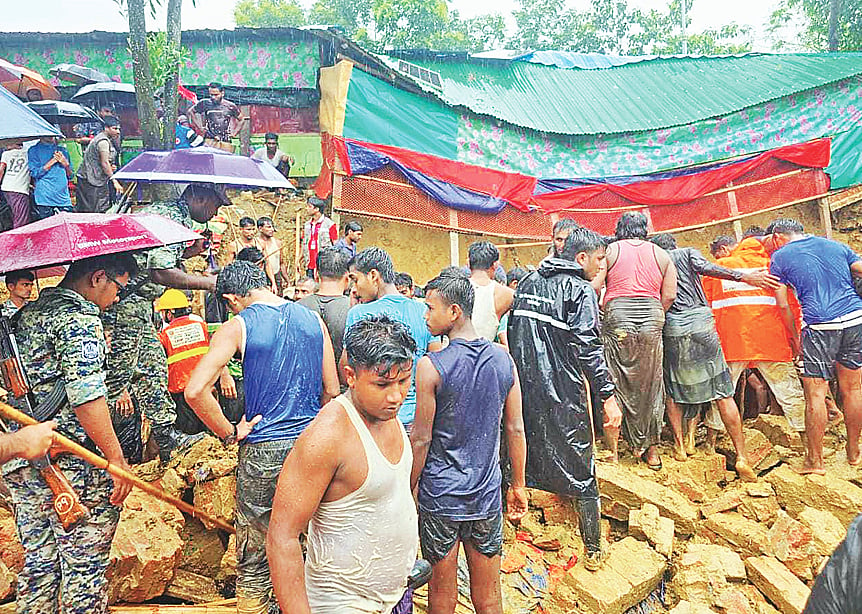
Photo Collected
At least 29 people, including 14 children, have died in a series of devastating landslides across four districts in southeastern Bangladesh following days of relentless torrential rain. The victims were largely concentrated in precarious settlements carved into the slopes of hills in Cox’s Bazar, Bandarban, Chittagong, and Rangamati, despite prior warnings issued by the national meteorological department.
Cox’s Bazar suffered the highest toll with 19 fatalities, 13 of whom were residents of Rohingya refugee camps. According to the United Nations Refugee Agency (UNHCR), persistent rainfall between July 4 and July 9 triggered 95 landslides within the refugee settlements, leaving over 4,000 people homeless and affecting more than 26,000 others. Officials report that approximately 80 percent of the housing within the 33 camps in Ukhiya and Teknaf is situated on steep or unstable terrain.
While local authorities stated that public announcements were made urging residents in high-risk areas to relocate to shelters, environmental experts contend that these reactive measures are insufficient. Mohammad Kamal Hossain, a professor at the Institute of Forestry and Environmental Sciences at the University of Chittagong, emphasized that disaster management cannot be limited to broadcasting warnings once rain begins. He argued that preventing such loss of life requires a systematic, year-round approach involving the permanent relocation of vulnerable families, reforestation efforts, and the strict protection of hillside environments.
The recurring nature of these disasters has prompted questions regarding the lack of long-term planning. Historical data shows that despite major landslides in 2007 and 2017—which claimed hundreds of lives and led to the formation of investigative committees recommending comprehensive reforms—the situation remains dire. Official figures in Chittagong indicate that the number of illegal, high-risk households situated on hills has ballooned from 666 in 2014 to over 6,500 today.
Disaster management experts, including Gohar Naeem Wara, argue that administrative inaction is a primary driver of the tragedy. While government bodies possess the legal and administrative mandate to conduct forced evacuations, experts suggest that field-level hesitation and a lack of political resolve have prevented the implementation of permanent solutions. Current management often fails to address the root causes of slope instability, such as illegal land clearing, deforestation, and the disruption of natural drainage systems, which leave hillsides increasingly susceptible to collapse during the monsoon season.
Moving forward, officials and environmentalists alike stress that managing landslide risks must transition from a seasonal emergency response to an integrated structural policy. This includes maintaining updated surveys of high-risk populations, enforcing strict anti-encroachment laws, and prioritizing the rehabilitation of displaced families to ensure that the hillsides are not only protected but that the communities living upon them are no longer in the path of inevitable, preventable disasters.
0%
0%
0%
0%