

Khulna is in crisis due to reduction of reservoirs and green areas, waterlogging in monsoons, water does not rise in summers
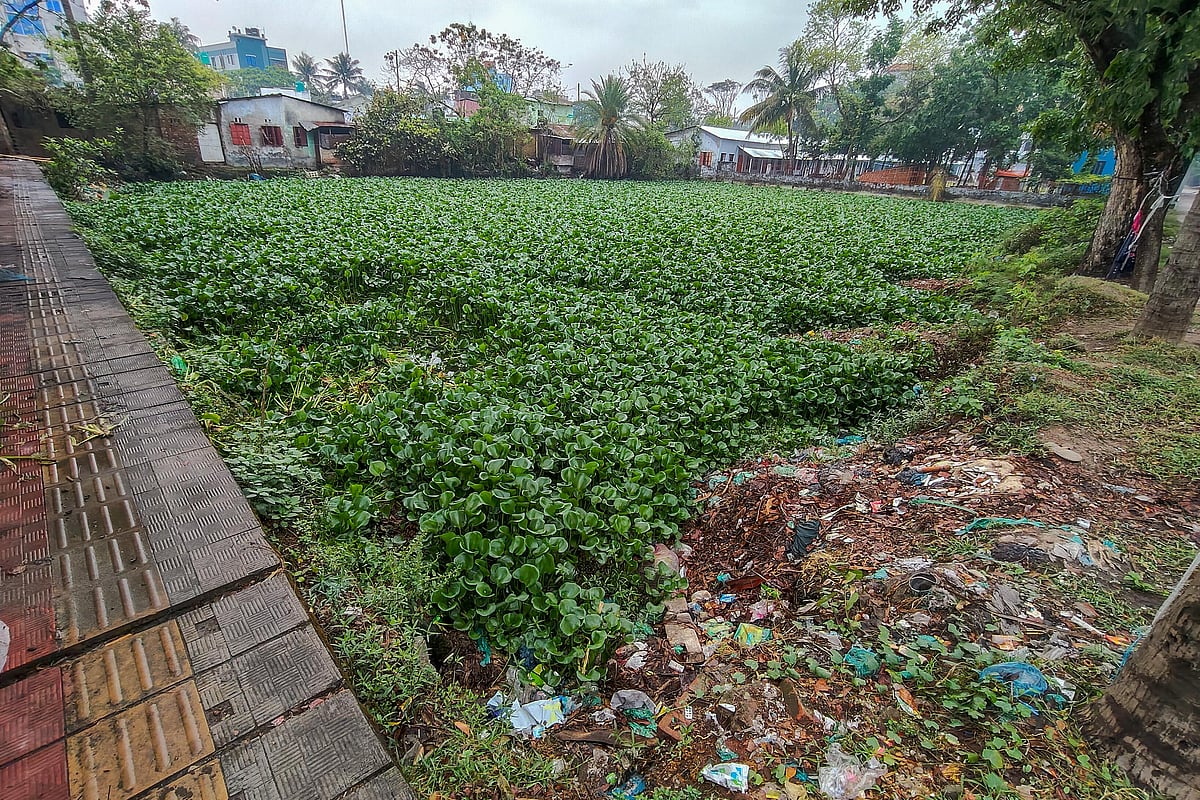
Photo Collected
Royal Mor is one of the heart centers of Khulna city. Around big educational institutions, residential hotels, hospitals, children’s parks – all are always crowded. Behind this busy cityscape hides a lost history—this area was once home to several large ponds, wetlands and open green spaces. The memories of those ponds are still alive among the old people of the city.
Even in the memory of the former treasurer of Khulna University, Mohammad Mazharul Hannan, many ponds in the city are still fresh. He was recalling his childhood memories and said, “There were ponds and ponds in Khulna.” We never showered at home. Sometimes in this pond, sometimes in that pond. There was a big pond right next to the United Nations Children’s Park near the Royal Cross. wire pool We swam, fished. Inter school swimming competition was held in that pond. There was a big pond next to the lion’s field in Sheikhpara. We used to play and jump there. Next to the synagogue is the Golcomani Park, which fills a large pond. Within the PTI, there was a large pool within the City Law College. Nothing could be retained.
বিজ্ঞাপন
In various wards of Khulna Nagar like Royal Mor, hundreds more such ponds, ponds, ponds have been lost. Instead, there are multi-storied buildings, shops, cinema halls, bus stands, residential projects.
Residents of the city say that waterlogging is occurring in Khulna with little rain due to the reduction of reservoirs. About 50 percent of the city faces water shortages during the dry season. According to Khulna Wasa data, the groundwater level is dropping by an average of 6 inches every year. Information from the Meteorological Office says that the maximum temperature in Khulna is increasing every year in the last 10 years.
বিজ্ঞাপন
The loss of reservoirs and green spaces is an important factor behind water scarcity and rising temperatures, researchers said. Professor Abdullah Harun Chowdhury of Khulna University’s environmental science discipline told Prothom Alo that the temperature of the city is continuously increasing due to the reduction of reservoirs and greenery and the duration of extreme heat is also getting longer. Apart from this, the underground water level in the city is also going down. As a result, most of the tube wells do not produce water in summer season, which is creating a new crisis for the city dwellers.
Researcher Mahbub Siddiqui, in his book Extinct Dighi-Pushkarini-Jalshay in Bangladesh, has presented information about hundreds of lost water bodies at 80 places in Khulna. On the other hand, Abul Kalam Samsuddin mentions in his book Adi-Parva of Khulna, once the type of settlement in the city was different – each family would build a settlement with pond, garden, open space.
In the initiative of the environmental organization Bangladesh Environmental Law Society (BELA), the data of 171 ponds in 31 wards of Khulna was collected in 2024. Mahfuzur Rahman, Khulna divisional coordinator of the organization, said that there were at least nine big ponds in the modern Khulna railway station area. Now there are railway lines and urban infrastructure. Many ponds, including the Golam Mawlar Pond on KDA Avenue, are now replaced by wide roads and high-rise commercial buildings. The main academic building of Khulna Collegiate School stands on the former Mariampara pond. Sangeeta cinema hall on the pond of Sheikhpara Mor, Hotel Royal is built on the pond of Anant Mallick. Many ponds are still neglected, some have turned into garbage dumps.
Chief Planning Officer of Khulna City Corporation. Abir ul Jabbar said there were about 3,600 public and private water bodies in 2012 when the master plan was made. Private ponds are almost all filled up. Now 18 government or institutional pond conservation and beautification plans have been taken, design work has been completed.
The Khulna Development Authority’s (KDA) latest survey of the reservoir was completed in 2025. The survey shows the current status of the water bodies identified in the Detailed Area Plan (DAP) map.
According to KDA data, the DAP map had 298 water bodies in 31 wards of the city. Of these, 80 water bodies have completely disappeared. 27 reservoirs are partially filled. The rest are fragile but somehow survive.
Ward-wise analysis of KDA data shows that among the 31 wards of the city, 1, 2, 3, 6, 9, 14, 16 and 17 each had a minimum of 15 to a maximum of 33 reservoirs. Some of the 31 wards are overcrowded. For example, there were once 19 ponds in Chota Boyra and Baniakhamar Mauza in Ward No. 17. Now there are seven. 13 have been fully and partially filled. In wards 13, 15, 18 and 24, the number of filled water bodies is more than the surviving water bodies.
KDA’s urban planner Tanveer Ahmed told Prothom Alo that a letter has been given to the relevant departments including the City Corporation to take necessary measures and effective initiatives to preserve the remaining water bodies in the interest of sustainable urban development, environmental protection and waterlogging relief.
The Environment Conservation Act, 1995 (Amended 2010) and the ‘Metropolis, Divisional Town, District Town Municipal Area and All Municipal Area Playgrounds, Open Spaces, Parks and Natural Reservoirs Conservation Act (2000) state that filling of ponds, ponds, ponds or any natural water bodies is prohibited and is a punishable offense under law. Despite the fact that the law was in place, the implementation on the ground was weak, a long-standing complaint.
According to the information of the Khulna divisional office of the Department of Environment, there is no complete account of how many reservoirs have been filled in Khulna so far. However, so far there is only one case of water reservoir filling. The case was filed in 2015 over an attempt to fill the 700-year-old Khanjahan Ali Dighi in Mujgunni area of the city.
Director of the departmental office of the Department of Environment, Md. Khondkar. Fazlul Haque said, “Filling of reservoirs is a big crime, many people still don’t know it. If we get a complaint, we close it. A lot of time is filled with secrets. These news do not come to us. But now surveillance has been increased. We will try to take action as soon as we get the news.
Bangladesh Environment Movement (Bapa) Khulna Coordinator Md. Babul Howladar said, there is lack of coordination between KDA, KCC, district administration and environment department. Due to this lack of coordination, negligence and in many cases silence of government departments, one reservoir after another has been filled.
Recently, visiting various places including Nirala Dighi, Bhagir Dighi, Lions School Pond, New Bazar, Andir Pond, Bastuhara Park Pond, Pabla area ponds, in some places the bank is collapsing, in some places it is partially filled, in some places the pressure of encroachment, and in some places the existence of water is covered with waste water.
Abu Saeed, a resident of Bhagir Dighi area, said that the people of the area used to bathe here once. Now there is a lawsuit going on about the ownership. The bank has been occupied. And in Kachuripana it is now a mosquito factory.
On March 28, the 90-year-old pond adjacent to the Pabla Madhya Para Mosque was being filled in the dark of night. The filling was stopped after the intervention of the Environment Department when local residents complained.
In recent years, little rain has caused flooding in the city. Abdul Alim, a resident of Ward No. 9, said that about 70 percent of Boyra, Muzgunni, Bastuhara and Daulatpur areas were once swamps. Now they have been filled with housing projects. As a result, waterlogging occurs with little rain. Again during the dry season water shortage occurs in about 50 percent of the area.
According to the information of Khulna Wasa, even 10 years ago, water could be drawn through tube wells at a depth of 120 to 125 feet in the city. Currently that level has come down to 130 to 135 feet. The water level is dropping by an average of about six inches per year.
Khulna University, KUET and other studies on groundwater show that Khulna has three layers of groundwater or aquifers. The first layer of water has already become unusable due to high levels of salt, iron and arsenic. The second layer also has limited use due to high salinity. On the other hand, as it is not possible to draw third level water through tube wells, residents are forced to use submersible pumps. This crisis becomes more acute during the dry season. Again, WASA draws more than half of its customer’s water from underground.
Sardar Shariful Islam, Deputy Director of Divisional Environment Directorate Office, Khulna, told Prothom Alo that due to the reduction of reservoirs, more underground water has to be extracted. In this, the underground space is being filled with salt water. It also increases the amount of salinity. It is becoming a matter of dire risk.
The impact of losing ponds and wetlands is not limited to water management, but also increasing urban temperatures. In the last 10 years, the maximum temperature in Khulna has increased from 10.6 to 10.7 degrees Celsius every year.
According to Khulna Meteorological Department, the highest temperature in 2015 was 36 degrees Celsius in May, which increased to 41.8 degrees in April 2024. During this period, 36.3 degrees Celsius was recorded in April 2016, 35.9 degrees Celsius in May 2017, 33.8 degrees Celsius in April 2018, 36.2 degrees Celsius in May 2019, 34.4 degrees Celsius in April 2020, 36.4 degrees Celsius in 2021, 35.2 degrees Celsius in 2022 and 36.7 degrees Celsius in 2023. However, in 2024, the temperature will jump to 41.8 degrees.
The study titled ‘Urbanization-induced Heatwave Risk Assessment of Khulna City: A 30-Year Analysis of Land-Surface Temperature, Climate Trends and Forecasts’ found that the average land temperature increased by about 7 degrees Celsius over the 30 years from 1993 to 2023. Almost one-fourth area of Khulna Nagar is now overheated. Most of the city is now filled with buildings, roads, concrete. The construction area has increased by about 44 percent in the last 30 years. About 38 percent of vegetation has declined.
Dhiman Kumar Roy, a member of the research team and head of the Department of Geology and Mining at Barisal University, said that this trend of land use change is directly related to the increase in temperature in the city. Khulna may become a high heat risk city in the future if effective steps are not taken now to increase vegetation and green areas in the city, conserve and restore water bodies.
Source: Prothom Alo Bangla
0%
0%
0%
0%


