Inside the final hours of Hasina’s fall: How the state machinery crumbled and the cabinet was left behind

The ousting of Sheikh Hasina on August 5, 2024, was not the result of a single, isolated decision, but the culmination of a rapidly deteriorating security environment and internal policy paralysis that gripped the ruling administration during its final days. While the student-led uprising had been building momentum since July, it was the collapse of the state’s coercive apparatus and a critical shift in military posture that ultimately rendered Hasina’s position untenable.
The turning point emerged on August 3, when Army Chief General Waker-Uz-Zaman convened a meeting at Army Headquarters. According to sources familiar with the proceedings, the military leadership made it clear that they would not deploy lethal force against protesters. Military officials reportedly conveyed that the weaponry at their disposal—including armor capable of causing mass casualties—was ill-suited for domestic crowd control, and the military would not stand against the will of the public.
By the night of August 4, military leaders concluded that Hasina’s government could not survive. Despite this, the atmosphere inside the Gonobhaban remained chaotic. Hasina, frequently in the company of her sister Sheikh Rehana, engaged in a series of desperate, late-night meetings with cabinet ministers and security chiefs to weigh options ranging from emergency rule to armed suppression. Sources indicate that during these discussions, General Waker-Uz-Zaman advised the Prime Minister that time had run out and urged her to seek a political solution.
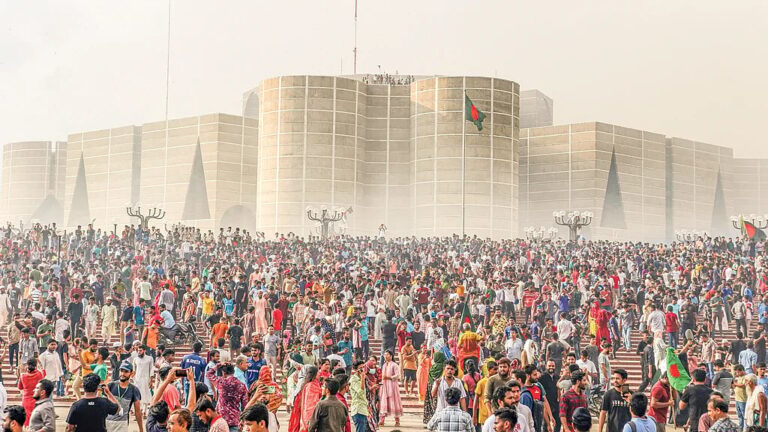
The final collapse began on the morning of August 5, as massive columns of protesters surged toward the capital from areas including Uttara, Jatrabari, and Savar. Faced with the reality that her government was losing control of the streets, Hasina prepared for departure. According to international reports and official accounts, she requested urgent clearance from the Indian government to seek temporary refuge.
The decision to resign was finalized following intense consultations between military top brass and Hasina’s son, Sajeeb Wazed Joy. Military officials communicated to Joy that immediate resignation was the only path to ensuring his mother’s safety as the protests reached the gates of the seat of power. By early afternoon, Hasina and Sheikh Rehana departed the Gonobhaban by helicopter, eventually boarding a military transport aircraft. She landed at Hindon Air Force Station near New Delhi, where she was met by Indian National Security Adviser Ajit Doval.
The sudden nature of her departure left the Awami League leadership in total disarray. Many ministers, lawmakers, and party officials remained unaware of the final plan until the Prime Minister’s flight was already airborne. Throughout the day, cabinet members had vacillated between the belief that the state would impose emergency measures and the encroaching reality of their own vulnerability. As the protesters breached government buildings, many party figures fled to hiding spots or sought protection from the military.
The downfall underscored a profound disconnect between the ruling elite and the national crisis. Even as diplomatic channels were reportedly exploring a transition of power through the Speaker of Parliament, internal indecision prevented any coherent strategy from taking root. Ultimately, the regime’s reliance on force, combined with a persistent refusal to acknowledge the scale of public opposition, led to an abrupt and chaotic end to Hasina’s tenure, leaving her administration to collapse under the weight of its own isolation.
0%
0%
0%
0%