Indigenous leaders demand constitutional recognition and land rights at International Day of the World Indigenous Peoples rally in Dhaka
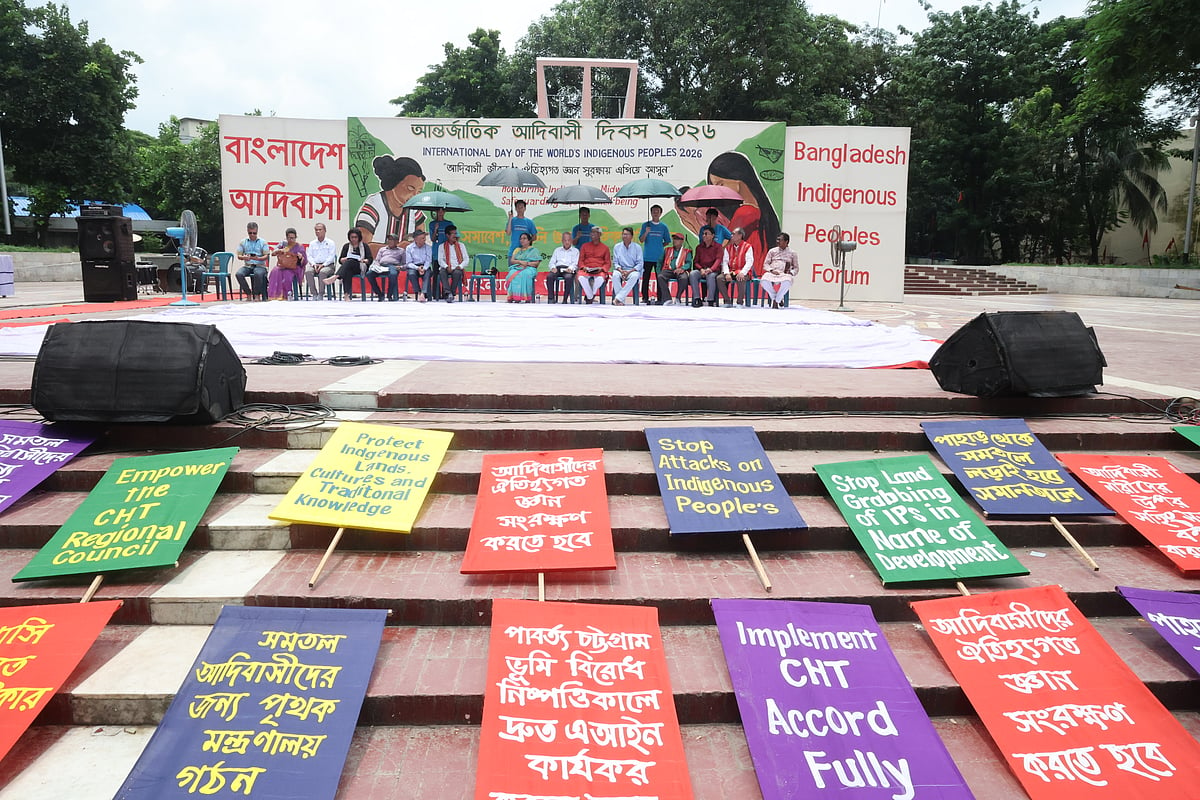
Photo Collected
DHAKA — Human rights activists, civil society representatives, and political leaders gathered at the Central Shaheed Minar in Dhaka on Sunday to mark International Day of the World’s Indigenous Peoples 2026, condemning the persistent lack of constitutional recognition, land rights, and fundamental protections for indigenous communities in Bangladesh. Speakers at the event, organized by the Bangladesh Indigenous Peoples Forum, asserted that despite changes in government, indigenous populations continue to face systemic discrimination, land grabbing, and an environment of impunity in both the hill tracts and the plains.
Khushi Kabir, coordinator of the organization Nijera Kori, emphasized that indigenous communities remain marginalized under successive administrations. She highlighted that indigenous individuals often struggle to reclaim their land even after court victories, as their holdings remain unregistered in government records. Furthermore, she pointed out that National Identity cards frequently fail to accurately reflect their indigenous heritage, undermining their identity as citizens.
Transparency International Bangladesh (TIB) Executive Director Iftekharuzzaman addressed the long-standing impasse regarding the Chittagong Hill Tracts (CHT) Peace Accord. He urged the government to establish a concrete roadmap for the full implementation of the accord, noting that many of its core provisions remain ineffective. Dr. Iftekharuzzaman further advocated for the direct involvement of the military in the peace process to restore public trust and called for the immediate activation of the Land Commission to address territorial grievances.
Supreme Court lawyer Sara Hossain highlighted the culture of impunity, citing the lack of justice in long-standing cases, including the abduction of Kalpana Chakma. She criticized the reduction of quotas for indigenous groups to one percent, labeling it unreasonable, and called for the restoration of quotas in education and employment to ensure adequate representation.
Ushatan Talukdar, vice-president of the Parbatya Chattagram Jana Samhati Samiti, lamented the state’s refusal to officially recognize these communities as “indigenous,” describing it as a continuation of colonial-era exclusionary politics. Other speakers, including writer and journalist Sohrab Hassan and Manusher Jonno Foundation Executive Director Shaheen Anam, echoed these sentiments, asserting that the absence of indigenous rights reflects a failure to uphold the democratic values and human rights the nation claims to champion.
The event concluded with the presentation of an eight-point demand charter. The primary demands include full constitutional recognition for indigenous peoples, the time-bound implementation of the CHT Peace Accord, the establishment of a separate ministry and land commission for indigenous communities in the plains, and the withdrawal of all false cases filed against indigenous activists.
Furthermore, participants demanded that the government officially celebrate the International Day of the World’s Indigenous Peoples, protect indigenous populations from hate speech and misinformation, ratify relevant United Nations declarations and International Labour Organization (ILO) conventions, and reinstate a five-percent quota in public service and educational institutions.
The protest, which featured participants from across the country dressed in traditional attire, included a rally and a cultural program. Demonstrators displayed placards calling for the protection of their ancestral lands, the end of judicial harassment, and the urgent reform of land management policies to safeguard their heritage.
0%
0%
0%
0%