Experts call for integrated referral system to ensure safety of journalists and human rights defenders in Bangladesh
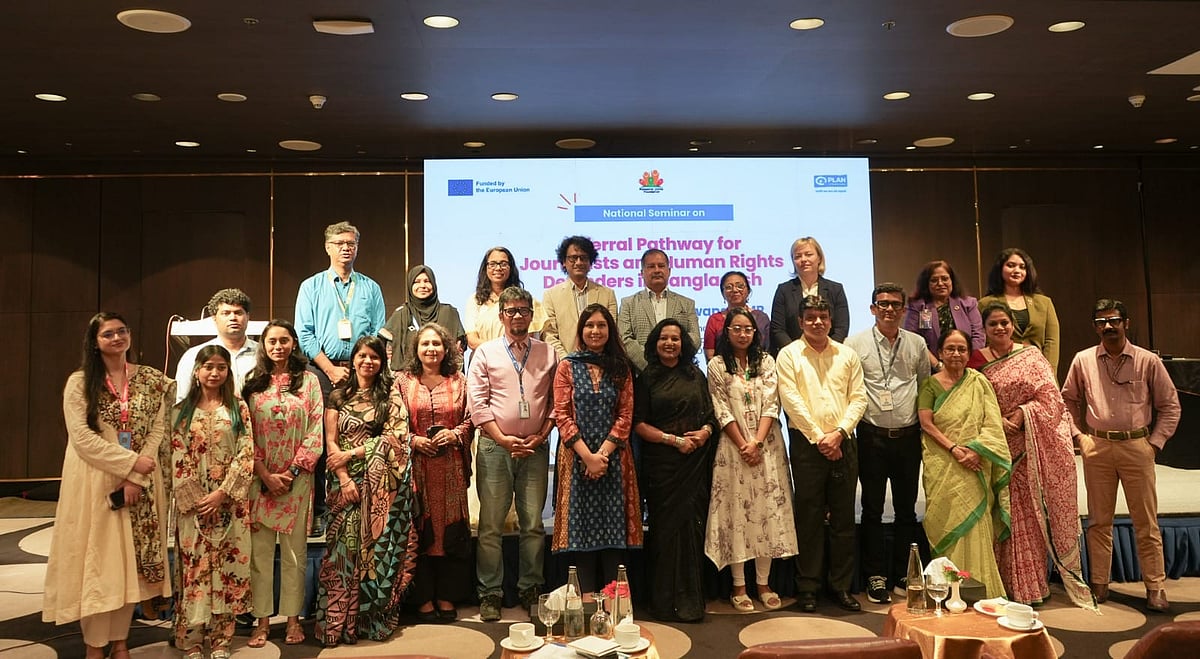
Photo Collected
DHAKA — Experts and stakeholders have called for the establishment of a cohesive, nationwide referral mechanism to ensure journalists and human rights defenders receive timely and effective protection against rising digital and physical threats.
The call came during a seminar titled “Referral Mechanism for Journalists and Human Rights Defenders in Bangladesh,” hosted by Plan International Bangladesh in the capital on Monday. The event served as a platform to present research findings on current support services, which include legal aid, psychosocial counseling, and digital security.
While various organizations provide these services, researchers noted that support remains fragmented. The study highlighted a significant disparity in service accessibility, noting that specialized assistance is notably scarce in sub-districts and remote areas. To bridge this gap, proponents emphasized the need for an integrated network that simplifies how at-risk individuals can access protection.
The research was conducted under the Freedom of Expression for Digital Democracy (FREEDOM) project, funded by the European Union. The project is led by Plan International and implemented locally by Manusher Jonno Foundation (MJF).
Zahir Uddin Swapan, political adviser to the Prime Minister and a member of parliament, attended as the chief guest. He stressed the importance of empowering the youth to adapt responsibly to the rapidly evolving landscape of artificial intelligence and digital technology, urging a focus on using these tools for positive societal change.
Baiba Zarina, deputy head of delegation and head of the political, economic, trade, press and information section of the European Union, underscored the need for clarity in crisis management. She stated that journalists and human rights activists should never be left in doubt regarding where to seek help, who to contact, or what specific assistance is available to them during an emergency.
MJF Executive Director Shaheen Anam pointed to the necessity of moving beyond policy formation toward rigorous implementation. She highlighted that the rise of misinformation, social media abuse, and digital harassment necessitates a more robust framework and a heightened level of civic awareness among the youth.
Farooq Wasif, director general of the Press Institute of Bangladesh (PIB), noted that while social media has expanded platforms for free expression, it has simultaneously introduced dangers such as hate speech and the malicious use of artificial intelligence. He advocated for a focus on media literacy and the protection of rights for both media professionals and general social media users.
Plan International Bangladesh Country Director Kabita Bose concluded that formal policies and platforms alone are insufficient to guarantee safety. She urged stakeholders to prioritize time-bound legal interventions and immediate, coordinated responses to complaints of harassment and intimidation.
0%
0%
0%
0%