
Barisal University is grappling with a severe shortage of faculty and infrastructure, hindering the academic progress of more than 10,000 students. While the university administration reports a current student-to-teacher ratio of 48:1, the effective ratio has ballooned to 69:1 due to the absence of more than 50 faculty members currently on study leave.
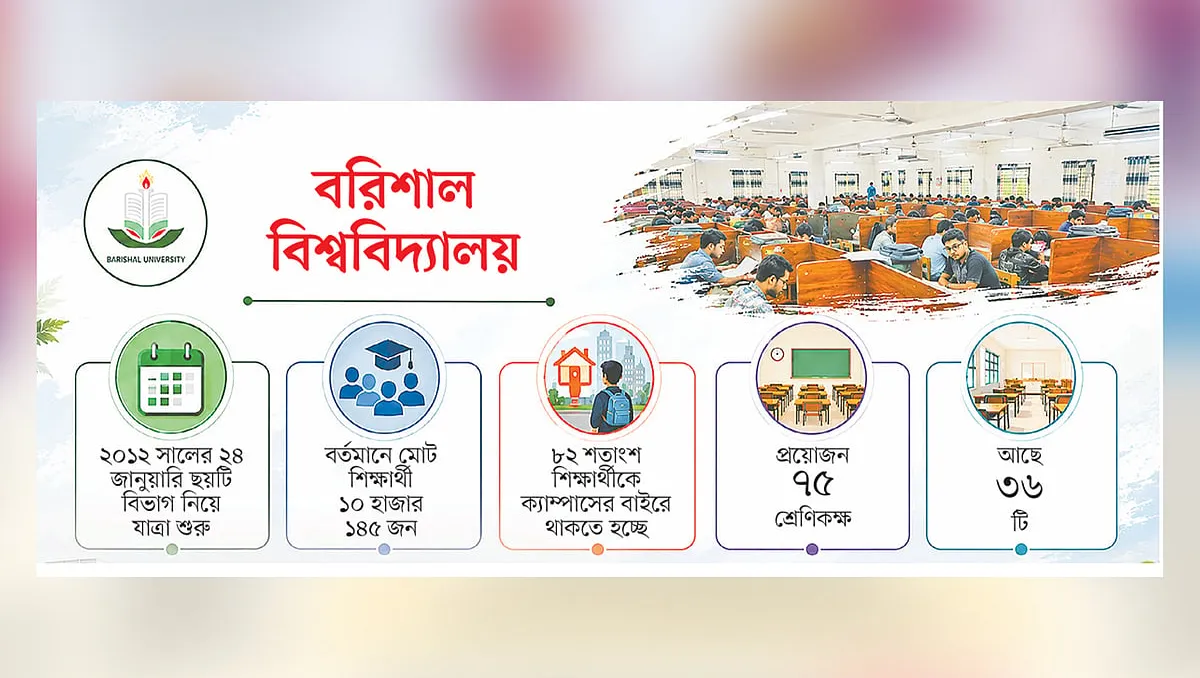
Established on January 24, 2012, with six departments and 400 students, the institution has expanded significantly, currently offering undergraduate and postgraduate programs across 25 and 24 departments, respectively. Despite this growth, official data shows only 148 of the 210 employed faculty members are actively engaged in teaching.
The shortage is further compounded by a massive gap in senior faculty roles. While the university’s structural framework calls for 49 professors, only one is currently employed. Out of 401 total sanctioned faculty positions, the University Grants Commission (UGC) has approved only 260, leaving 50 vacancies even against the limited approved headcount. Experts typically recommend a 1:20 ratio for quality higher education and research, a benchmark Barisal University is struggling to approach.
Faculty members report that the high workload—comprising teaching, examination duties, research supervision, and administrative committee work—places immense strain on the available staff. Associate Professor of Physics Md. Khorshed Alam noted that his department manages over 400 students across seven batches with only four teachers, making it difficult to maintain quality research and academic oversight.

Infrastructure deficits are further exacerbating the crisis. The university currently requires at least 75 classrooms to accommodate 150 student batches but possesses only 36. This shortage forces departments to share spaces, leading to irregular class schedules and, in some cases, the premature termination of lectures to accommodate examinations. Students cite these persistent disruptions as a primary driver of worsening session jams, with some departments already facing delays of three to five months.
Residential and auxiliary facilities are equally strained. The central library provides only 130 seats for over 10,000 students, forcing many to find alternative study spaces. Meanwhile, the university's four residential halls offer accommodation for only 1,800 students, leaving approximately 82% of the student body to seek off-campus housing, which entails higher living costs and safety concerns.
Vice-Chancellor Professor Mamun Ur Rashid acknowledged the severity of the situation, stating that the administration has petitioned the UGC to expedite new faculty recruitment. Regarding infrastructure, the Vice-Chancellor confirmed that a project proposal for a new academic building has been submitted to the Ministry of Education, with plans for additional dormitories currently in the drafting stage.




