
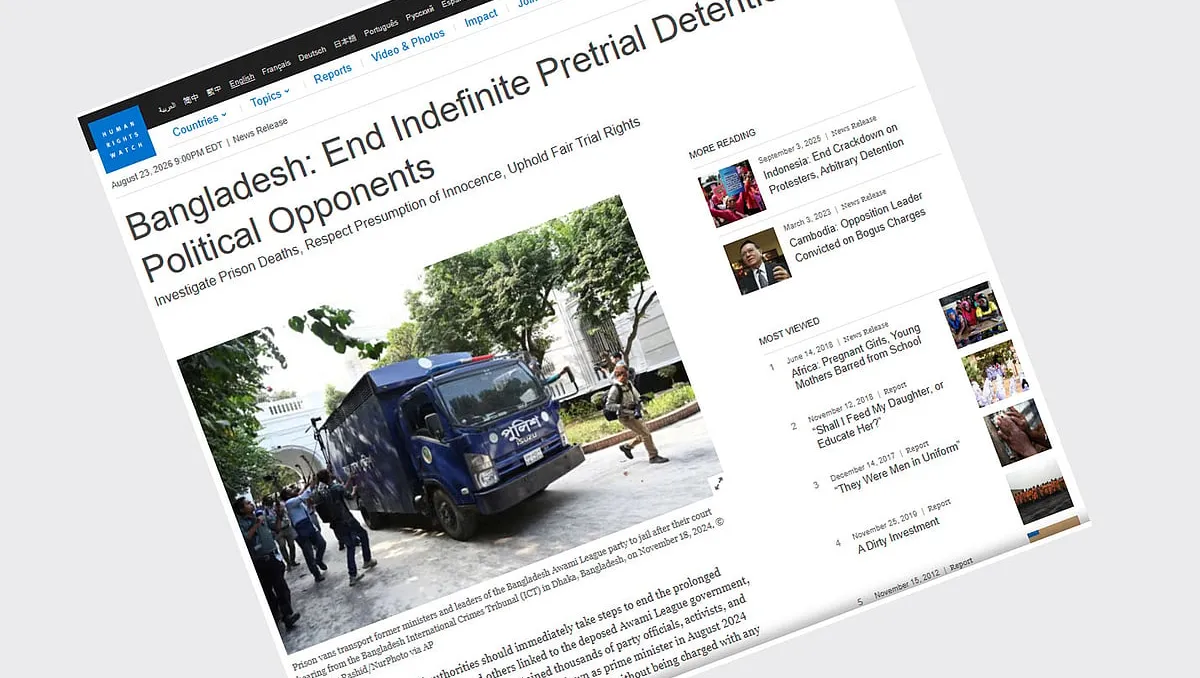
Human Rights Watch (HRW) has urged Bangladeshi authorities to take immediate action to end the prolonged detention of political figures and others associated with the ousted Awami League government. In a report released on Monday, the New York-based rights organization criticized the government for keeping hundreds of individuals behind bars without formal charges.
Following the ouster of former Prime Minister Sheikh Hasina in August 2024, police arrested thousands of party officials, activists, and supporters. While some individuals may face credible allegations of human rights abuses, HRW noted that many have been detained without visible evidence linking them to the killing of protesters. Families and legal counsel report that many detainees are elderly or suffering from severe health conditions, yet they remain deprived of basic rights, including bail and medical care. According to the organization, at least 10 Awami League leaders have died in custody since Prime Minister Tareq Rahman took office last February, most of whom had not been formally charged with specific crimes.
Elaine Pearson, Asia director at Human Rights Watch, stated that the current administration is mirroring past patterns by detaining political opponents without due process or evidence. She emphasized that while Prime Minister Rahman’s government has promised reform, the continued detention of political rivals undermines those commitments. Furthermore, HRW warned that a proposed bill to restructure the National Human Rights Commission could impede investigations into arbitrary arrests if passed in its current form.
The report details a systemic use of judicial hurdles to prevent the release of high-profile detainees. In several instances, even when the High Court granted bail, authorities reportedly obstructed the process by filing new cases against the detainees. A prominent example highlighted is the 22-month detention of 82-year-old former Chief Justice A.B.M. Khairul Haque. Despite multiple bail orders from the High Court, police repeatedly arrested him in new cases, sometimes alleging he was at a murder scene over 10 kilometers away from where he was actually located at the time of a prior alleged offense. He was eventually released on August 19 following intervention by the Appellate Division.

The situation remains dire for others held by the International Crimes Tribunal. Although the tribunal allows detention without charges for over a year only under "exceptional circumstances," it has denied bail to all 160 individuals currently in its custody. Among them is 81-year-old former adviser Taufiq-e-Elahi Chowdhury, held for 22 months without formal charges. Similarly, 75-year-old former lawmaker Kamrul Ahmed Mojumder faces significant health complications, including gangrene and a broken hip, yet remains incarcerated despite repeated bail denials.
Other notable figures facing severe health crises include 75-year-old activist Shahriar Kabir and 71-year-old lawmaker R.A.M. Obaidul Muktadir Chowdhury. HRW also documented the deaths of 85-year-old Ramesh Chandra Sen and 65-year-old S.M. Ziaul Zia while in state custody, citing allegations of inadequate medical treatment and denied bail.
Human Rights Watch asserted that under international law, pre-trial detention must be the exception, not the rule, and must be subject to rigorous individual review. Pearson concluded that a justice system allowing elderly individuals to die in prison before charges are even filed fails to meet international standards. The organization has called on the Bangladeshi government to conduct independent investigations into all deaths in custody and to immediately halt the practice of indefinite pre-trial detention.




