
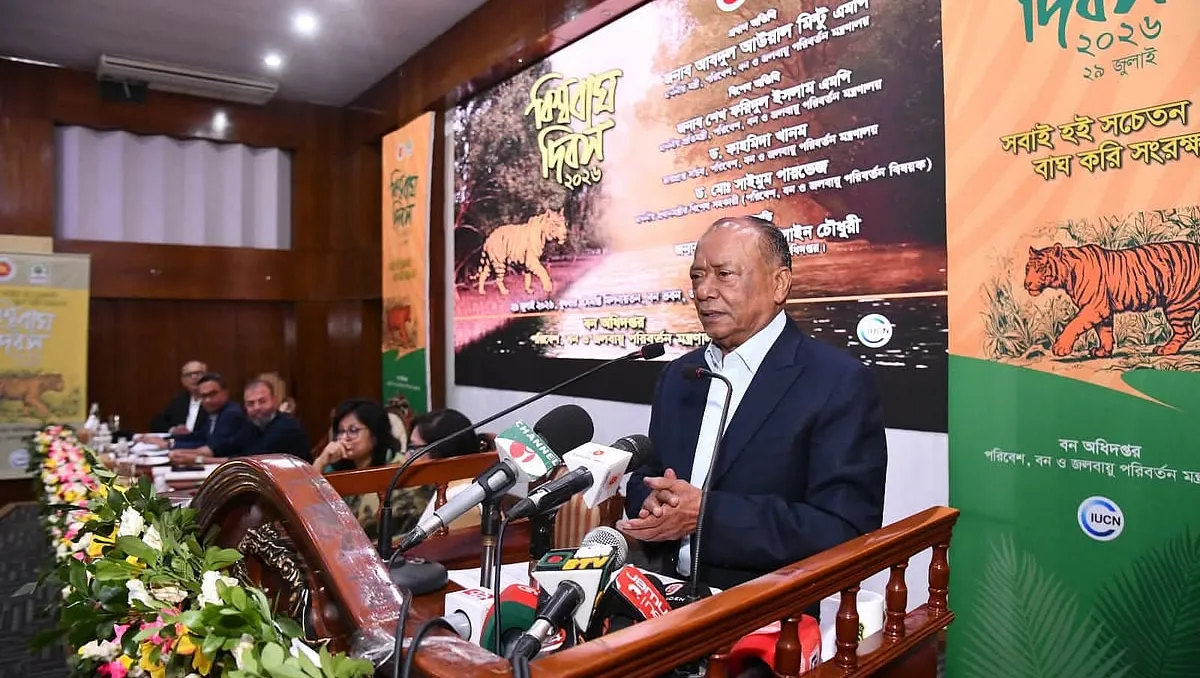
Environment, Forest and Climate Change Minister Abdul Awal Mintu has underscored the complex tension between rapid industrialization and environmental preservation, asserting that sustainable development hinges on achieving a delicate balance between economic growth and the protection of biodiversity. Speaking as the chief guest at an event organized by the Forest Department to mark World Tiger Day at the Ban Bhaban in Agargaon on Wednesday, the minister emphasized that while production must increase to improve citizens' living standards, the resulting environmental impact requires pragmatic management rather than unrealistic legal restrictions.
Minister Mintu cautioned against the strict, often impractical application of environmental regulations that could halt essential infrastructure without offering viable alternatives. Citing the domestic demand for 2.3 billion bricks annually, he noted that calling for an immediate ban on brick kilns without widespread adoption of eco-friendly block technology ignores the reality of the construction sector. He argued that laws, while necessary, must be applied with an understanding of economic necessity, warning that over-regulation without alternatives could paralyze national development.
Addressing specific conservation proposals, the minister expressed skepticism regarding the creation of new tiger habitats in the Chittagong Hill Tracts. Given existing challenges with human-elephant conflict in the region, he warned that introducing predators could necessitate the displacement of local populations. He insisted that conservation efforts must prioritize the coexistence of wildlife and humans, noting that environmental policies that disregard the realities of human survival are ultimately destined to fail.
The event also featured a research paper presented by Professor M.A. Aziz of the Department of Zoology at Jahangirnagar University, which highlighted the declining biodiversity of the Sundarbans due to climate change and human interference. The research emphasized that the survival of the Bengal tiger is inextricably linked to the protection of its primary prey, the spotted deer, which is currently threatened by illegal poaching and snare traps.

Reflecting on the broader strategy for tiger conservation, State Minister for Environment, Forest and Climate Change Begum Habibun Nahar stressed the importance of reducing the local community’s dependency on the Sundarbans. She noted that international partnerships with organizations such as the World Bank, the International Union for Conservation of Nature (IUCN), and German agencies like GIZ are currently focused on creating alternative livelihoods for forest-dependent populations.
Acting Secretary of the Ministry, Fahmida Khanam, reinforced the need for stricter industrial oversight, specifically calling for the reduction of pollution from factories located within a 10-kilometer radius of the Sundarbans. The seminar concluded with a call for greater public awareness, underscored by a presentation from the WildTeam, as officials reaffirmed their commitment to mitigating both internal and external threats to the forest ecosystem to ensure a sustainable future for the nation’s wildlife.




