
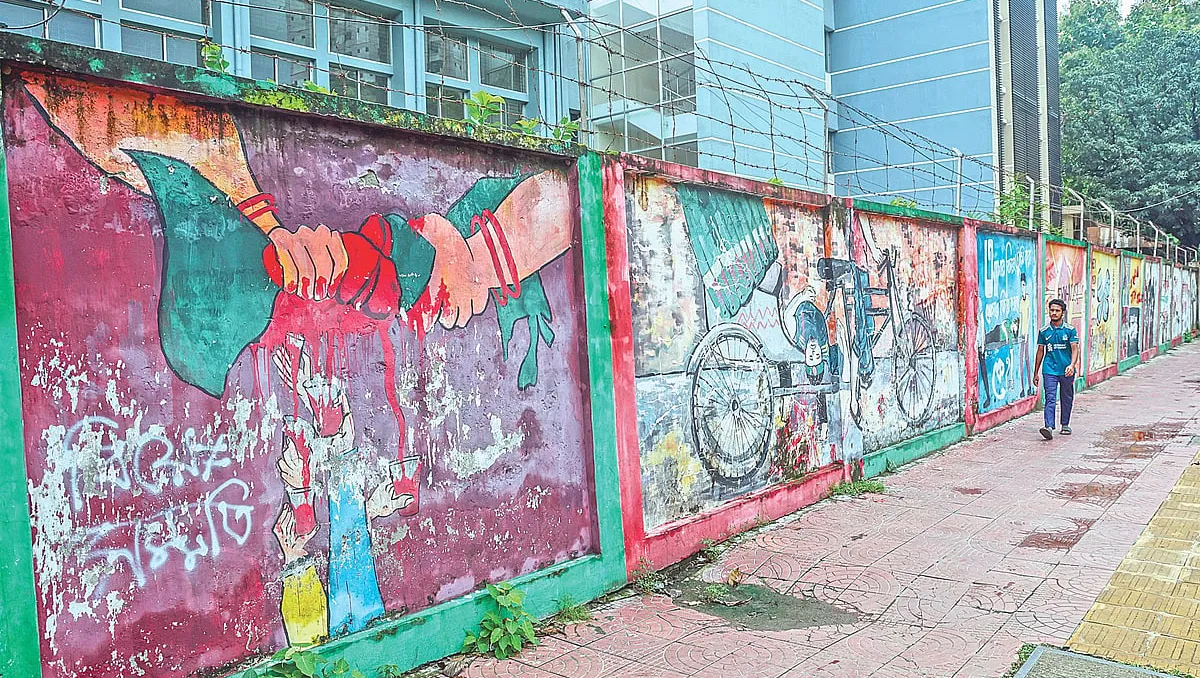
Two years after the student-led uprising that reshaped Bangladesh’s political landscape, the vibrant murals and graffiti that once served as the visual manifesto of the revolution are rapidly disappearing. The walls of Dhaka and cities across the nation, once adorned with bold calls for systemic reform, freedom of expression, and an end to authoritarian rule, are being overtaken by commercial advertisements, political posters, and utilitarian notices.
During the height of the July movement, thousands of students from schools, colleges, and universities transformed public spaces into canvases of resistance. Armed with spray paint and brushes, they covered boundary walls, highway pillars, and government buildings with art that transcended simple protest. These murals became a raw, collective expression of a generation’s aspirations—demanding a society free from corruption, sectarianism, and inequality. Icons such as the defiant posture of martyr Abu Sayed and references to the revolutionary poetry of Kazi Nazrul Islam became symbols of a national awakening, widely documented and shared across social media to galvanize public support.
As time passes, however, the physical remnants of this "people's art" are fading. In areas like Mohammadpur, Lalmatia, and Manik Mia Avenue, the revolutionary slogans are being obscured by posters for pest control services, internet connectivity, rental listings, and coaching center advertisements. In several instances, the murals have been painted over with plain white coats to make room for promotional materials. This systematic erasure has drawn criticism from those who participated in the movement, who see the vanishing graffiti as a loss of the revolution’s cultural and ideological legacy.

University students and activists, including Dhaka University student Nazma Akter, have expressed deep disappointment at the lack of preservation. For many, these murals were not merely decoration; they were a record of a historic struggle and a promise of a future built on equity. Observers argue that while the ephemeral nature of street art is expected, the significance of these particular works warranted a conscious effort to document or preserve them as part of the nation’s historical record.
Academic and activist Samina Lutfa, a professor at Dhaka University, noted that the graffiti served as a vital aesthetic and political language for the 2024 uprising. She emphasized that the spontaneous, raw nature of the artwork captured the immediate reactions and hopes of a generation in a way that formal records often fail to do. As these walls return to their former states of commercial utility, advocates are urging a broader recognition of this period, warning that allowing the physical art to vanish risks letting the underlying spirit and the hard-won lessons of the July movement fade from the national consciousness.




