
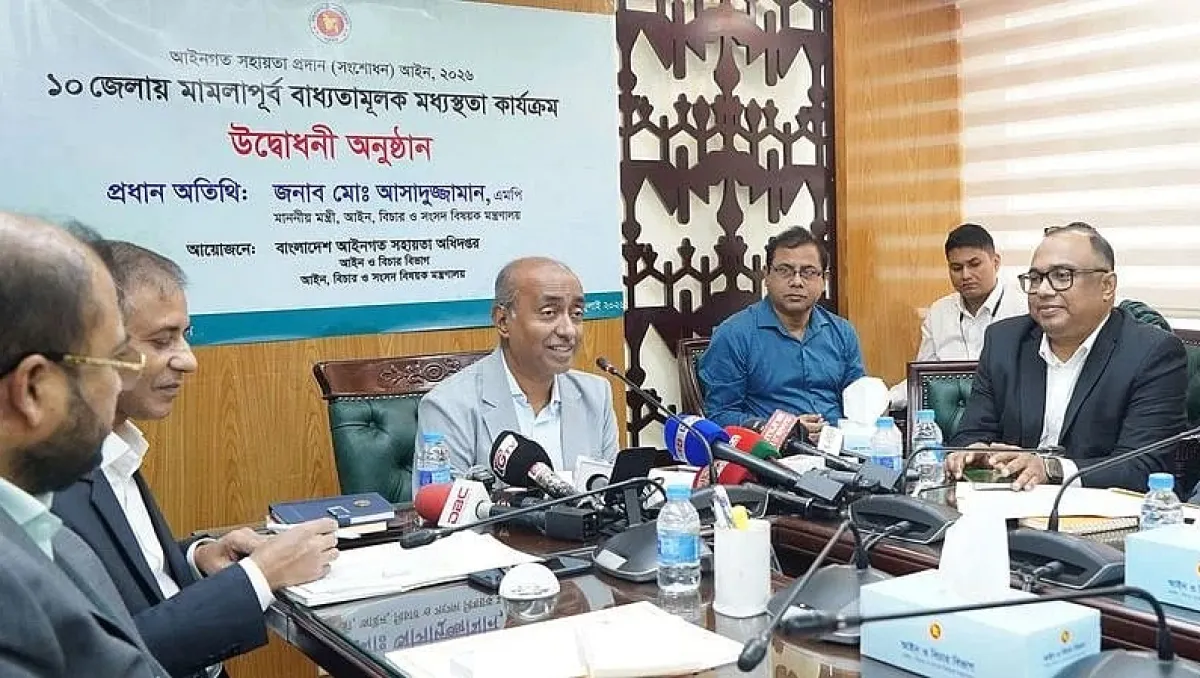
Law Minister Dr. Asif Nazrul has announced an ambitious roadmap to reduce the national backlog of legal cases to under two million within the next year, banking on the expansion of mandatory pre-filing mediation. Addressing a seminar on the implementation of the Legal Aid Services Act, 2026, at the Secretariat on Tuesday, the minister emphasized that shifting the focus toward alternative dispute resolution (ADR) is essential to alleviating the immense pressure currently weighing on the judiciary.
With approximately 4.5 million cases currently pending in courts across Bangladesh, the minister noted that judicial shortages have created a systemic bottleneck. The government’s recent pilot initiative, conducted from February to May, has provided compelling evidence that pre-filing mediation can serve as a viable relief valve. Data from the pilot phase indicates an average reduction of 62.2 percent in cases across various legal categories.
Specific metrics highlight the effectiveness of this approach: family court filings dropped by 51 percent, while dowry-related cases saw a significant decline of nearly 68 percent. Furthermore, property disputes under the State Acquisition and Tenancy Act plummeted by over 88 percent. The minister asserted that these results prove mediation significantly reduces the time, cost, and emotional toll on litigants, while preventing the influx of new filings from overwhelming the court system.
To institutionalize this change, the government has launched mandatory pre-filing mediation services across ten districts: Bogura, Thakurgaon, Patuakhali, Bhola, Narail, Jashore, Faridpur, Cox’s Bazar, Panchagarh, and Tangail. Addressing judges and legal aid officials, the minister directed that all cases eligible for settlement be referred to district legal aid offices or authorized mediators at the earliest opportunity.

The Director General of the National Legal Aid Services Organization, Md. Monjurul Hossain, lauded the initiative as a landmark move that transitions from experimental projects to a permanent, institutional framework. He stressed that the organization is committed to building a sustainable justice system that prioritizes swift and equitable outcomes.
The minister concluded by calling on the media to play an active role in raising public awareness about these government-funded services. By ensuring that citizens understand their options for resolving disputes outside of formal litigation, the state aims to protect vulnerable populations from the economic and psychological burdens of protracted legal battles. As part of this push, district officials in Cox’s Bazar have been tasked with achieving a measurable reduction in their district’s high backlog—currently exceeding 100,000 cases—by this coming September.




