
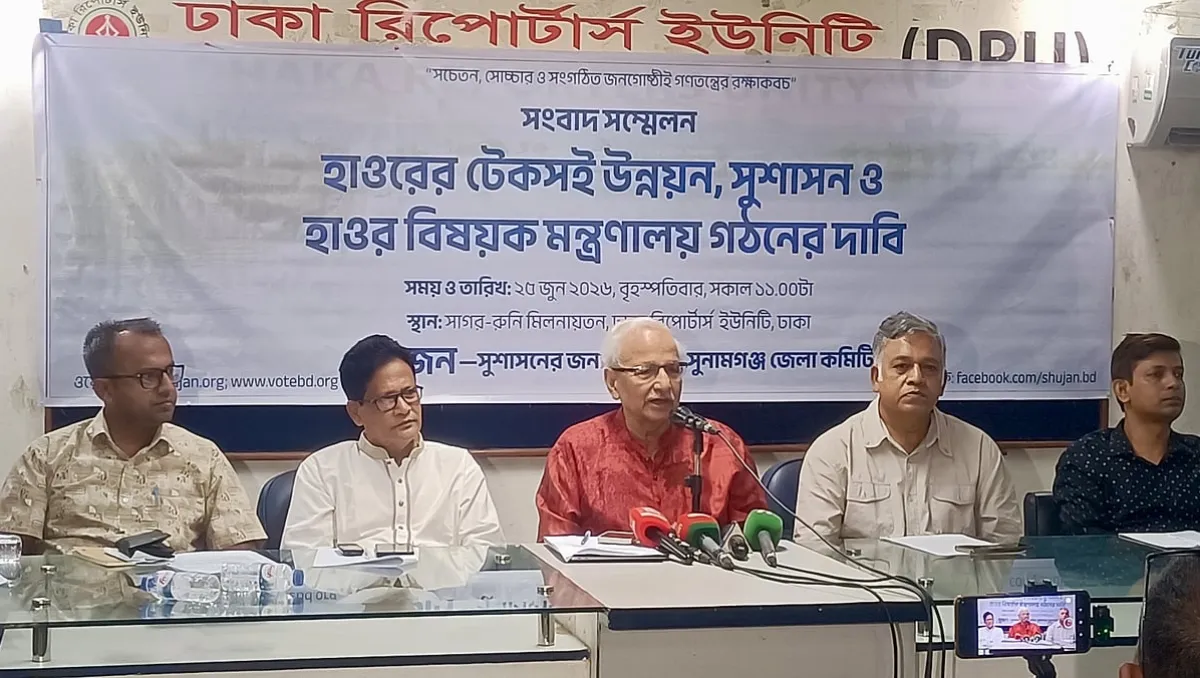
The civil society organization Shushashoner Jonno Nagorik (SHUJAN) has called for immediate government intervention to support farmers devastated by recent flooding in the country's haor regions. During a press conference held Thursday at the Dhaka Reporters Unity, SHUJAN Secretary Badiul Alam Majumdar emphasized that addressing the plight of these farmers is critical to national food security, environmental sustainability, and the broader goal of establishing transparent governance.
Majumdar argued that the challenges facing the haor region are not merely local issues but national concerns that directly impact the country’s economic health. He noted that when crops are destroyed by floods, the nation is forced to rely on costly food imports, straining foreign currency reserves. By curbing corruption and mismanagement in the region, he said, the government could secure the livelihoods of thousands while strengthening the nation’s agricultural resilience.
The scale of the agricultural crisis was outlined by SHUJAN’s Sunamganj district leadership, who reported that over 220,000 hectares of land in the district’s 139 haors are used for Boro rice production, yielding approximately 1.3 million metric tons of grain annually. Despite this massive economic potential, the region remains trapped in a cycle of instability, largely due to systemic failures in infrastructure management.
The organization alleged that widespread corruption and mismanagement in the construction of flood-protection embankments are primary drivers of the crisis. Although project guidelines dictate that construction should begin by mid-December, implementation is frequently delayed until February or March. This negligence leaves crops vulnerable to premature flash floods. Speakers further alleged that Project Implementation Committees are often compromised by political influence and contractor syndicates, leading to subpar construction that disrupts natural water drainage and exacerbates waterlogging.

Beyond the immediate agricultural losses, the region is facing an acute environmental decline. The report noted that native fish species in the haors have plummeted from roughly 150 varieties to fewer than 70, while vital grazing lands and indigenous forests are steadily vanishing.
To combat these recurring disasters, SHUJAN put forward a series of policy recommendations, including the creation of a specialized ministry dedicated to haor management. The group advocated for moving away from temporary earthen embankments in favor of sustainable solutions, such as dredging rivers and canals to restore natural water flow. Furthermore, they urged the implementation of scientific hydrological mapping, the depoliticization of oversight committees, and the adoption of climate-resilient farming practices to ensure the long-term survival of one of the country's most vital economic engines.




