
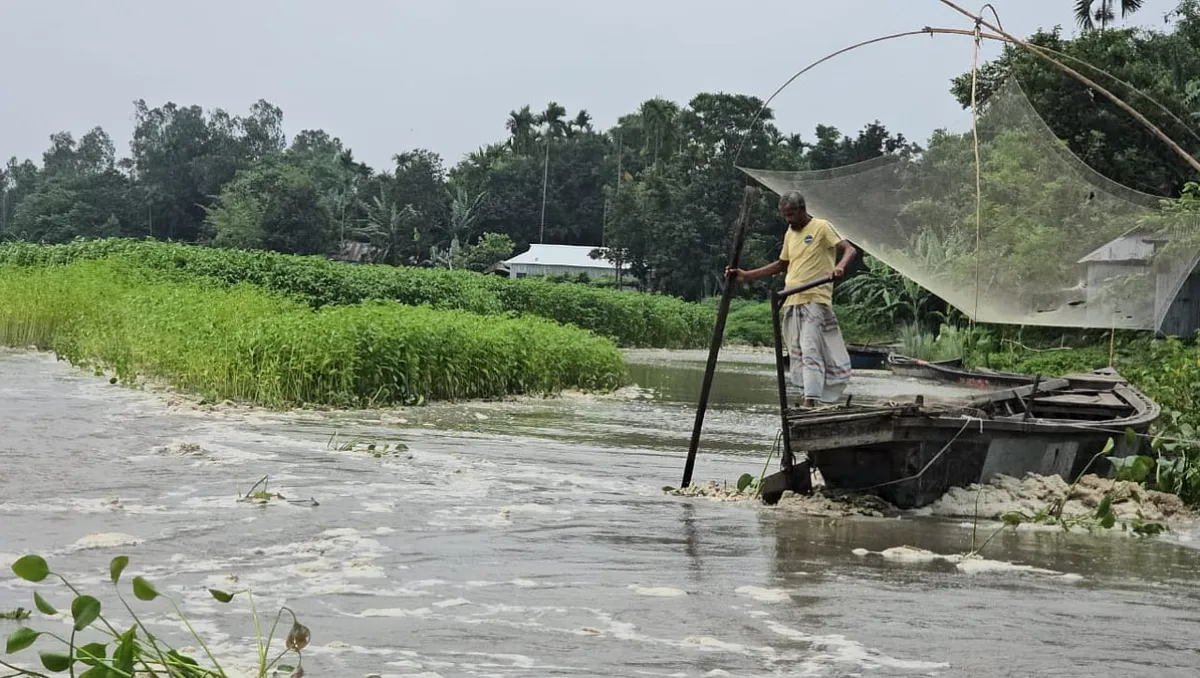
Persistent rainfall and surging upstream waters have triggered fears of flash flooding across northern Kurigram, as the district's primary river systems continue to swell. While water levels remain below the danger threshold for now, the rising tide has prompted widespread concern among residents living along the banks of the Teesta, where erosion has already begun to compromise vulnerable land.
According to the Kurigram Water Development Board (WDB), the Teesta River is expected to rise further over the next 72 hours, creating the potential for short-term flooding in low-lying areas. As of Tuesday morning, data from the WDB indicated that the Teesta at the Kaunia point had climbed 13 centimeters, flowing 36 centimeters below the danger mark. Parallel trends were reported across the district’s other major waterways, with the Dharla, Brahmaputra, and Dudhkumar rivers all recording marginal increases.
The rising water has already begun to inundate low-lying agricultural fields in the Teesta riverine regions, raising alarm among farmers anxious about impending crop losses. Abdus Salam, a farmer in the Thetrai union of Ulipur, reported that surging waters have already begun to submerge plots of chili and pointed gourd. Similarly, in the Gharialdanga union of Rajarhat, farmers are scrambling to salvage their harvests, with many forced to pull peanuts from the ground early as floodwaters infiltrate jute fields and vegetable patches.

Local residents are increasingly on edge, fearing that the combination of rising river levels and localized erosion will cost them their homes and livelihoods. Rakibul Hasan, executive engineer of the Kurigram WDB, acknowledged the intensifying situation, noting that while the rivers have not yet breached danger levels, the immediate forecast points toward the inundation of low-lying terrain. Authorities are currently monitoring the developments as the region braces for the impact of potential short-term flooding.




