
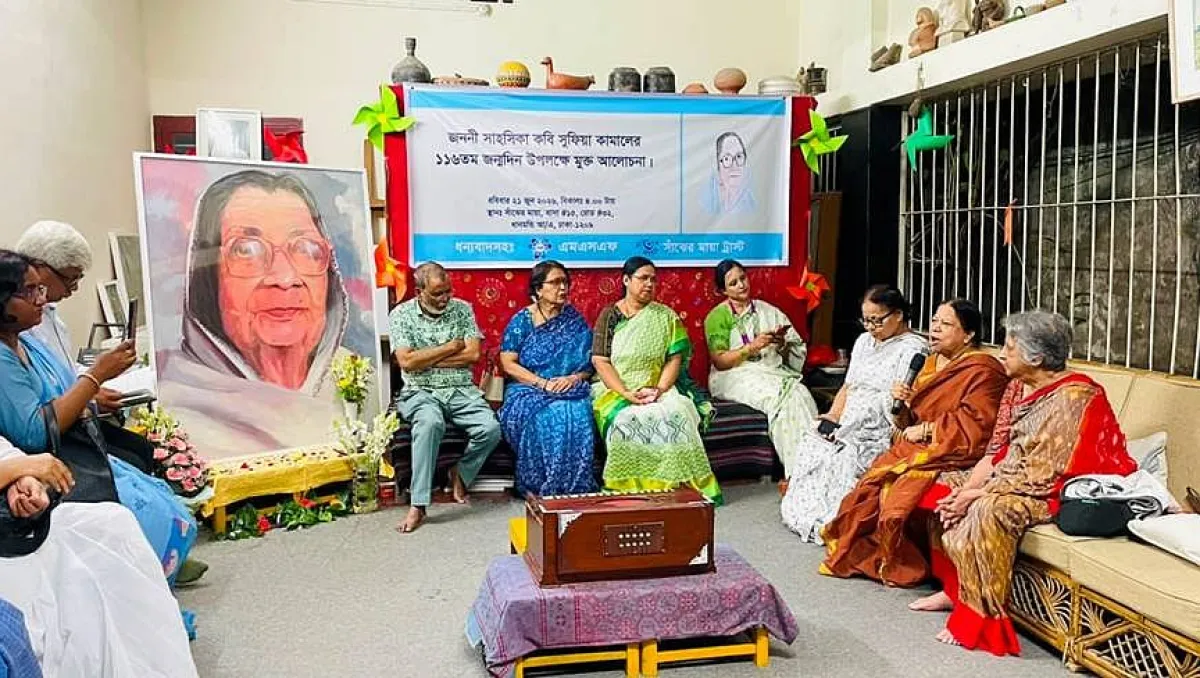
The 116th birth anniversary of Begum Sufia Kamal, the celebrated poet and pioneer of the women’s rights movement in Bangladesh, was marked on Sunday with a commemorative discussion and cultural program. The event, held at her residence, "Sanjher Maya," in Dhanmondi, was organized jointly by the Human Rights Culture Foundation (MSF) and the Sanjher Maya Trust.
Human rights activist and development organizer Khushi Kabir, serving as the keynote speaker, described the late poet as a "towering personality" whose influence continues to illuminate the nation. She emphasized that Sufia Kamal’s life and legacy were deeply rooted in her unwavering commitment to feminism, human rights, democracy, and freedom of expression. Kabir noted that anyone with a profound love for Bangladesh remains influenced by the poet’s enduring principles.
Presided over by MSF Executive Chief Advocate Saidur Rahman, the event featured a dedicated session titled "Poet Sufia Kamal in the Eyes of the Younger Generation." Participants analyzed the poet’s vast literary contributions, her foundational role in establishing women’s rights, her activism during democratic movements, and the continued relevance of her ideals in contemporary society.

Reflecting on her mother’s life, Saida Kamal described her journey as an expansive, storied existence that bridged the gap between a simple domestic life and a lifelong struggle for human rights. Other speakers at the event, including women’s rights advocates and cultural figures such as Khurshida Imam, Trishna Sarkar, and Md. Jahedul Alam Hito, shared personal anecdotes and highlighted the various facets of her character.
The discussion was complemented by a cultural program featuring musical performances by Jannatul Ferdous Lucky of Chhayanaut and the Nazrul Institute, Ferdous Rahman Chandan of Sunbeams School, and Mahbuba Sultana Lima. Additionally, staff members from the MSF contributed to the tribute through recitations of poetry dedicated to the legendary activist, with the proceedings moderated by Tania Khatun.




