
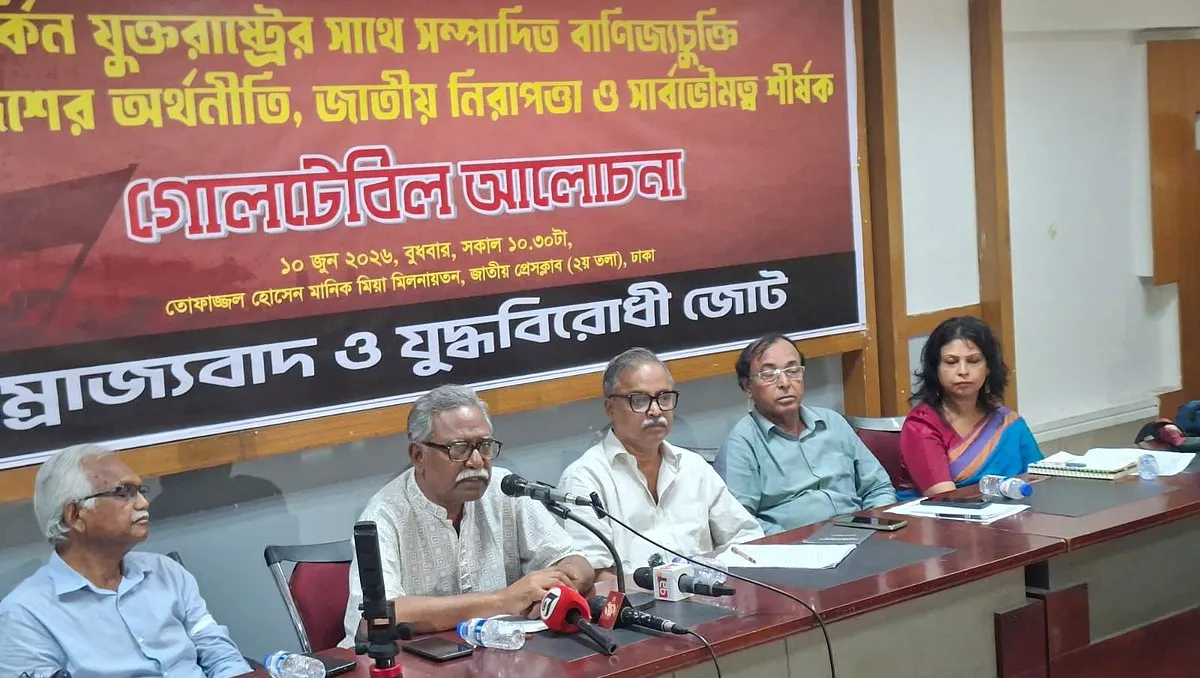
Prominent economists and civil society leaders have leveled sharp criticism against a recently signed trade agreement between Bangladesh and the United States, characterizing the pact as an asymmetrical "diktat" that threatens the nation's economic sovereignty and fiscal health. During a roundtable discussion titled "Trade Agreement with the USA: Threats to Economy, National Security, and Sovereignty" held at the National Press Club in Dhaka, experts argued that the deal imposes unilateral obligations on Bangladesh while offering no concrete reciprocal benefits.
Professor Anu Muhammad, a noted economist, asserted that the agreement bypasses standard market principles by compelling Bangladesh to purchase expensive American goods under the guise of addressing trade deficits. He argued that the pact lacks the foundational fairness typically found in World Trade Organization regulations and international commerce policies. Furthermore, he questioned the timing of the deal, which was finalized just three days before national elections by an interim government, despite the fact that other nations—including India and members of the European Union—have opted to avoid or defer such commitments.
According to the analysis presented, the economic fallout could be severe. The requirement to import commodities such as wheat, cotton, fish, and meat from the U.S. at higher costs is expected to shrink national revenue while necessitating increased domestic subsidies, ultimately burdening the public. Concerns were also raised regarding the potential negative impact on critical local sectors, including pharmaceuticals, dairy, information technology, and the management of natural gas resources.
Professor Mustafizur Rahman, a distinguished fellow at the Centre for Policy Dialogue (CPD), described the agreement as inherently lopsided and called for its immediate cancellation. He pointed to a striking diplomatic miscalculation: the agreement was signed on February 9, yet on February 20, a U.S. court struck down the very additional tariffs that had prompted Bangladesh to seek the deal in the first place. Had the government waited even a few days, the premise of the agreement would have been rendered unnecessary.

Highlighting the disparity in the terms, Professor Rahman noted that the pact explicitly details Bangladesh’s obligation to provide zero-duty access for American products within a strict five-to-ten-year window. In contrast, the agreement remains vague regarding benefits for Bangladesh, promising only that a formula for mutual gain will be developed at an unspecified future date.
The experts also warned that the agreement could curtail Bangladesh's future trade autonomy. The terms reportedly require Bangladesh to consult with the U.S. before entering into new trade pacts with other nations, such as China. Furthermore, the mandatory duty-free status granted to American goods could set a precedent that compels Bangladesh to offer similar concessions to other trading partners, potentially destabilizing the country's broader trade policy. The roundtable, organized by the Anti-Imperialist and Anti-War Alliance, featured contributions from various political leaders, journalists, and industry representatives who collectively echoed the call for a reassessment of the government's stance.




