
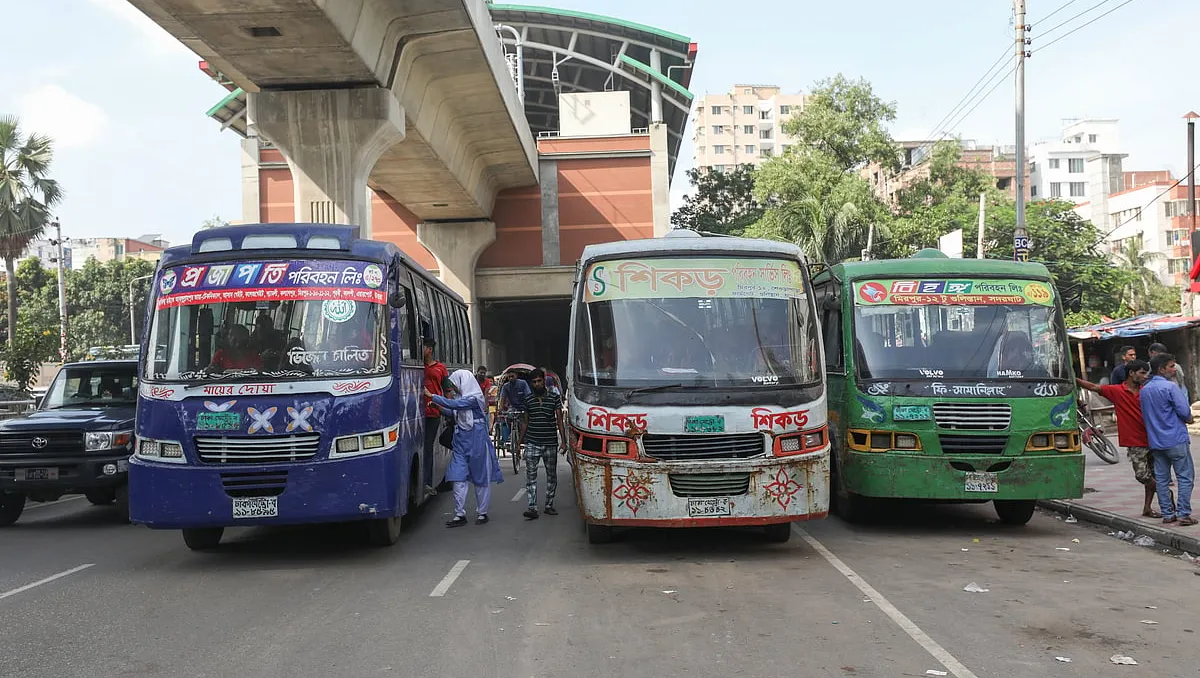
After the increase in the price of diesel, the bus and minibus fares are heavily increased by the transport owners. Not only the price of fuel, but other expenses including parts used in transportation have increased and they are demanding to fix the new fare by adding it. However, the question has arisen as to how logical it is to increase the fare in public transport in accordance with the demands of the transport owners.
In August 2022, diesel prices were increased by 42 percent to Tk 114. Then the government increased the bus fare by 40 paisa per kilometer or 22 percent. After that, the price of diesel was reduced several times. At the same time, the government has officially reduced bus-minibus fare by 8 paise per kilometer in two phases. But the transport owners did not reduce the bus fare accordingly. The government also had no oversight.
Last Saturday, the price of diesel was increased to Tk 115 per liter. That is, one rupee has increased per liter. Experts feel that there is no justification for increasing the transport fare for this one rupee increase.
Most of the country's goods and passenger transport runs on diesel. Among them, the government does not fix the fares of goods vehicles including trucks, covered vans. Bangladesh Road Transport Authority (BRTA) fixes the fares for non air-conditioned (Non-AC) buses and minibuses.
Apart from this, passenger boats also run on diesel. Among them, the leaders of the launch owner association have written to the government demanding a 42 percent increase in the fare on the waterway.
Meanwhile, a meeting was held at the BRTA office in Banani on Sunday night with transport owners and labor leaders. According to the sources present in the meeting, the transport owners and labor leaders pressed for rescheduling of the fare by taking into account the increase in other costs apart from the increase in the price of fuel oil. BRTA, on the other hand, only increases bus fares at the rate of increase in fuel prices. The meeting ended without any decision.
A committee of BRTA analyzes the overall cost of transport while fixing or increasing fares. The chairman of the authority is ex officio. There are officials from various government departments in the committee. Apart from this, there are three to four members of transport owners and labor unions. Although there is a representative of Consumer Association of Bangladesh (CAB) to look after the interests of the passengers, he can hardly exert any influence as he stands alone.
Cost analysis committee considers 12 aspects and investment of bus-minibus in determining the fare. While buying the bus, its lifespan, passenger seating and seat-wise passenger occupancy rate are taken into consideration. Apart from this, about 20 issues are taken into account in the operational expenditure sector including fuel. Analyzing this system of fare determination, it has been found that some of the expenses shown for running the bus have reasons to be considered as 'extravagant expenses'.
On August 5, 2022, the government increased the price of diesel by 34 taka per liter to 114 taka. Soon after this, the transport owners increased the fare as they wished. Later, the government decided to increase the transport fare up to a maximum of 40 paisa per kilometer.
After 25 days of increasing the price of diesel in August, the government reduced it again. The price was reduced by Rs 5 to Rs 109 per liter on August 29. Then on September 1, the government decided to reduce the fare of diesel buses and minibuses by 5 paise. But the transport owners and workers did not accept it.
Two years later, on April 1, 2024, the price of diesel was further reduced by Rs 3 to Rs 106 per liter. On that day, it was decided to reduce the transport fare by 3 paisa, but it was not implemented.
Before that, bus fare was reduced by 3 paisa in 2016 and 2 paisa in 2011. But the transport owners did not accept that either.
Sources in the transport sector say that in the case of buses, BRTA first decides the additional fare by adding 'adjacent expenses'. Again, the transportation is charged in excess of the fixed fare.

For example, the distance from Farmgate in Dhaka to Savar is 19.6 kilometers. Welcome, Labbayek and Lovely transports on this route charge a fare of 50 taka. Even if you get down three to four kilometers before Savar bus stand, the same fare is charged.
In 2022, bus fare was 2.5 taka per kilometer. Accordingly, the fare from Farmgate to Savar is Tk. 49. That is, one rupee more is being charged since then. Thereafter, the fare was reduced by 8 paise per kilometer in two stages. As such, the rent is supposed to be 47 taka.
Most passengers travel short distances in Dhaka's transport. You have to pay 10 taka when you board the bus in Dhaka. The minimum rent is fixed by the government. Here the profit of transport owners is more.
Additional fares are being charged for long distances. According to the decision of the government, the fare of long-distance buses is 2 taka 12 paisa per kilometer. And the bus fare in major cities including Dhaka, Chittagong is 2 taka 42 paisa per kilometer. Minibus fare in the metropolis is 2 taka 32 paisa per kilometer.
"Spend it all"
BRTA's latest bus fare costing analysis showed that a new bus operating in the metropolis costs Tk 35 lakh. It is assumed to last for 10 years. These buses will be renovated once every five years. It costs six and a half lakh taka. Based on these, the bus fare has been fixed.
But in Dhaka, new buses costing Tk 35 lakh are hardly seen. Bus-minibus means discolored, rickety, dirt-torn seats. Another controversial issue is that the government has made a law that a bus-minibus can run in Dhaka for up to 20 years. But the rent is fixed for 10 years. In other words, 11 to 20 years old bus can be charged the same fare as a new one.
The busses will be serviced every 25 days and every 3 months as per the fare schedule. It will cost about 40 thousand rupees. There is no such information available on the expenses being spent on the buses of Dhaka.
A separate cost of 65,000 taka has been estimated for keeping city transport buses in garages and terminals. But Dhaka does not have a separate garage for any bus. These buses stay next to the road.
An annual engine overhauling (major repair) is estimated to cost about three lakh rupees.
The monthly salary of the transport driver, two driver's assistants and twice the bonus on festivals have been taken into account in the cost analysis of bus fare determination. However, no such information was available to the transport workers that they get such a bonus. And monthly salary is not in vogue.




