
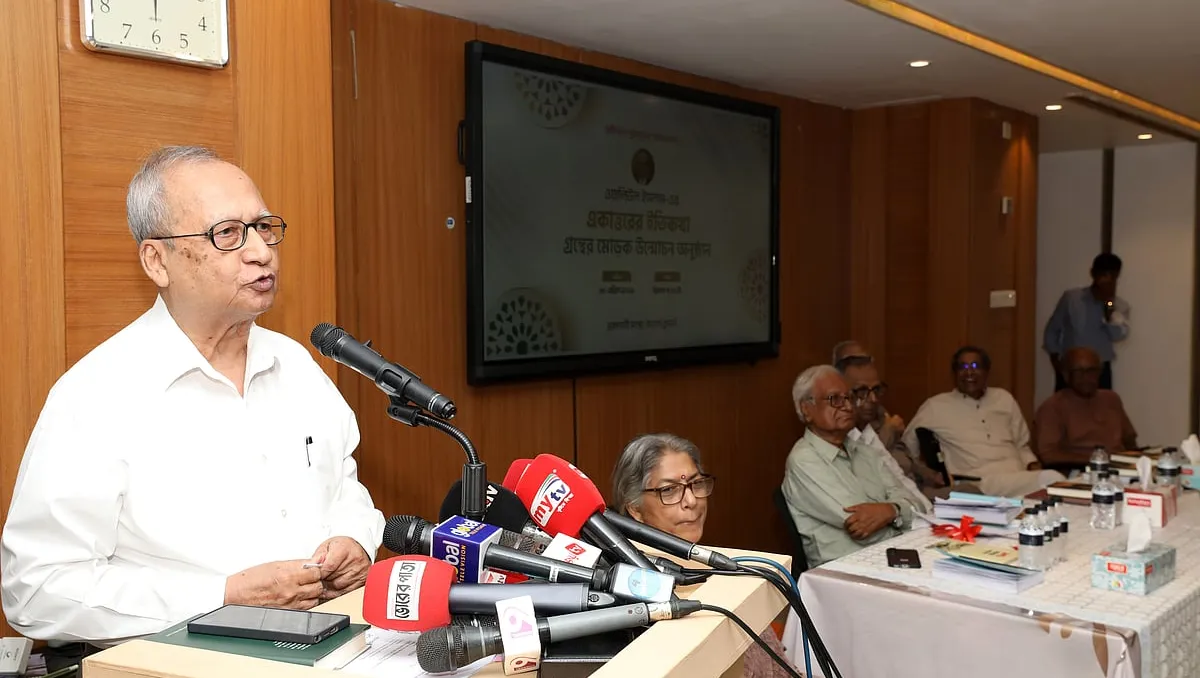
Shirin Parveen Haque, the founder of Nari Paksha, said that not only a few educated people participated in the liberation war. Children of many farmers also participated. But they did not write any book. Books are written by educated people. For that reason, the more books are published about the liberation war, the more opportunities will be created to know about this people's war. Referring to the 'heroes' of the liberation war, he said, their war is not over. Still many of them could not be included in the government allowance list.
Mofidul Haque, Trustee of Liberation War Museum, said, "This is an exceptional book about the Liberation War. The author's in-depth analysis, facts, theories and great sense of humor will keep the reader interested. The liberation war was a people's war. How a nation rose up for war, what was the administrative role, internal conflicts in the administration, how the activities of the expatriate government were being conducted in Calcutta, there are many things in it. whose contribution, the author mentions. But he did not use unkind words out of hatred towards anyone.
Prothom Alo Editor Matiur Rahman said, the author Waliul Islam has presented a lot of information, many book quotations, many people's roles, many documentary documents in the book. He was in charge of Magura Sub-Divisional Administrator as a CSP Officer during the War of Liberation. In the beginning, he was hesitant about participating in the liberation war. Later participated directly. He frankly admitted that doubt. He is self-critical in many such matters.
Matiur Rahman said, "The author has shown how division was created in politics during the liberation war." A section of the government-in-exile, including Mujib's forces, could not accept Prime Minister Tajuddin Ahmad. These differences continued even after independence. Tajuddin Ahmad was being sidelined. In fact, since the war of liberation, there have been many conflicts between politics, politics and the army, and the army and the civil administration. As a result of this conflict, in 1975 Bangabandhu Sheikh Mujibur Rahman was killed and the power changed. However, this conflict did not end. He said, 'How far we will be able to go through so many conflicts and differences, that uncertainty still remains.'
Former Secretary Mohammad Ali said, this is a very informative book. Waliul Islam has a long administrative experience and in addition to serving at the highest level of the state, he served in the government in exile in the country and in Calcutta during the Liberation War. His direct experience makes the book important.

Liberation war researcher Khairul Islam said that almost every general and bureaucrat who participated in the liberation war wrote books about their experiences. In those books mainly 'I did', 'I did' presented one's achievements. But Waliul Islam kept himself hidden. His language is 'what I saw'. His dispassionate description makes the book important as a piece of history.
Commenting on the book, author Waliul Islam said, "What I have learned, if I cannot convey it to the next generation, it will be lost." The book is written from this idea. As a writer, I did not try to convey any particular message. What I saw, what I thought to be true. But what is true in my opinion may not be true to many people.
Taslim Uddin Khan, managing director and chief executive officer of SMC, who organized the publication of the book, said that Waliul Islam was the chairman of SMC. His experience and assessment of the Great War of Liberation is reflected in the book.
The 71-year-old Itikatha book was published by Mawla Brothers. Shahreen Haque spoke on behalf of Mawla Brothers at the event. Conducted by Dr. Tehran and Hosne Ara.




