
I was quite disappointed when I arrived at Baikka Beel Wetland Sanctuary from Tanguare Haor. The bill is completely dry. Birds are also very few. So I cut short the trip to Baikka Bill and left for Satchari National Park in Habiganj. I came to Srimangal from Baikka and took the bus to Shaistaganj. I got into a CNG-powered auto-rickshaw from Shaistaganj.
After traveling about six kilometers, the driver stopped the autorickshaw in front of a bamboo grove and said, 'Sir, my house is in front. If you allow me, I will come to meet mother.'' 'Okay, go. Let's take a look at the bamboo grove.
I saw a bird sitting on the top of the bamboo tree in the light and darkness and took a few shots quickly. But somehow I could not find a picture of his face. I looked at it once, but I could only take one picture, which I did not like. Even after waiting for a while, I could not see his gomramukh. Due to lack of time, I was forced to step on the road to Satchari. This is the incident of 24 February 2018. Since then I have looked for the bird several times in different parts of the country, but unfortunately not once.
After seven years, on the evening of January 12, 2025, I met him for a while at Hazarikhil Wild Animal Sanctuary in Fatikchari, Chittagong. But I could not take a good picture at all.
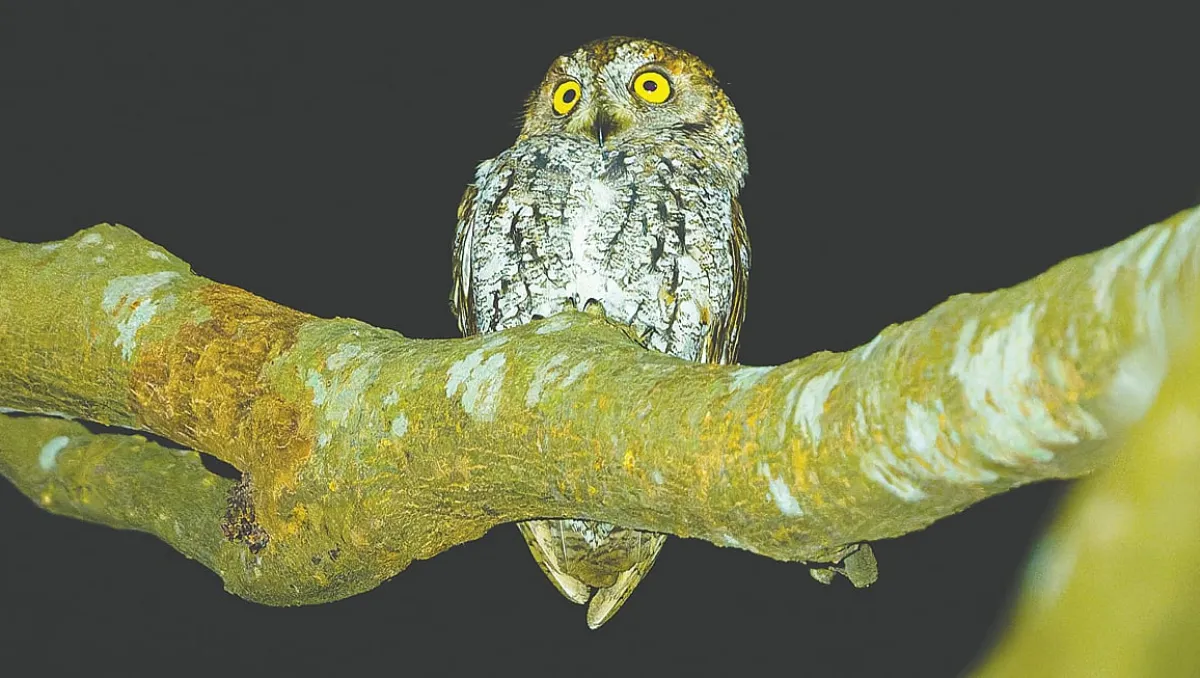
Finally, on the night of March 25 this year, I left for Hazarikhil in a group of six people organized by the bird watching group 'BirdingBD Tours'. Reached Hazarikhil early in the morning and spent the whole day looking for birds in different spots of the sanctuary. At night, I went up to a small hill about a kilometer away from the guesthouse and sat quietly listening to the call of the Red Nimpokh (Mountain Scoop Owl) on my mobile phone. But the Red Nimpokh answered the call from a distance but did not come near. Then the call of the little owl seen in the bamboo grove of Shaistaganj was played. After ringing a few times, the bird from close range answered. One of the team saw the bird when he shined a torch on the tree. I quickly took the required number of pictures before the bird became disturbed and turned off the torch.

The bird seen in Banshjhar and Hazarikhil of Shaistaganj is the commonly seen resident bird of this country. Also known as Black Spotted Nimpokh or Little Nimpychacha. In West Bengal it is called Kokilkanthi Pacha. English name Oriental, North Indian or Eurasian Scoop Owl. Otus sunia is the scientific name of the owl belonging to the genus Estrilgidae. Apart from Bangladesh, they have a global spread from Pakistan to Japan, Indonesia and eastern parts of Siberia.
A small hummingbird. Body length 17-21 cm. Weight 75-95 grams. The owl has three forms. Such as reddish, brown and gray. There is reddish color around the earlobes and the sphere of the face. There is no neck brace. The feathers on the upper part of the body are sparsely spotted, but the feathers on the head and lower part of the body are heavily spotted. Eye color is yellow. Beak and legs are grey. There is no difference in appearance of patchy-patchy. It can be distinguished from the Nimpokh (banana scoop owl) by its smaller size, yellow eyes, rufous edges around the ears and face, and the absence of a throat band.
They can be found in forests, gardens and wooded rural areas throughout the country. Solitary or in pairs. During the day it hides itself in the shady branches of trees or bamboos. At night, it sits on trees and searches for prey on the ground. Diet includes insects, lizards, rodents, small birds etc. Calling three-four times in a gentle voice 'tuk-tuk-ku-ruk--'.
March to August breeding season. At this time, the owl kept calling throughout the night. Nests are made in the natural bark of the tree or in the hollow of the trunk. Three to five eggs are laid, white in color. The ladybug alone lays it on the egg and the ladybug feeds the egg-donating ladybug. Eggs hatch in 22-25 days. Both doves and doves raise chicks together. Life expectancy is three to four years.




