

Visually impaired man defies adversity to support aging mother through manual labor
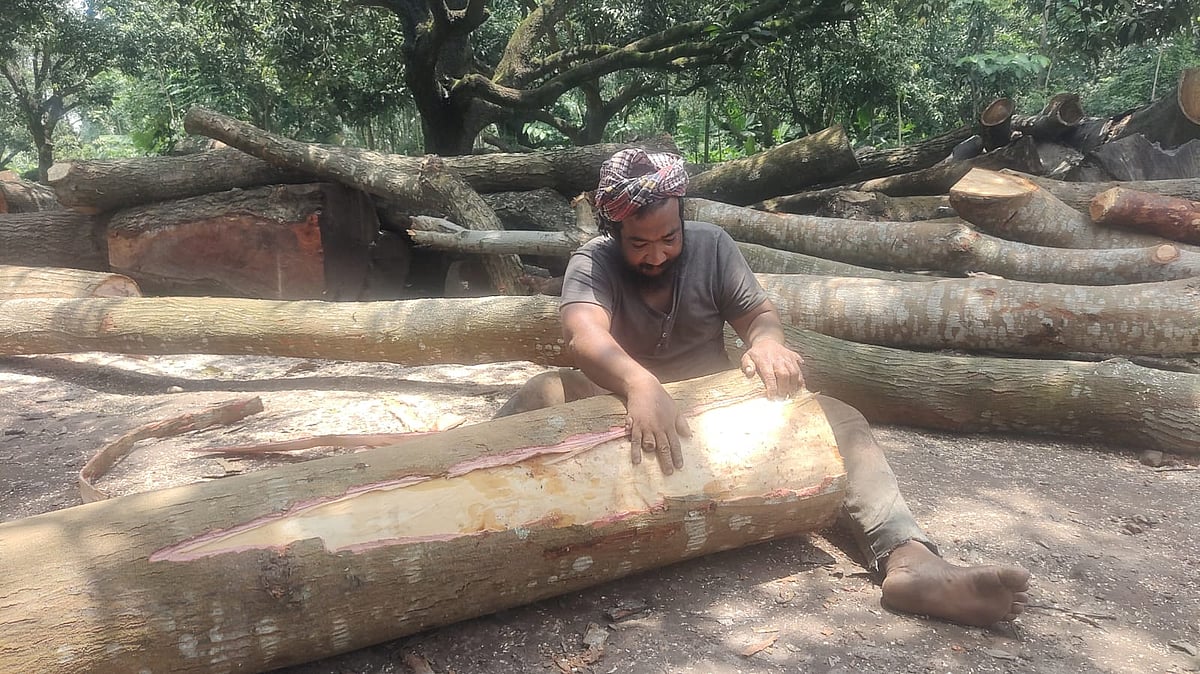
Photo Collected
A mother’s realization that her young son had lost his remaining sight came in a heartbreaking moment when he stepped on a plate of rice set before him. For Ruli Begum, the diagnosis offered no hope, leaving her to fear for the future of her blind child. Yet, decades later, the uncertainty that once haunted the family has been replaced by a story of resilience and hard-earned dignity in Telipara village, located in the Bholahat upazila of Chapainawabganj.
Today, 52-year-old Mukles Ali stands as the primary breadwinner for his household. Every morning, his mother leads him to the main road, where he carries a sack and a modest lunch of roti, salt, and green chilies. From there, he navigates two kilometers alone to reach a local wood-sawing factory. Under the supervision of owner ATM Hasanuজ্জামান, Mukles spends his day rhythmically striking wooden logs with a half-brick to strip away the bark. He collects the byproduct in his sack to be carried home, where Ruli Begum dries it to sell as firewood, earning an additional 100 to 150 taka daily.
The family’s livelihood is sustained through this labor, supplemented by Ruli Begum’s widow allowance and Mukles’s disability pension. While Mukles’s younger brother, Sohel Rana, works as a muezzin at a local mosque, he struggles to support his own four children, leaving the responsibility of caring for their mother firmly in the hands of the eldest son.
Neighbors and acquaintances speak of Mukles with profound respect. His refusal to beg—even in the face of abject poverty—is a defining trait noted by those who have watched him work for years. Factory owner ATM Hasanuজ্জামান recalls telling Mukles that he could earn more through charity, to which Mukles replied that he would rather live with the dignity of his own labor than accept a handout.
Local educator Moazzem Hossain remarked that in a society where many able-bodied individuals neglect their aging parents, Mukles’s devotion to his mother is an inspiring exception. Business associate Saidur Rahman, who has operated at the same site for three decades, expressed hope that an individual or organization might eventually provide a more sustainable income for the pair as they continue to age.
Bholahat Upazila Executive Officer (UNO) Nahid Hossain acknowledged the government’s efforts to support the family through existing welfare programs, including the recent provision of corrugated iron sheets for their leaking roof.
Despite his steadfast work ethic, Mukles carries a singular regret: the lack of financial resources to seek medical treatment for his eyes. “I could never afford to treat my eyes due to a lack of money,” Mukles said. “If someone could get my eyes treated so I could see again, I would look after my mother. I ask for nothing else.”
0%
0%
0%
0%