
Kurigram man preserves fading musical history with massive collection of vintage gramophones and records
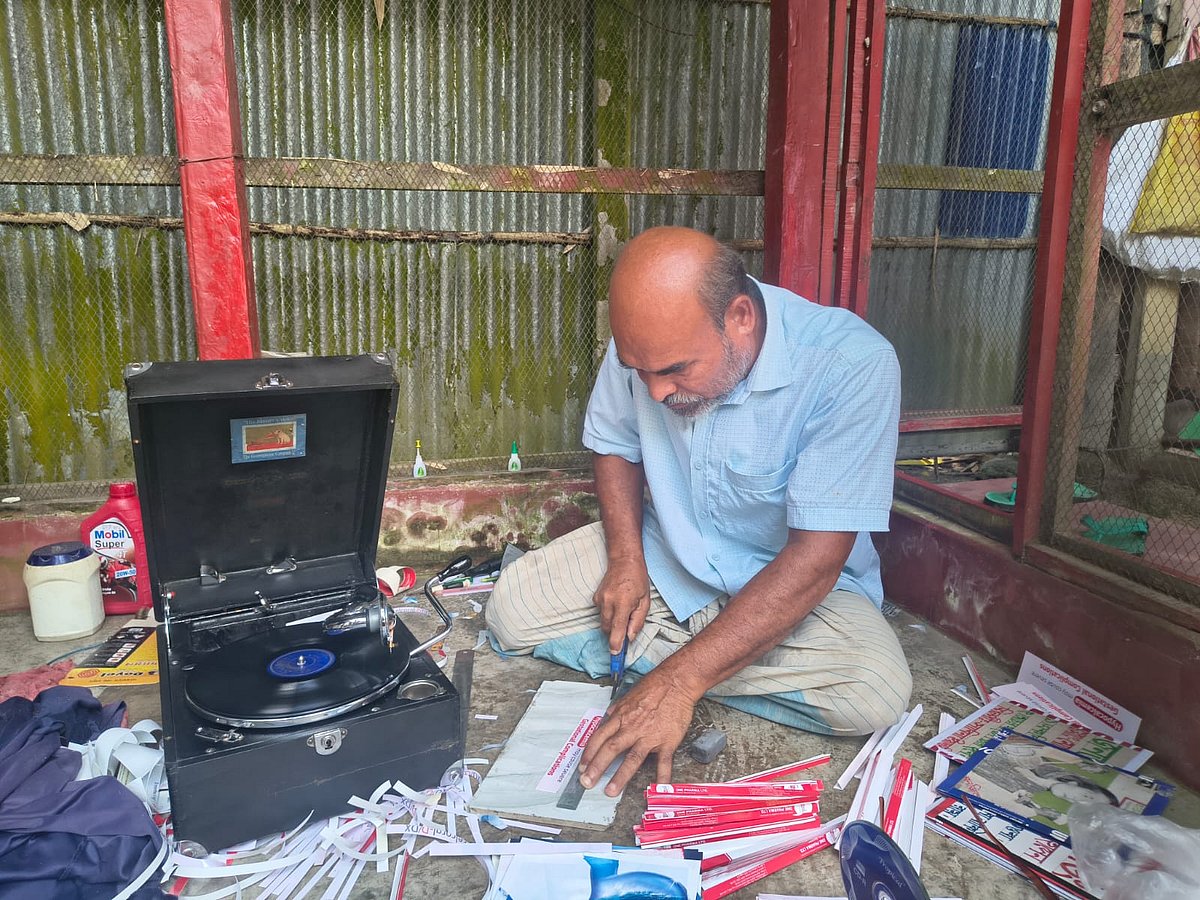
Photo Collected
ULIPUR, KURIGRAM — In a humble tin-roofed house in Jummahat, Amzad Hossain has curated a living museum of a bygone era. His collection of 22 gramophones and thousands of vintage records serves as a sonic time capsule, preserving the melodies of the 20th century against the rapid tide of modern digital technology.
Hossain’s collection includes eight rare, hand-cranked gramophones and 14 electric record players, all of which remain fully functional. Accompanying these machines are approximately 5,000 records—comprising 3,000 extended play (EP) discs and 2,000 long-play (LP) records—alongside roughly 1,000 audio cassettes. Among his most prized possessions are three rare recordings featuring speeches and songs dedicated to the founding father of Bangladesh, Sheikh Mujibur Rahman.
The passion began in the 1970s when Hossain assisted his father, Delwar Hossain, at their family-run business, Janata Mike Service. His fascination grew into a lifelong obsession as he traveled across the country to hunt for rare recordings, once paying 5,000 taka for a single record by legendary folk artist Abbasuddin Ahmed. Even while working as a civilian employee for the Bangladesh Army, Hossain spent much of his salary scouring the markets of Dhaka, including Old Dhaka and Mirpur, to expand his archive.
In 1991, he opened the Janata Audio-Video Center in Mirpur, which functioned as a rental hub for records and video cassettes. Following his retirement in 2017, Hossain returned to his village in Ulipur, establishing a makeshift museum across three rooms of his home. Despite his dedication, the collection faces significant threats. The lack of proper climate control and archival shelving in his tin-roofed house has left the records vulnerable to humidity and physical deterioration.
Hossain’s meticulous efforts to preserve these items involve unorthodox methods, such as repurposing empty mosquito coil boxes as protective sleeves for the delicate records. While he personally repairs damaged machinery, he acknowledges that the burden of maintaining such a large collection has become overwhelming.
The financial and physical toll has sparked domestic tension. His wife, Moslema Begum, expressed deep concern over the family’s lack of savings, noting that the resources spent on the collection have left them struggling to cover basic medical expenses. She lamented that the records are currently suffering from neglect due to the lack of proper storage.
Hossain remains deeply anxious about the future of his life’s work. He fears that without professional intervention or support from government institutions, this historical archive will vanish once he is gone. For now, he continues his daily ritual of cleaning each gramophone and cataloging his records, clinging to the hope that these remnants of history will eventually find a permanent, safe home.
0%
0%
0%
0%