
Concerns Emerge Over Independence and Institutional Oversight in Bangladesh Draft Legislation Against Enforced Disappearances
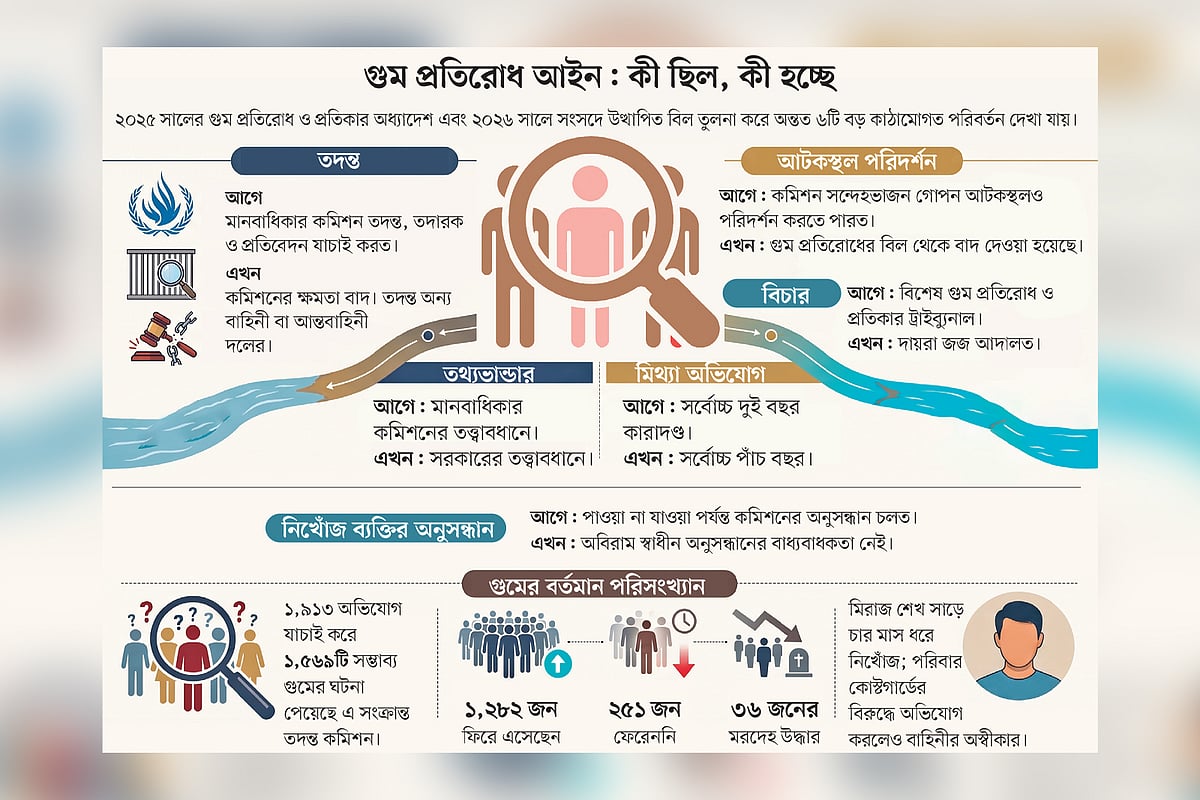
Photo Collected
The introduction of the proposed “Enforced Disappearance Prevention and Remedy Bill, 2026” has ignited a debate over the independence of investigations into state-sponsored abductions in Bangladesh. Legal experts and human rights activists warn that the current legislative framework fails to ensure truly impartial inquiries, raising concerns about institutional bias when security forces investigate their own colleagues.
The plight of Miraj Sheikh, a resident of Mongla in Bagerhat, highlights these systemic hurdles. His family alleges that he was abducted by members of the Coast Guard on April 10. Despite a High Court order issued on July 12 mandating his recovery and appearance before the court within 15 working days, his whereabouts remain unknown four and a half months later. The Coast Guard has consistently denied any involvement, leaving the case in a legal vacuum.
Under the interim government’s 2025 ordinance, investigations were placed under the National Human Rights Commission (NHRC). The ordinance granted the Commission authority to inspect secret detention centers and required it to continue searches until the fate of the missing person was determined. However, the new bill currently before Parliament replaces this structure. While the bill stipulates that a security force cannot investigate allegations against its own members, it permits the government to delegate the inquiry to another security agency or a joint task force. Critics argue this keeps investigations within the state’s security apparatus, rather than under an independent civilian body.
The government’s shift comes as Bangladesh marks the International Day of the Victims of Enforced Disappearances. Data from the government-formed Commission of Inquiry, led by retired Justice Mainul Islam Chowdhury, reveals that between January 2009 and August 2024, at least 1,569 individuals were subjected to enforced disappearance. While 1,282 were eventually released, 251 remain missing and 36 have been found dead. The Commission suspects the actual figures could reach as high as 6,000 cases, as many incidents were never formally documented due to police refusal to accept reports.
Investigative findings implicate various agencies, including the Rapid Action Battalion (RAB), police, the Detective Branch (DB), the Counter Terrorism and Transnational Crime unit (CTTC), the Directorate General of Forces Intelligence (DGFI), and the National Security Intelligence (NSI). The Commission noted that perpetrators often utilized “smoke and mirrors,” with personnel from one agency using the identities of another to avoid detection, further complicating the process of identifying responsible entities.
The United Nations Working Group on Enforced or Involuntary Disappearances has previously advised that investigations must be independent and that all detention sites should be subject to oversight by an independent authority. International standards, outlined in the International Convention for the Protection of All Persons from Enforced Disappearance, emphasize that investigations must be comprehensive and shielded from potential retaliation by those under suspicion.
Concerns also extend to the judicial process. The new bill removes the provision for special tribunals, opting for standard District and Sessions Courts. Experts fear these courts may lack the specialized expertise required to handle sensitive evidence involving command chains, joint agency operations, and forensic data from secret detention sites.
Furthermore, the bill imposes a potential five-year prison sentence for “false complaints.” While aimed at preventing abuse of the law, civil society groups like Transparency International Bangladesh warn that such provisions could intimidate families who already operate in a climate of fear. Justice Mainul Islam Chowdhury maintained that for any investigation to be deemed credible, it must be conducted by an agency entirely independent of the law enforcement and security hierarchy, ensuring that those in power cannot influence the outcome of the search for the disappeared.
0%
0%
0%
0%