

BNP-led government to prioritize Padma and Teesta Barrage projects, says Prime Minister Tarique Rahman
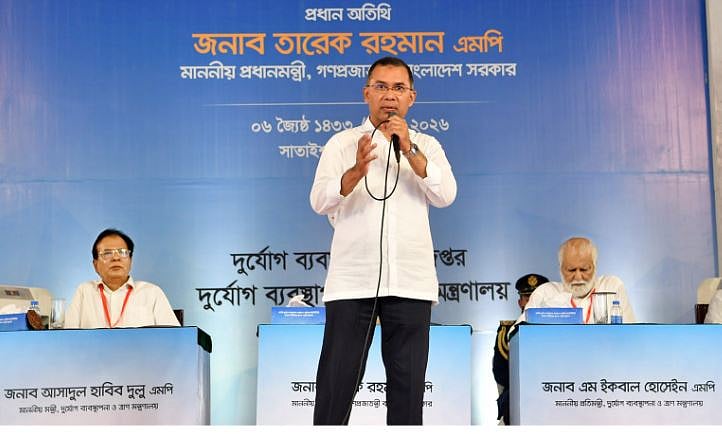
Photo Collected
Prime Minister Tarique Rahman has said that the Bangladesh Nationalist Party (BNP) government will take initiatives to implement major water management projects, including the Padma Barrage and the Teesta Barrage, in a bid to address water scarcity and agricultural challenges in different parts of the country.
He made the remarks while laying the foundation stone of the National Disaster Management Research and Training Institute building in Gazipur on Wednesday afternoon.
The Prime Minister said the government has already decided to move forward with the Padma Barrage project, particularly aimed at improving water distribution in the northern and southern regions, including Rajshahi. He claimed that due to upstream water diversion and barrage construction across the border, Bangladesh receives less water during the dry season, affecting agriculture and rural livelihoods.
He also stated that saline water intrusion from the sea has been increasing in southern districts, including areas near the Sundarbans, leading to environmental damage and loss of biodiversity. According to him, the proposed barrage would help retain excess monsoon water and make it available during dry periods.
Tarique Rahman further highlighted the broader impacts of climate change, saying that weather patterns in Bangladesh have shifted significantly in recent decades. He pointed to declining winter intensity, falling groundwater levels, and increased pressure on deep tube wells as major concerns for agriculture and drinking water supply.
He also referred to rapid urbanization and environmental degradation, noting that areas once covered with vegetation have been replaced by settlements, while groundwater extraction has intensified. He warned that continued depletion of underground water resources could create long-term structural risks for the country.
The Prime Minister said the government’s disaster management strategy includes both infrastructure development and public awareness. He emphasized that while natural disasters cannot be prevented, their impacts can be reduced through preparedness, training, and proper resource management.
He added that the newly established disaster management institute would focus on research into climate change impacts, earthquake preparedness, and coastal disaster response, as well as training personnel involved in protecting lives and property.
Earlier in the program, officials from the Ministry of Disaster Management and Relief and the Directorate of Disaster Management delivered speeches, and a documentary on disaster management activities was presented. Senior government officials, advisers, and members of parliament were also present at the event.
0%
0%
0%
0%