
Santal Womans Nose Ring Unlocks Forgotten Memories
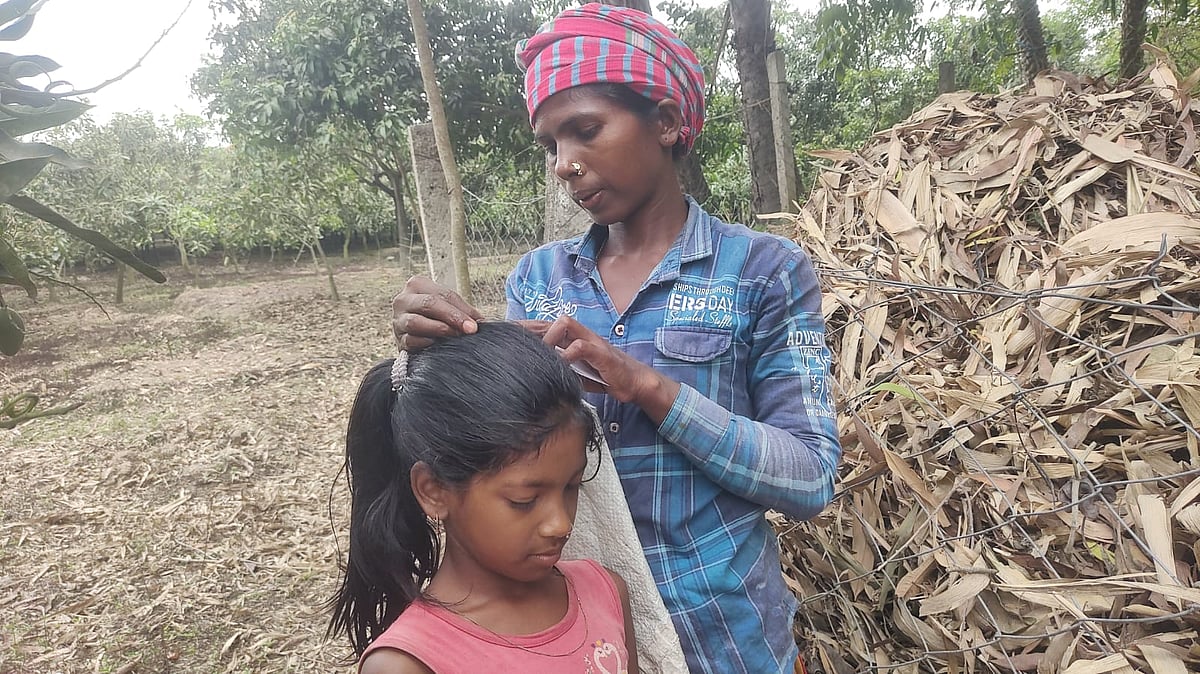
Photo Collected
**A Golden Flower in Dry Earth: A Santal Woman’s Treasured Nose Pin**
BIRGRAM, Bangladesh – In the heart of Chapainawabganj’s Nachol upazila, within the arid landscape of the Barind tract, lies the Santal village of Birgram. A shallow canal, now a parched trench under the relentless May sun, snakes its way past the settlement. Amidst the dried leaves of a bamboo grove bordering this dry waterway, a woman meticulously gathered fuel. Her blue checkered shirt and a vibrant red gamcha wrapped around her head were simple attire, but it was the small, exquisite gold nose pin adorning her nostril that caught the eye.
বিজ্ঞাপন
A simple compliment on the piece of jewelry, intended to elicit a smile, instead brought a shadow to her sun-weathered face. Tears welled in her eyes as the fleeting joy of gathering leaves dissolved. This was Nila Hasda, a housewife and daily wage laborer from Birgram, whose husband, Momin Tudu, also works as a laborer.
The sudden shift in her demeanor prompted a gentle inquiry. “Did my comment about your nose pin upset you? Did I cause you pain?” Nila, her face still clouded, nodded.
বিজ্ঞাপন
With a deep sigh, Nila began to recount the story of the precious ornament. The nose pin, she explained, was crafted for her by her “Boro Ma” – her paternal uncle’s wife – when Nila was a child. Her Boro Ma, whose husband had passed away, had worked the land and used her earnings to create the gold pin, a gift for her beloved childless aunt, who lavished affection on Nila.
Nila paused, lost in the bittersweet memories of her Boro Ma, and the pain of her current ill health. Her aunt, Nila explained, was now bedridden with illness, unable to work. While her aunt’s nephews were tending to her, Nila had not seen her in a long time. The demands of survival kept her from visiting, and thoughts of her aunt often brought tears to her eyes.
She spoke of her childhood, one of seven siblings in a household where even three meals a day were a luxury. Her Boro Ma, childless herself, had shown Nila a special fondness, often sharing treats. The day she received the nose pin, Nila recalled feeling like the happiest girl in the world. Her aunt’s embrace and kiss on that day were etched in her memory. She paraded her new adornment through the village, and even after marriage, she refused to part with the gift, despite her husband’s offers to buy her new jewelry.
As Nila spoke, she walked with her daughter, Sanchita Murmu, a second-grader whom Nila is determined to educate, hoping to spare her the hardships of her own life. Nila has even crafted a nose pin for her daughter with her own earnings, a mirroring of the gesture that so joyously marked her own childhood. The daughter’s delight upon receiving the gift had, in turn, reminded Nila of her aunt.
Upon reaching Nila’s home, as she began to unload her bundle of dried leaves, Sanchita ran to embrace her mother. Nila affectionately stroked her daughter’s hair. Sanchita, however, remained shy, offering only a gentle smile in response to further attempts at conversation before darting away.
“My daughter is very shy,” Nila explained. “It’s her first time meeting a stranger. If you wish to speak with her, please visit our village during one of our festivals.”
Source: Prothom Alo Bangla
0%
0%
0%
0%