
Rare White Fig Tree in Bagerhat Highlights Need for Conservation of Ancient Species
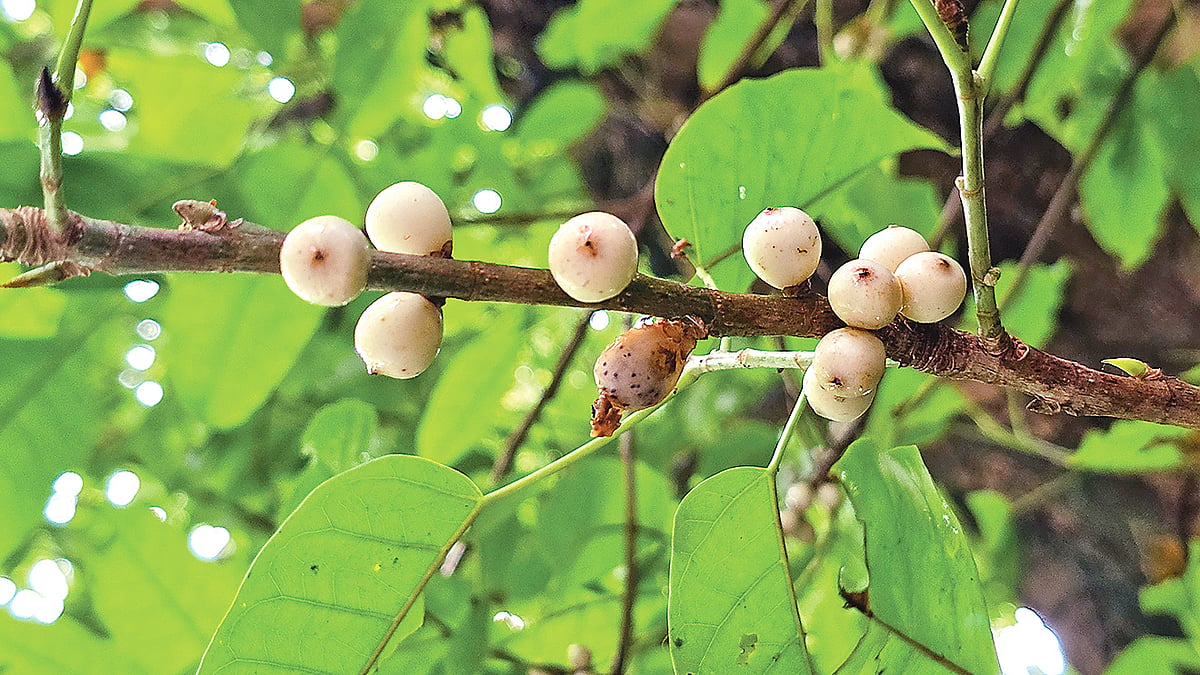
Photo Collected
On May 27, an excursion toward Fakirhat in Bagerhat led to the identification of a rare and ancient White Fig tree, known locally as Sada Pakur. While traveling from Khulna toward the residence of ornithologist and author Sharif Khan, the sighting of a unique, large tree prompted an unscheduled stop along the road leading to Jatrapur Bazar.
The tree, identified botanically as *Ficus virens*, stands near Attaki village and displays characteristics distinct from typical banyan or common fig varieties. Local residents, estimated to be between 30 and 40 years old, noted that the tree has remained largely unchanged in size since their childhood. They observed that the tree is currently in a state of decline, with dead branches and damaged bark, and it is considered of no practical use for fuel or timber.
Observations at the site revealed that the tree is heavily burdened by parasitic growth, including various ferns whose roots are infiltrating the bark, potentially obstructing nutrient circulation. Villagers estimate the tree to be between 70 and 80 years old. While the International Union for Conservation of Nature (IUCN) Bangladesh classifies the species as “Least Concern,” suggesting a wider distribution, the specimen remains a rarity in the local landscape.
Botanically, the White Fig belongs to the Moraceae family. Unlike the sacred fig, which sheds all its leaves during winter, the *Ficus virens* is semi-deciduous. It is known as a “strangler fig” because birds consume its fruit and disperse seeds onto host trees; these seeds germinate and eventually envelop the host, sometimes causing its demise while the fig tree establishes its own base.
The specimen in Attaki village has reached a limited size due to the surrounding dense vegetation, which restricts its natural canopy spread. Although it does not produce the characteristic aerial prop roots of a banyan, it can reach heights of up to 100 feet in wetlands. Given its age and the scarcity of the species in the region, experts suggest that protective measures are necessary to preserve this tree, including the propagation of new saplings through stem cuttings to ensure the survival of this indigenous species.
0%
0%
0%
0%
More News from Science